Mechanical Proof the Earth Is Not a Globe: Gustav F. Ebding
Images from the Document
Download the Document
Overview
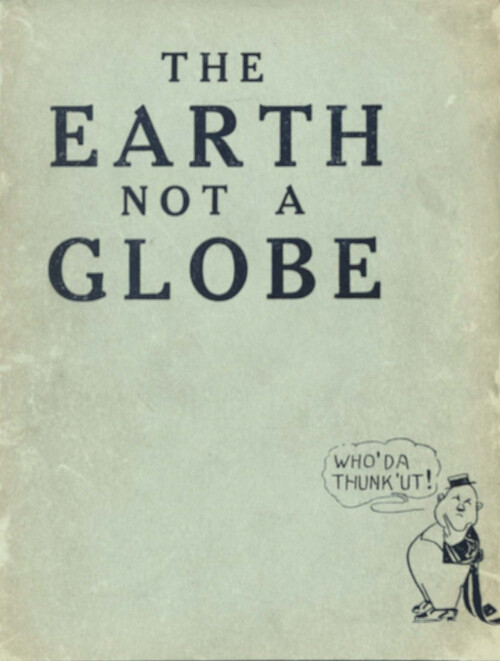
Gustav F. Ebding’s Mechanical Proof the Earth Is Not a Globe is not a restrained scientific monograph in the modern academic sense. It is a highly polemical, self-consciously revolutionary anti-globe text from 1927, written in a dramatic and combative voice, and presented by its author as a work that might one day “become HISTORY.” The title page and prefatory material already make clear that Ebding believed he was advancing a profoundly disruptive claim about the Earth’s true shape, one so disruptive that he initially frames the work almost as a restricted draft rather than an ordinary public book.
What makes the book especially interesting within the broader concave-Earth and anti-globe literature is that Ebding does not build his case mainly through theology, nor through inversion geometry in the later geoperipheral sense. Instead, he presents what he calls a “mechanical proof” based on ordinary line-of-sight, geometry, horizon behavior, and what he insists are direct, non-theoretical facts. His central rhetorical contrast is between “fact” and “mind-stuff”. For him, astronomy is not a science of secure proof, but a swollen structure of assumptions, inferences, and appearances falsely promoted as facts. His own method is pitched as more primitive, more direct, and more trustworthy precisely because it claims to rest on fixed geometrical and mechanical demonstration rather than elaborate cosmological theorizing.
The strongest single theme in the surviving excerpts is Ebding’s attempt to overturn the standard evidences for globularity by arguing that they are not true facts at all. The appearance of lighthouse tops before their bases, the sea horizon, pole-star elevation, lunar eclipses, and circumnavigation are all treated not as proofs, but as appearances interpreted through prior theory. Ebding repeatedly insists that astronomy’s real error lies in passing off inference as fact. From there he moves to his own preferred claim: that line-of-sight and straightedge relations show not a convex globe but a concave Earth, “to the best of our knowledge.”
This makes the book important less as a polished final theory than as a vivid example of an interwar anti-globe mindset: anti-authoritarian, hostile to credentialed science, fascinated by “plain fact,” rhetorically militant, and convinced that modern astronomy rests on a bluff of prestige rather than demonstration. It belongs in the same broad family as later concave-Earth and hollow-world writings, but it feels older in style—closer to a courtroom brief, public challenge, or manifesto than to a systematic cosmology.
Structure and Content
1. A Book Framed as a Dangerous Revelation
The front matter of the book is unusually dramatic. One early page says the “drull little book” may one day become “HISTORY,” while the formal title page presents it as Mechanical Proof the Earth Is Not a Globe, written and published by Gustav F. Ebding in 1927. Immediately after that, the author addresses editors and publishers, saying the draft is “not for the public” and pleading that the “REAL SHAPE OF THE EARTH” not be divulged until the “final experiment” is underway. He invites correction of any misstatements, but demands that a fact be recognized as a fact.
That opening matters because it establishes the tone of the entire work. Ebding does not write as someone proposing a modest alternative hypothesis. He writes as someone convinced he has uncovered a reality that institutions are not prepared to handle responsibly. The text’s style is almost conspiratorial, but also prosecutorial: the public has been misled, astronomers have overstated their case, and this book is meant to break the spell.
2. The Book’s Real Target: Astronomy’s Abuse of the Word “Fact”
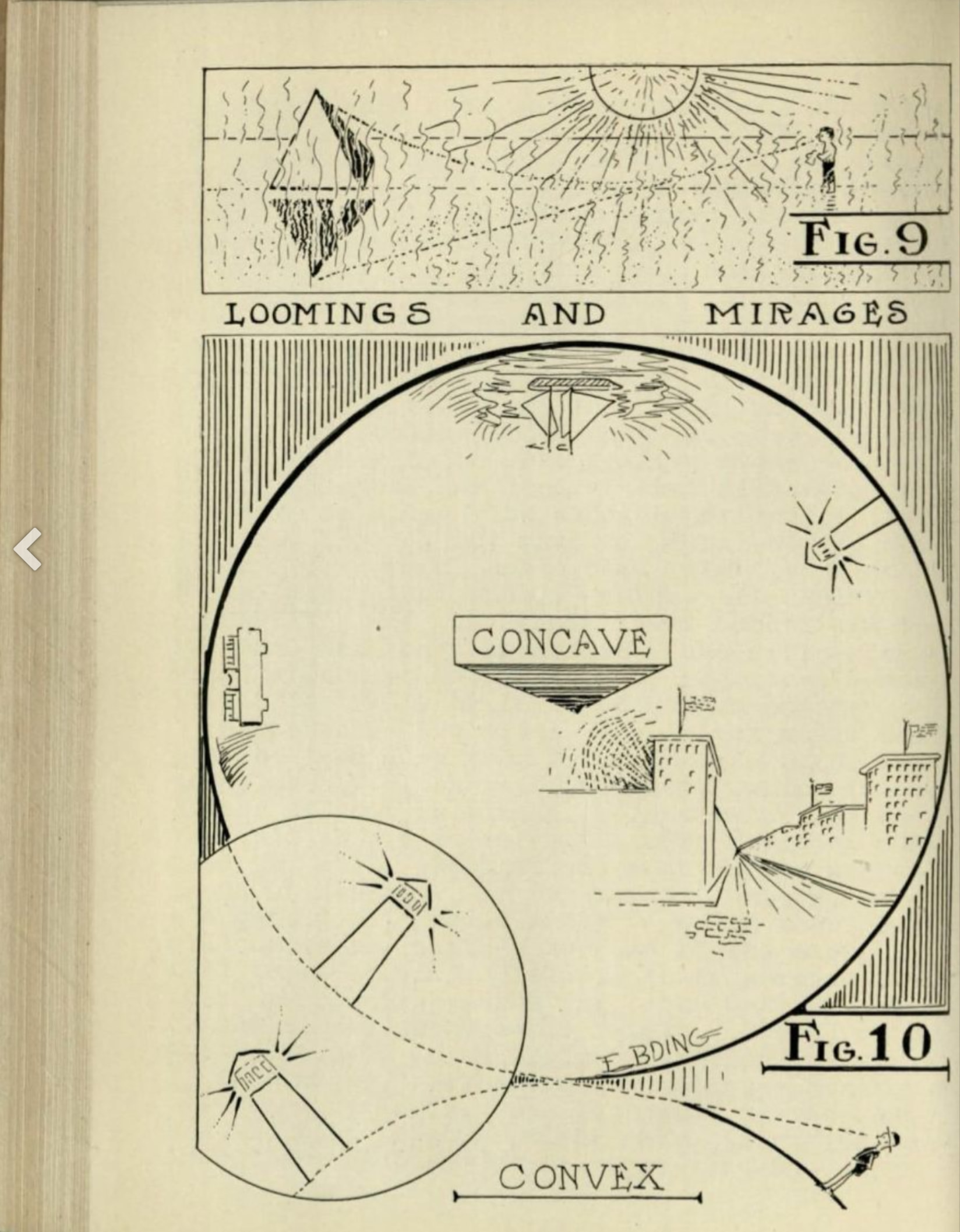
One of the clearest and most revealing sections begins with the heading “The sum of evidence termed ‘facts’ held for the spherical notion.” There Ebding quotes a standard textbook-style summary of the familiar reasons people infer the Earth is globular: lighthouse tops appearing before bases, dip of the horizon, pole-star elevation and depression with latitude, the globular appearance of other planets, Earth’s circular shadow in lunar eclipses, and circumnavigation. He then attacks the entire list by arguing that these are not facts at all, but only appearances from which conclusions are inferred.
His key complaint is semantic but also epistemological: astronomy, he says, has blurred the line between what is seen and what is concluded. A lighthouse top appearing first is an appearance, not a fact proving convexity. An inference is not a fact. A theory is not a fact. In his rhetoric, modern astronomy has become so enclosed within its own assumptions that “guess” and “assumption” are treated as though they were synonymous with truth.
This section is central to understanding the whole book. Ebding is not merely claiming a different Earth shape. He is trying to strip the globe model of its epistemic prestige by arguing that its evidences are weaker, looser, and more interpretive than people admit.
3. “Mechanical Proof” as the Alternative
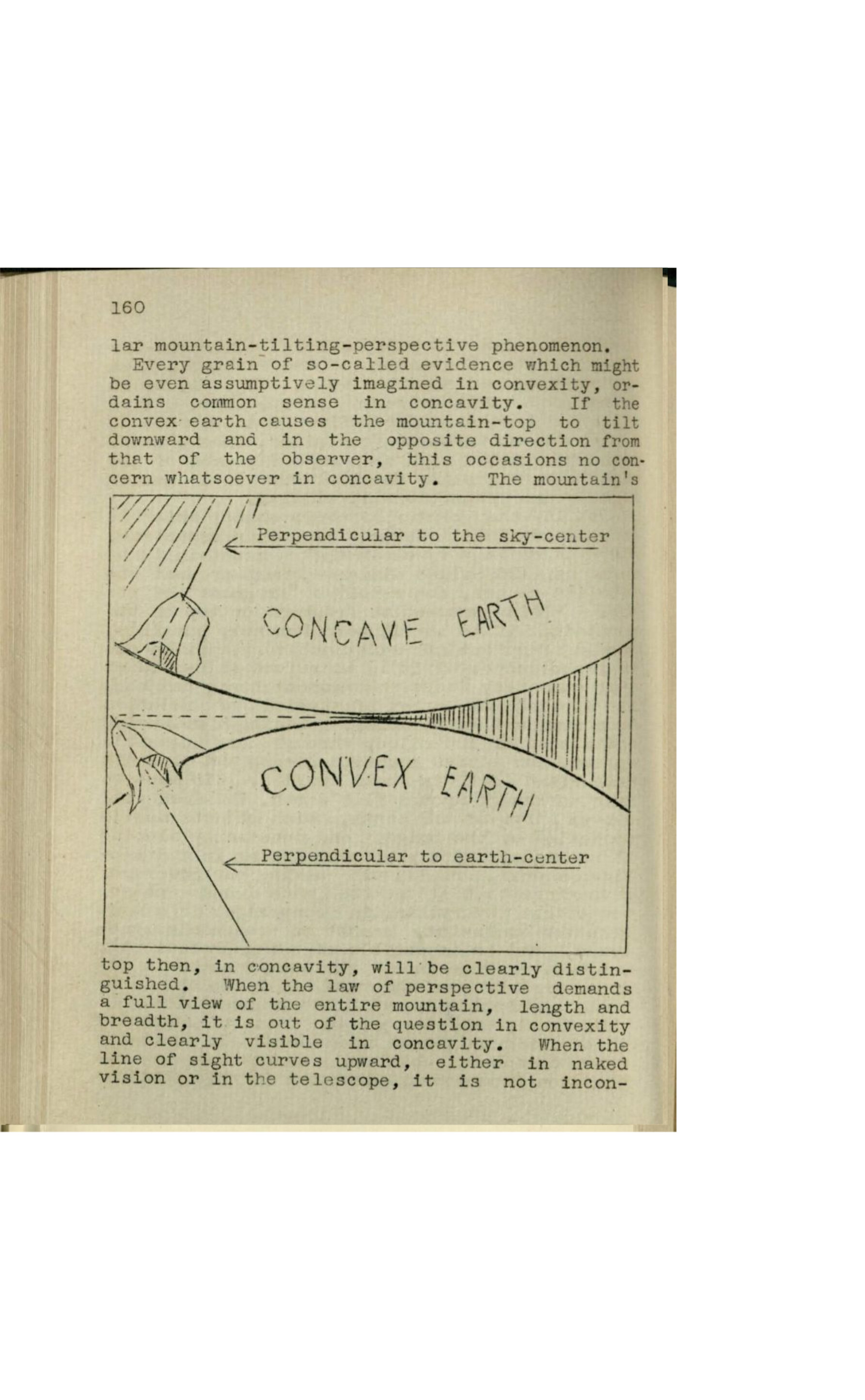
After attacking conventional evidences, Ebding contrasts them with what he calls mechanical evidence. In one major excerpt, he argues that if a straightedge or line of sight touches the Earth in more than a single tangent relation, then what is being formed is a chord of arc, not a tangent. From this he claims that line-of-sight experiments in cardinal directions demonstrate that the Earth is not convex in the way standard astronomy assumes. Instead, he says the geometrical and mechanical facts assert that the Earth is concave, and that this is the highest and “best” conclusion available to our knowledge.
This appears to be the heart of his book’s main thesis. The “mechanical proof” is supposed to derive from simple geometry applied to actual observational lines, rather than from distant astronomy or speculative cosmology. Ebding is essentially arguing that basic terrestrial geometry outranks astronomical theory. If the Earth-line behaves in a certain way under direct mechanical examination, then astronomy must submit to that fact rather than reinterpret it away.
4. The Earthline and the Horizon
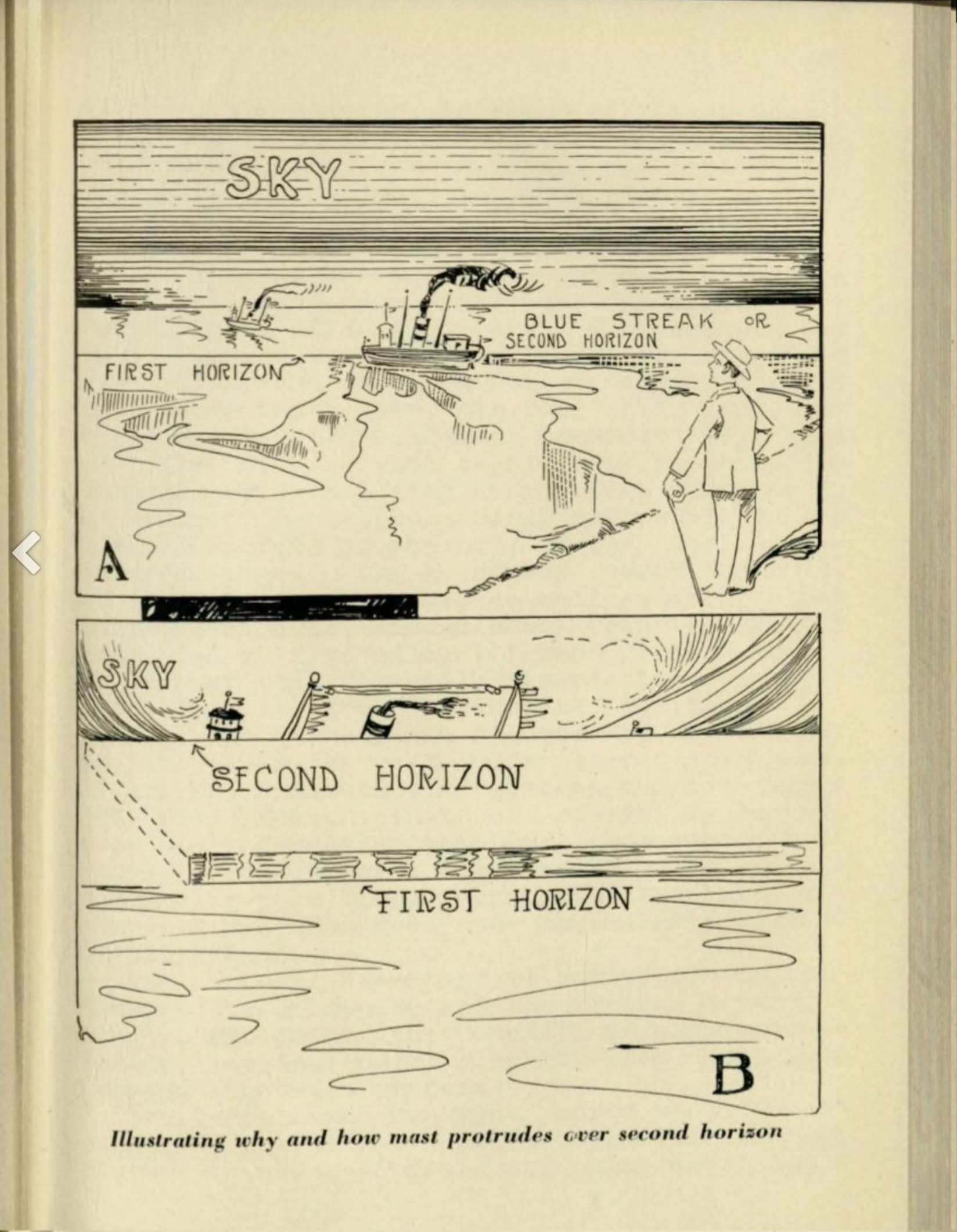
Another important strand of the book concerns what Ebding calls the earthline or geolinear expanse. He argues that the Earth, including land and water, can be treated as a line in relation to sight and measurement. He then discusses how the horizon changes as one lies down, raises the head, stands, or gains elevation. This changing horizon, he says, is what led people to infer a curved Earth—but he insists that it proves nothing of the sort by itself. He promises to show that increased elevation does not demonstrate that one is seeing over the brink of a convex globe.
This is a classic anti-globe move, but Ebding expresses it with unusual force. He wants to dismantle the common intuition that “seeing farther from higher up” settles the curvature question. To him, common-sense globe arguments are psychologically persuasive but logically weak. The horizon is treated as one of the most deceptive appearances in ordinary experience, and the book seems to devote a substantial portion of its argument to reinterpreting that deceptiveness.
5. A Polemic Against Astronomical Authority
Ebding’s argument is not confined to geometry. Large parts of the surviving pages are devoted to a sweeping attack on scientific authority, especially the idea that credentialed astronomers or physicists should be trusted simply because of status. He repeatedly argues that history shows a pattern: innovators are mocked first and celebrated later. To make the point, he invokes Christopher Columbus, the Wright brothers, Charles Lindbergh, Thomas Edison, Alexander Graham Bell, and Albert Einstein, all as examples of people initially ridiculed or dismissed before later being vindicated.
The message is plain. If these figures were first treated as fools, then the mockery directed at a new anti-globe thesis proves nothing. In fact, for Ebding, ridicule is almost evidence that a genuine breakthrough may be at hand. This gives the book its distinct emotional texture: it is not only a geometrical challenge, but a moral drama about courage, conformity, and the blindness of experts.
6. Scientists as Human, Not Sacred
Closely connected to that historical rhetoric is a repeated insistence that scientists are not elevated beings, but simply human beings with specialized training in one line only. Ebding argues that laboratory men and authorities are often no better psychologically, philosophically, or civilly than mechanics or ordinary people. Specialized expertise, in his telling, does not protect them from vanity, mental rigidity, or collective error.
This anti-credential posture is crucial to the book’s worldview. Ebding wants the reader to stop treating scientific institutions as courts of final appeal. What matters is not prestige but whether a claim is a genuine fact. His favored contrast is between the open, plastic, receptive mind and the sealed, overstuffed, self-important mind that cannot receive truth even when it is directly shown.
7. Copernicus as Framing Device
One especially odd and fascinating feature of the preface is Ebding’s decision to hand the reader over to Nicolaus Copernicus himself. He reprints, in substantial part, the dedication from On the Revolutions of the Heavenly Bodies to Pope Paul III. That long insertion emphasizes Copernicus’ own fear that people would reject his theory because it contradicted common sense and inherited opinion, and his insistence that mathematical reasoning should be judged carefully rather than mocked.
Ebding’s purpose here seems strategic and ironic. He is using Copernicus—the symbolic father of modern heliocentric astronomy—as a mirror against modern astronomers themselves. Just as Copernicus once challenged an established consensus, Ebding implies, so he now challenges the current one. The preface is meant to suggest that orthodoxy always mistakes its own assumptions for eternal truth, and that today’s anti-globe claim may stand to astronomy as heliocentrism once stood to geocentrism.
8. The Book’s Likely Arc Beyond the Visible Pages
The visible excerpts suggest that the larger book proceeds through many examples, illustrations, and geometrical demonstrations. The author thanks an engraver and notes that the book uses two methods of illustration, with the more detailed sketches engraved and the simpler ones drawn directly by the author. This strongly suggests that the book is not only rhetorical but visually argumentative, with diagrammatic support playing a major role in the proof structure.
The overall arc, as far as can be inferred, seems to move from preface and framing, to demolition of the usual globe evidences, then into a positive line-and-arc “mechanical” proof for concavity, and then outward into broader reflections on science, authority, innovation, and historical blindness. In that sense, the work resembles both a technical pamphlet and a manifesto.
Key Themes and Insights
- Fact vs appearance: Ebding’s most repeated theme is that standard globe evidences are only appearances or inferences, not strict facts.
- Mechanical proof over astronomical theory: He treats terrestrial geometry and direct line relations as more trustworthy than distant cosmological interpretation.
- The Earth as concave: The main positive claim visible in the excerpts is not merely “not a globe,” but specifically that the Earth is mechanically and geometrically concave.
- Anti-authoritarian science rhetoric: Astronomers are depicted as prestige-bound, dogmatic, and careless with the word “fact.”
- History as argument: Columbus, Edison, Bell, the Wright brothers, Lindbergh, and Einstein are all used as examples of innovators first ridiculed and later vindicated.
- The horizon is deceptive: The changing horizon with elevation is treated as psychologically persuasive but not probative of convexity.
- The book presents itself as explosive: The opening appeal not to reveal the Earth’s real shape before the “final experiment” gives the text a dramatic, almost clandestine tone.
Section-by-Section Summary
Front Matter and Authorial Framing
The opening pages establish the book as a major challenge to accepted Earth-shape doctrine. Ebding presents it as potentially historic, and even asks editors not to publicize the “real shape” before his final experiment is underway. This immediately places the work in a dramatic register.
Preface and Copernican Irony
The preface explains the book’s rough production, mixed style, and broad ambition. Then Ebding inserts the dedication from Copernicus, clearly using it as a rhetorical parallel: the innovator mocked in one age may become the founder of a new truth in another.
Attack on Globe “Facts”
A major early section targets the textbook list of reasons for believing the Earth is globular. Ebding insists these are not facts but appearances and inferences. This is the book’s main epistemological offensive.
The Earthline and the Horizon
The next visible section discusses the Earth-line, horizon distance, and elevation. Here Ebding tries to show that horizon behavior has been overinterpreted and does not prove what globe advocates think it proves.
Mechanical / Geometrical Demonstration
The most decisive claim in the visible material is that straightedge and sight-line relations form chords rather than tangents in ways that mechanically indicate a concave Earth. This is the core of the book’s positive case.
Polemic Against Scientific Prestige
Interwoven with the technical argument is a broader cultural and psychological argument: scientists are human, error-prone, and often hostile to real innovation. Historical examples are used to frame anti-globe work as part of the same pattern.
Why This Document Matters in Concave Earth Literature
This book matters because it represents a distinct style within anti-globe and concave-Earth writing. It is not primarily a Biblical cosmology, not primarily an inversion-geometry model, and not primarily a hollow-world metaphysics. Instead, it is an attempt to ground anti-globe argument in ordinary mechanics, line geometry, and a relentless attack on the misuse of the word “fact.”
It also captures an important psychological and cultural pattern in this literature: the belief that elite science protects itself by prestige and verbal inflation rather than by genuinely superior proof. Ebding is valuable as a historical voice because he shows how anti-globe thought often framed itself not as anti-science, but as more faithful to fact than official science. Whether one agrees or not, that is a major strand in the genre.
And finally, it matters because of its style. This is an intense, vivid, highly self-aware document. It is not a quiet treatise. It is a declaration of war on the evidential confidence of modern astronomy. That alone makes it memorable.
Conclusion
Mechanical Proof the Earth Is Not a Globe is a forceful 1927 anti-globe work that tries to replace the prestige of astronomical inference with what Gustav F. Ebding calls direct mechanical fact. Its main burden is to argue that the standard evidences for a globe are only appearances interpreted through assumption, while straightforward geometrical and line-of-sight reasoning point instead toward a concave Earth.
For readers interested in the development of concave-Earth and anti-globe thought, the book is valuable not only for its claims, but for its posture: anti-authoritarian, rhetorically charged, fiercely insistent on distinguishing fact from theory, and convinced that real breakthroughs are always mocked before they are understood. In that sense, it stands as both a technical challenge and a cultural artifact of a very particular kind of dissenting cosmology.