Tamarack Mines Shaft Experiment - Proves Earth is Concave via Plumb-line Divergence

Tamarack Mines Shaft Experiment: Evidence for a Concave Earth

The Tamarack Mines Shaft Experiment, conducted in the early 1900s, is one of the most compelling investigations into Earth’s geometry. Performed in the Tamarack Mine in Calumet, Michigan, it studied the behavior of long plumb lines in deep vertical shafts. With depths exceeding 4,250 feet, these measurements provided a rare opportunity to observe gravitational phenomena over extended distances. The results, interpreted by concave Earth proponents, suggest strong evidence for a world curving inward.


Overview of the Experiment

The Tamarack experiment sought to determine whether plumb lines converged (as predicted by the convex Earth model) or diverged (suggesting concavity). Its meticulous design ensured that measurements were precise and immune to common sources of experimental error.


Methodology

Plumb Lines Configuration

  • Two plumb lines, each over 4,250 feet long, were suspended in separate mine shafts spaced approximately 1,500 feet apart.
  • The wires were crafted from piano-grade steel, selected for its tensile strength and minimal stretch under tension. Cast iron bobs, weighing 50 pounds each, provided consistent anchoring.

Precise Measurement Techniques

  • The distance between the plumb lines at the surface and the bottom of the shaft was measured with finely calibrated instruments.
  • Surveyors used triangulation techniques with theodolites capable of sub-arcsecond accuracy to ensure exact alignment.

Controls and Precautions

  • Air Currents: Wooden baffles were installed at various depths along the shafts to minimize airflow, ensuring that measured divergence was not influenced by drafts.
  • Magnetic Interference: Multiple iterations used non-magnetic materials for the plumb bobs, such as lead, to rule out distortion caused by magnetic fields from surrounding ore.
  • Structural Vibrations: Measurements were conducted during mine shutdowns, with all heavy machinery halted to prevent vibrations affecting the plumb lines.

Repetition and Verification

  • Several trials were conducted using different materials (bronze wires, steel wires, lead bobs) and configurations to verify the results under varied conditions.

Findings

The experiment’s data revealed that the plumb lines diverged as they extended downward into the shaft:

  • Divergence Observed: At a depth of 4,250 feet, the distance between the plumb lines increased by approximately 0.07 feet (slightly under an inch).
  • Consistency: Similar divergence was observed in multiple trials across different shafts, bobs, and experimental setups.

These findings stand in direct contradiction to the convex Earth model, where plumb lines should converge toward a central gravitational core.


Interpretation within the Concave Earth Model

Divergence and Earth’s Curvature

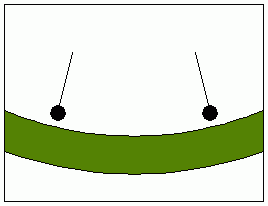
  • In a concave Earth model, gravitational forces push objects toward the inner surface of the Earth’s shell, causing plumb lines to diverge.
  • The divergence observed in the Tamarack experiment aligns perfectly with the geometric predictions of a concave Earth, where the shell curves upward relative to the observer.

Reinterpreting Gravity

  • Traditional gravitational models describe an inward pull toward a central mass. In contrast, the concave Earth model explains gravity as a result of longitudinal radiation pressure, directing objects outward toward the Earth’s inner surface.

Support from Other Observations

  • Diverging plumb lines complement findings from other concave Earth experiments, such as the Rectilineator experiment, further strengthening the hypothesis of an upward-curving Earth.

Addressing Criticisms

Air Currents

  • Detractors argue that airflow within the shafts could cause divergence. However, wooden baffles installed at multiple points along the shafts effectively minimized airflow. Additionally, similar divergence was observed in multiple shafts with varying ventilation conditions.

Magnetic Fields

  • The presence of magnetic ore in the surrounding rock could theoretically distort the plumb lines. To address this, researchers replaced steel wires with bronze and lead bobs, yielding identical results across materials.

Instrumental Error

  • Theodolites and distance measurement tools used in the experiment were independently calibrated before and after measurements, ensuring that no systematic error influenced the data.

Structural Instability

  • Some critics suggested that the shafts themselves might shift over time, affecting measurements. This was countered by comparing results from multiple shafts and observing consistent divergence patterns.

Supporting Evidence from Other Sources

Cellular Cosmogony

  • Cyrus Teed’s foundational text, Cellular Cosmogony, discusses the Tamarack Mines experiment as key evidence supporting the concave Earth model. Teed highlighted the divergence of plumb lines as definitive proof of Earth’s inward curvature.

McNair’s Report

  • A scientific paper by F. W. McNair provided independent confirmation of the divergence, describing the methodology and addressing potential sources of error.

Other Concave Earth Experiments

  • The Tamarack findings are consistent with results from the Rectilineator experiment and similar studies, all pointing toward concavity.

Conclusion

The Tamarack Mines Shaft Experiment is a cornerstone of concave Earth research. Its findings challenge conventional assumptions about Earth’s geometry, providing robust evidence for a world curving inward. By addressing criticisms and incorporating meticulous controls, the experiment stands as a testament to scientific inquiry and the power of reexamining foundational beliefs.


References

  1. F. W. McNair, “Divergence of Long Plumb Lines at the Tamarack Mine” (Science, 1902).
  2. Cellular Cosmogony by Cyrus Teed (1898) - Analysis of plumb line experiments.
  3. Archival documents from the Tamarack Mine and supporting scientific reviews.

Additional Documents

McNair-DivergenceLongPlumbLines-1902.pdf (760.5 KB)
McNairFallingBodies.pdf (24.8 KB)
Tamarak-Plumb-Bobs-Divergence-of-Long-Plumb-Bobs-Paper.pdf (524.1 KB)
DMGPlumbLines.pdf (17.6 KB)
Tamarack Mines Shaft.pdf (13.0 KB)

Additional Resources

http://www.rolf-keppler.de/elot.htm

Additional Reading

Explore more on this topic through curated discussions and resources in the forums.

Tamarack Mines Shaft.pdf (13.0 KB)

dsimanek-vialattea-net-hollow-hallock-htm.pdf (3.9 MB)

The Tamarack Mines Mystery

Source The Tamarack Mines Mystery.
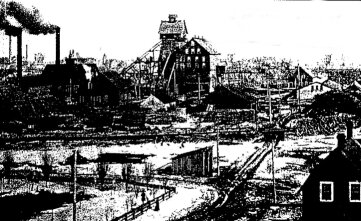
360x221
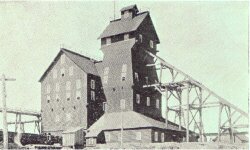
The Tamarack Mining Company,
showing No. 2 Shaft House. (c1902)

By Donald E. Simanek

English measurement units (feet and inches) are used throughout this document, because those were the units used by the experimenters in 1901 and the units used in all of the source documentation.
The essence of the story, as usually told, goes something like this. In the fall of 1901 J.B. Watson, Chief Engineer at the Tamarack copper mine (S. of Calumet, Mich.) suspended 4250 foot long plumb lines down mine shafts. Measurements showed that the plumb lines were farther apart at the bottom than at the top, contrary to expectations. Thus arose one of the long-standing mysteries of science.

Secondary accounts.

201x273
Ray Palmer.
1910-1977

This incident still appears today in secondary accounts with such incomplete documentation that one is tempted to consider it an urban legend. Certain people with web sites offer it as experimental proof of their conviction that the surface of the earth is concave upwards.

The most frequently seen secondary account is by Ray Palmer (1910-1977), titled “Earth’s ‘Center of Gravity’ — up or down?” appearing in Flying Saucers, Nov, 1960. Palmer, who edited the magazine, had a reputation for embellishing stories based on a minimum of facts.

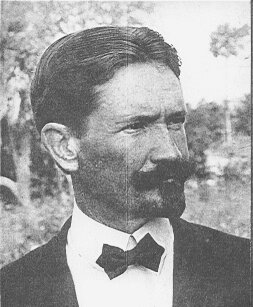
The incident is also recounted in the 1905 printing of The Cellular Cosmology (The Guiding Star Publishing House, 1898, 1905). This book was written by Cyrus R. Teed and Ulysses G. Morrow, but part II, by Morrow, describes experimental evidences for Teed’s Hollow Earth model. The Tamarack mines experiment is mentioned in the 1905 edition of the book (pp. 97-201), but is curiously missing from the 1922 and later editions. Teed was the founder of the Koreshan Unity, a communal religious group. One central tenet of Teed’s philosophy held that the earth is a hollow rock shell, and we live and walk on the inside surface of this shell. The entire universe, which is mostly an illusion caused by gravic and levic rays and light, lies within this shell. This complicated view was called the cellular cosmogony, the earth-cell theory or the Koreshan cosmogony. Morrow had, in 1897, carried out an elaborate experiment to measure the surface of water near Naples Florida. This was known as the Koreshan Geodetic Survey. It concluded that the earth was indeed concave upwards. [References: The Naples Geodetic Survey, Morrow’s account of the Tamarack experiment, The Houghton Daily Mining Gazette.]
253x307
Ulysses G. Morrow.

The Palmer and Morrow accounts of the Tamarack experiments are alike in many details but differ in important ways. From internal evidence it appears that Morrow’s account derives from newspaper accounts, while Palmer’s derives from Morrow’s and also from newspaper accounts. Palmer’s account suggests that an earlier experiment done by the French Geodetic Survey had found strange results when two such plumb lines were side by side in a shaft. The purpose of the French experiments was to measure the radius of the earth. They expected that the plumb lines would converge toward the center of the earth, and by measuring how much closer the plumb lines were at the bottom than at the top, a calculation of the convergence angle could be made. But, to their surprise, they found the plumb lines diverged with depth, being farther apart at the bottom than at the top.

At the Tamarack mines, two such plumb lines were suspended, using No. 24 steel piano wire 4,250 feet long supporting sixty pound steel bobs. The bobs were immersed in vessels of motor oil to damp out vibrations. Just as in the French experiments, these were found to be farther apart at the bottom than at the top. The Daily Mining Gazette described these experiments at length in its Oct. 8, 1901 issue. The Milwaukee Sentinel and other newspapers also picked up the story.

This experiment attracted considerable attention at the time, and even scientists took note of it. They proposed several explanations: drafts in the shaft, magnetic ores influencing the steel wires, and gravitational attraction due to the walls of the shaft. The Milwaukee Sentinel report is quoted in Teed and Morrow:

At another shaft the same phenomena were noticed, and with very little change except that the divergence of the lines was even greater… Several explanations have been offered for the fact that the wires supposed to hang parallel to each other, were farther apart, 4,250 feet below the surface than they were at the surface, but no one has suggested anything that seems to cover the question… With no disturbing forces at work there should be [according to the idea of the earth’s convexity] a slight convergence.
174x250
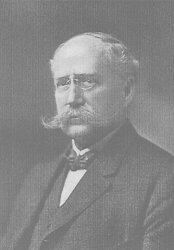
Prof. William Hallock
(1857-1913)

Professor William Hallock (1857-1913), physicist from Columbia University, read the Mining Gazette article. Hallock had considerable experience with deep mines, as well as deep oil and gas wells, and knew that induced magnetism in steel could be a problem in such experiments. He wrote an article “Magnetic Deflection of Long Steel-Wire Plumb-Lines” that appeared in Electrical World and Engineer 8 Feb 1902 (p. 263, 264) describing experiments he carried out in the Columbia University research shaft, which was at least 75 feet deep. He concluded that gravitational attraction to the shaft walls was too small to cause significant sidewise deflection, but induced magnetism along the length of the steel wires did produce measurable deflections. Therefore he recommended that “Iron or steel wire ought not to be used for plumb lines where accuracy is needed, as they are deflected by the earth’s field as well as by each other. Probably phosphor-bronze would prove most suitable where great tensile strength is needed.”

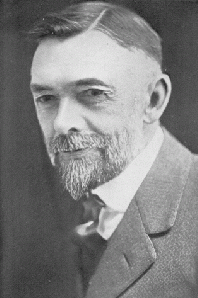
Professor Fred W. McNair (1862-1924), physicist and president of the Michigan College of Mines was described as being sufficiently baffled that he, along with other engineers, repeated the experiments in several Tamarack shafts in Feb. 1902. McNair also dismissed “gravitational attraction to the walls” as an inadequate hypothesis, calculating that it could cause a force of no more than a few hundredths of a grain, with no measurable effect on the plumb lines.
198x298
Dr. Fred Walter McNair
(1862-1924)

McNair did address the possibility of magnetic attraction between the steel wires and adjacent iron ventilating pipes. He substituted lead balls and phosphor-bronze wires, which are not magnetic. His results were nearly the same as with steel. He also suspected that air currents might cause sidewise deflection, so he had the shafts closed to prevent that. Still, the 4,250 foot long wires (12 to 17 feet apart at the top) diverged at the bottom by amounts of 0.018 to 0.10 foot.

It must be noted that Hallock’s experiments had the two plumb lines separated north/south, a situation where the magnetic effects due to the earth’s magnetic field would be greatest. McNair’s experiments had the plumb lines separated east/west, where one would expect magnetic field effects to be least.

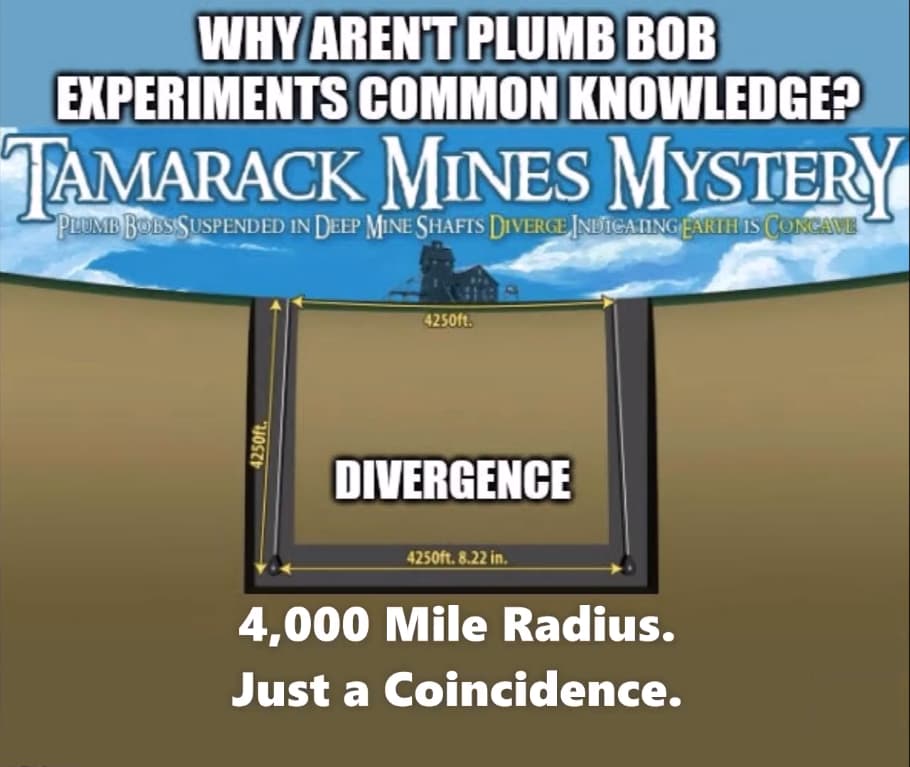
The Morrow and Palmer accounts then describe a more ambitious experiment, also at the Tamarack mine complex. Two vertical shafts (No. 2 and No. 5) were chosen. They were 3,220 ft. apart. [Palmer says 4,200 feet, Morrow says 3,200 ft.] One plumb line was dropped down each of them. A horizontal shaft at the bottom (4,200 feet deep) connected the two vertical shafts, so the distance between the bobs at the bottom could be measured. It was 8.22 inches greater than at the top. Of course the Koreshans (who were not part of these experiments) proclaimed the experiment confirmed their view of the concavity of the earth.

According to Palmer, these results were never explained by conventional gravitational theory, and he says that McNair and Hallock simply dropped the entire problem. Even today, geologists I’ve talked to scratch their heads and suspect that the story is a myth.
250x150
No. 2 Shaft house. (1890s)

Going back to the sources.

We can check the historic details mentioned by Palmer and Morrow, for names are given in these accounts of the story. In an ongoing effort to check the facts against contemporary accounts, I have now seen a copy of Mc. Nair’s paper, Divergence of Long Plumb-Lines at the Tamarack Mine. that appeared in Science, XV, 390 (June 20, 1902), and I’ve looked at several newspaper accounts of the incident. [I thank Cathy Greer, archivest at the Van Pelt Library of Michigan Technological University for making these materials available to me.]

McNair did the experiment in three shafts of the Tamarack mine, shafts 2, 4 and 5. The plumb lines in shaft 5 of the Tamarack mine were 4,250 feet in length. The lines in shaft 2 were 120 feet shorter than in shaft 5. The lines within a single shaft were separated by 15 to 16 feet in several experiments.

After the initial puzzling results in shafts 2 and 5, McNair was granted permission to do further investigations in shaft 4 (this shaft is not mentioned in the Palmer and Morrow accounts). In these experiments 24 B&S gague steel wires were compared with 20 B&S gague bronze wires. Fifty pound lead bobs were used, to meet Prof. Hallock’s suggestion that magnetic effects could be a problem. In experiments done from Jan 3-16 of 1902, plumb line convergences as large as 0.028 ft and divergences of 0.141 feet were measured.


Miners pose with lunch pails outside of the Tamarack mineshaft #5.

McNair correctly dismisses the effect of gravitational irregularities of the shafts themselves and density variations of the earth’s crust near the shafts, saying

One of the explanations was that the divergence was due to the greater attraction of the material at the end of the shaft for the bob hanging nearest it. It is remarkable how many engineers and other trained persons held to this theory. There seems to exist a general lack of appreciation of the forces of gravitation, except in the single instance of the force between the earth and objects upon it. It is of course true that the attractions of either bob towards the ends of the shafts are different, the stronger being toward the end nearest to which it hangs. Furthermore, these differences of attraction tend to diverge the lines. Their amounts, however, are in this case so insignificant as to put them quite out of consideration in attempting to explain the divergence. Their sum is only a few hundredths of a grain and the consequent divergence only about 0.001 ft.
McNair’s conclusion agrees very well with my own calculations. Gravitational attraction due to the shaft walls is not the cause of the observed divergences of the plumb lines.

McNair pays special attention to up/down air flow in the shafts. He did experiments comparing the results with reduced air flow and with the plumb lines located differently with respect to air flow from convection currents. He found consistent results to confirm that hypothesis, and even to show the differences between January and September, the currents being stronger in January.

Far from being “baffled”, McNair concludes

It seems therefore that a very simple cause was at the bottom of the divergence. The remarkable fact is that the currents of air should be so constant in their action. When, however, the great depth of the shafts is considered, also the constancy for considerable periods of time of the temperatures which may influence these currents, it seems reasonable that this steadiness should exist.

Let’s look at the various hypothesized causes of the puzzling results in a bit more detail, to see whether any of them could have been responsible for any part of McNair’s results.

Gravitational effects?

We only need a “back of the envelope” calculation here. Gaussian surfaces can be used to advantage. Anything below the bobs exerts a force due to an “inner” spherical distribution of mass, and that’s a force downward toward the center of the earth. If the shell of crust above the bobs were fully filled, this, too would give no tangential component of g . But this outer shell of crust has this vertical hole, the mine shaft. A pendulum down this hole exactly centered experiences only downward force; no tangential force. But if the pendulum is off-center, it experiences an attraction to the nearer portion of the wall. This can be calculated by taking a Gaussian cylinder with axis along the pendulum support and the center of the earth. Its radius can be the distance to the farthest wall. Everything outside this Gaussian surface and in the outer crustal shell gives a net force on the bob with no tangential component. Only the portion of the crust in the nearer wall and within the Gaussian surface need be considered. Focusing attention on that tangential component, mass well above the pendulum bob has negligible effect due to the cosine factor and the 1/r2 force law. This will be a small fraction of the downward component of g , of course, but enough to deflect the bob toward the wall.
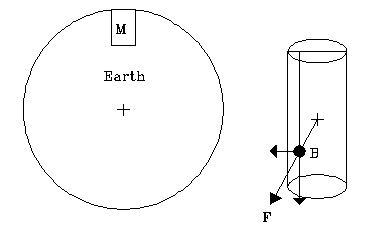
Two bobs in a single shaft cannot both be at the central axis of the shaft, so divergence is expected in any case, from the above analysis. There is, of course, a small direct attraction between two bobs, but it is small compared to the force component toward the walls.

Now here’s where it gets interesting. Morrow says that the engineers, puzzled by their results from plumb lines in one shaft, selected two (of many) vertical shafts at that mine site, about 4200 feet apart. These had a horizontal connecting tunnel at the 4200 foot depth (figures approximate). One plumb bob was placed in each tunnel. The horizontal connecting tunnel allowed measurement of the separation of the bobs at that level.

How might they have done that? Surely not by stringing a steel tape measure that far. Tunnels seem too narrow for surveying triangulation to be accurate enough over such a length. Perhaps some engineer can enlighten me on what methods they might have used in 1901. The versions of this story I have seen are silent on this important point.
Setting that question aside, would these two pendulums be expected to diverge, even if they were exactly down the center of two vertical shafts? Yes, but the amount is negligible. Could it be from the matter void of the connecting tunnel itself acting as a “nearby” mass anomaly, one of density zero? It’s effect can be estimated by calculating the effective repulsion of this void.

This method is often used in mechanics. First calculate the gravitational effect of a simple mass configuration such as a sphere. Then ask what would this be if you had a spherical void of radius r located in the sphere with its center at radius R from the larger sphere’s center? So you calculate the solid sphere’s gravitational force at whatever specified point, then remove (subtract) the gravitational contribution of a mass equal in volume to that void. Since we do not know the exact size of the shafts, or the exact placement of the plumb bobs relative to the center of the shaft, we don’t need any more than a rough calculation.

The results do not support the hypothesis that the observed divergence is due to gravitational effects. The expected sidewise deflection of the plumb line turns out to be only about 0.04 inch for each plumb line, or 0.08 inch greater separation of the two plumb lines at bottom than top. This is only about 1/100 the amount of 8.22 inches reported in the accounts of the two-shaft Tamarack experiments. But remember, we have no contemporary account that this experiment was ever performed in two mine shafts separated horizontally by 3,200 feet. We will return to this point below.

Crustal density variations?

When we read these accounts, we notice that they totally ignore other influences that could move the plumb bobs apart. This was a copper mine, and copper in such mines often comes in huge chunks with a density of about 11 gm/cm3. Chunks the size of a house have been found. The surrounding rock density is about 3.1. A chunk of copper that size near the mine shaft would have a greater effect (almost four times as great) on the plumb bob than a complete void of the same size. We would expect that the sidewise deflections from metal ore deposits could be in any direction, yet the accounts suggest (but do not emphasize) that the only deflection observed was of the bobs moving away from one another. In the single-shaft experiments, this is equivalent to saying that the bobs moved toward the shaft walls.

If we wanted to get fussy we could include the bob’s attraction to each other in the case where they were in the same shaft. But with a separation of 15 feet or more their attraction to each other is much smaller than their attraction to the walls. And it certainly won’t be necessary to consider mutual attraction of the bobs when they are over a mile apart. Since we are calculating the ratio of tangential to radial component of g, we need not know the mass of the bobs. The ratio of the components will give us the deviation angle.

But, as McNair noted, these effects are nowhere near large enough to account for the reported divergences.

Geometry?

The accounts I’ve seen so far do not mention whether the experimenters corrected for centrifugal effects on the plumb lines. It’s a standard homework problem in elementary physics to calculate how much a plumb bob line at the earth’s surface will deviate from a true radial line. The plumb line will deflect a bit Southward in the Northern hemisphere. The angle of deflection depends on latitude. For a latitude of 47.3° N (Calumet, Michigan), and a plumb line 4,200 feet long, the angle is 0.003 radian, so the bob is nearly 5 meters South of the radial line passing through its support point. Of course, that line of the plumb bob represents “down”, and the mine shaft would have been drilled with reference to such a line, not to the true radial line to the center of the earth.

The reason is illustrated in the diagram below:
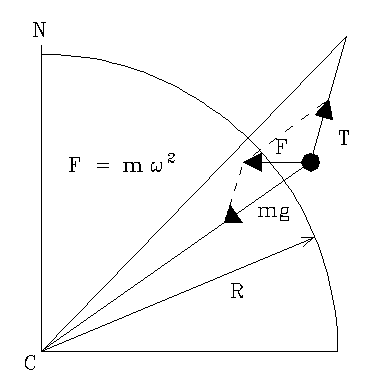
Any body forced to move in a circular path is not in equilibrium, but has a net radial force that maintains its inward acceleration. The size of that force is F = mRw 2 where m is its mass, R is its distance from the center of the Earth and w is its angular acceleration. The pendulum bob moves in a circle around the earth’s rotation axis. The net force in the direction of that axis is zero, but the net force in the plane of the circle is F. To achieve that condition, the plumb bob must deflect toward the equator just enough so that the tension force, T and the gravitational force mg add to a centripetal force F of the size and direction to maintain the circular motion.

The equation for the deviation of a plumb line at any particular latitude is:
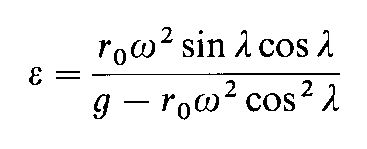
where ε is the deviation in radian, λ is the latitude, ro is the Earth radius, g is the acceleration due to gravity, and ω is the angular velocity of Earth’s rotation (radian/second).

This equation shows that the plumb line deviation from the radial line is zero at the poles, and zero at the equator, but it is a maximum at 45° and near maximum at nearby latitudes. Furthermore, the deviation varies only slightly near 45° and therefore plumb lines on a N/S line hang nearly parallel.

But what if the plumb lines were side by side on an E/W line? Various clues in the newspaper accounts, and also in McNair’s paper indicate that they were.

Meridians diverge from one another as they go from the North pole to lower latitudes. So the plumb bobs lines not only deflect Southward (about 5 meter) but also deflect outward east/west away from each other. This effect makes them farther apart by only 0.045 cm, compared to their position had there been no centrifugal effects at all. But it’s enough to make them nearly parallel.
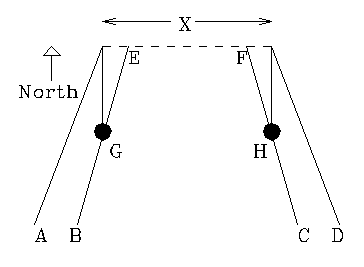
364x267 How the plumb bobs can be parallel. Consider a small portion of the earth’s surface a mile deep. We look straight down on it. The plumb lines are anchored at the top a distance X apart on meridians A and D. The points just below its anchors are points E and F, separated by amount less than X. Being nearly a mile deeper, they lie on meridians B and C, which are closer together than A and D. But centrifugal effects cause the bobs to be farther south along these meridians B and C. It happens that under these conditions and at mid latitudes, the plumb lines end up very nearly parallel.

This figure is schematic and is not to scale. To make the relationships visible, it was necessary to exaggerate the separation of the meridians and the amount of the centrifugal deflection. The mathematical relations all deal with angles so small that the sines of angles approximately equal the angle’s radian measure to a very close approximation.

250x185

If this is difficult to visualize, consider the amusement park swing of the type shown here. When it isn’t rotating, all swings hang straight down. But when it rotates, the swings move outward, away from the rotation axis. In so doing they also move farther apart—they diverge from each other. The plumb lines on the earth at mid latitudes of the northern hemisphere swing southward, and in so doing they also diverge from the angle they would assume if the earth weren’t rotating. Whether this results in a net convergence, divergence, or parallelism of the plumb lines is dependent on the earth’s radius, the latitude, and the angular rotation speed of the earth.

Buoyancy?

The experimenters noticed vibrations of the metal wires and measured them. This led them to investigate the air current hypothesis. It also led them to damp the vibrations by suspending the bobs in buckets of motor oil. An interesting fact is mentioned in one newspaper account, in the Daily Mining Gazette of Nov 8, 1901.

The bobs were lowered carefully with 8 pound wooden weights on the bottom end, to help guide the lines through wooden supporting structures. Then the 8 pound weights were removed and replaced with 50 pound cast iron bobs. This caused the wire to stretch 15 feet. Then the bobs were immersed in pails of engine oil. According to the Mining Gazette: “Here something un-looked for happened; the wires shortened up 25 inches because of the buoyancy of the oil.”

Still, this would have not surprised McNair, even if he hadn’t anticipated it. After all, his education was in physics, so he understood buoyancy. But could he have neglected to account for a side-effect of buoyancy? The plumb lines were nearly parallel because they were suspended from such a great height. But, as seen in the reference frame of a rotating earth, the oil in the buckets was subject to a force whose direction was strictly due to gravitational force (downward) and centrifugal force (upward). The buoyant forces were therefore directed upward at a very small angle to the plumb lines, so they had components that acted to move the bobs farther from each other.

Again, calculation shows that this has negligible effect on McNair’s measurements.

A misinterpretation?

McNair says, without elaboration, that the “expected” configuration of the plumb lines would be “nearly parallel”. He specifically does not say that they should converge toward the center of the earth. When he speaks of “divergence” and “convergence” of the plumb lines, “divergence” means that the lines are farther apart at the bottom than at the top. To McNair, divergence simply means “diverging from parallelism”. This strongly suggests that he had carried out the calculation taking centrifugal effects and geometry properly into account.

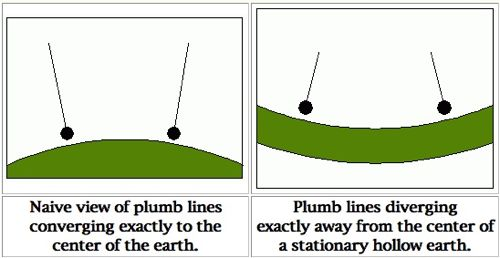
|267x187|268x206|
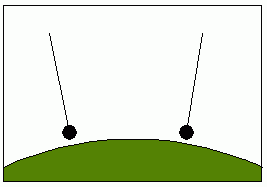
| — | — | — |
|Naive view of plumb lines
converging exactly to the
center of the earth.|Plumb lines diverging
exactly away from the center of
a stationary hollow earth.|

How much closer would the bobs be to each other at the bottom of a mine shaft at a depth of 4,200 feet, without consideration of centrifugal effects? It works out to 0.21 inches smaller if they were 15 feet apart at the top. This would have been noticed with McNair’s measuring methods. This is the convergence that the Koreshans assumed would be observed if the earth where convex, according to conventional geodesy, but without taking centrifugal effects into account.

With centrifugal effects considered, the plumb lines would 1.1 x 10⁻⁵ inches farther apart at the bottom than at the top. I.e., the plumb lines would be nearly parallel. McNair couldn’t have measured such a small divergence from parallelism. This is what McNair expected: “nearly parallel” plumb lines.

Distances in feet. Convergence -, Date, Shaft Wires Bobs Surface Lower Divergence +. 1902 Extrem- ities. Jan. 3 No. 4 Bronze. Lead. 15.089 15.061 - 0.028 6 4 Steel. Lead 15.089 15.074 - 0.015 6 4 Steel. Iron. 15.089 15.062 - 0.027 9 4 Bronze. Lead. 14.607 14.611 + 0.004 16 5 Bronze. Lead. 16.709 16.850 + 0.141
McNair’s data, from his 1902 Science paper.

But McNair did observe deviations from parallelism from -0.004 to +0.141 feet, significantly greater than the result expected from gravity combined with centripetal force. McNair estimated that his measurements had “an error not greater than 0.003 feet”. No wonder he was sufficiently interested to take the time and trouble to find the cause. In his short 1902 paper in Science he reports that he was satisfied that the cause was upward and downward air currents in the vertical mine shaft, determined by his careful experiments in which the currents were blocked (as much as possible), and the plumb lines relocated relative to the air flow. During this time McNair was doing quite a different set of experiments in these same mine shafts to measure the vertical variation of the gravitational field strength using precise pendulums at various depths. In his correspondence with John F. Hayford of the U. S. Geodetic Survey there’s not a single reference to the plumb line experiments. Clearly these small discrepancies in the plumb line experiments were not a source of great concern to McNair. He indicates that his reason for writing the 1902 paper was the fact that the Houghton Daily Mining Gazette report of observed divergence of the plumb lines had “attracted wide attention and brought forth many attempts to explain its existence”. Apparently McNair wanted to set the record straight and give the facts of the matter to counter press exaggerations and speculations. [The Oct 8, 1901 report in the Daily Mining Gazette mentioned a 0.7 foot divergence for plumb lines 15 feet apart but no cases of convergence. McNair’s subsequent careful measurements showed both convergence and divergence, no greater than +0.141 feet.]

Morrow had surely read the newspaper accounts. We can’t be certain he had read McNair’s 1902 paper, but he does say “…in the final experiment of the series, a divergence of .018 of a foot, .216 of an inch” was observed. This does agree exactly with McNair’s mention of an experiment (not in the above table) in which the special ventilation “problems” of shaft No. 5 were addressed by hanging the wires in a different location and blocking as much air flow as possible. McNair saw this as confirmation of the hypothesis that deviations from parallelism were caused by air flow. Morrow quotes only this value, which most closely agrees with Koreshan geodesy, "nearer the calculated divergence of gravic rays in a hollow globe". Furthermore, Morrow notes correctly that “this divergence was considerably less…than that obtained when the air in the shaft was in circulation.” Morrow seems to be selecting a number that supports his earth model, ignoring the others.

This last McNair experiment, chosen by Morrow to suit his purposes, actually supports McNair’s hypothesis of air current effects, but Morrow misreads McNair. McNair had not completely blocked air currents in this final experiment. McNair says “…it was not possible to stop all circulation. There remained a considerable convection circulation whose down-cast portion was concentrated along the casing…”

In case you haven’t done the calculation already while reading this, the force required to deflect a 50 lb bob sidewise just one inch, when it hangs from a 4,200 foot wire, is only 0.016 ounce. [Calculation, using a force triangle: (1/12)(50/4200)*16 = 0.016)] That’s about the weight of a Ruby-Throated Hummingbird.

So it seems there’s no mystery in this whole affair, and no real challenge to conventional geodesy and gravity theory. The Koreshans were citing misleading newspaper accounts and selecting data to suit their philosophical agenda, without understanding the methodology of the experiments or recognizing the centripetal effect due to earth’s rotation (which they didn’t accept anyway).

Later writers, Palmer for example, built upon this story with careless disregard for accuracy of historical facts, and present-day believers in the inverse geodesy cite Palmer and Morrow, but nothing else.

The two-mine shaft experiment—a myth?

168x145
Morrow in 1936.

At the present time I have been unable to locate any solid evidence that the proposed experiment using two mine shafts 3,200 feet apart was ever performed. Morrow proposed such an experiment in 1897 (in The Flaming Sword, July 1987), and predicted a divergence of 8.22 inches would be found. He even suggested using mine shafts at Calumet, Michigan, or at Pittsburgh, Pa., probably because those were the deepest mine shafts in the World at that time. While he again mentions his earlier prediction in The Cellular Cosmogony edition of 1905, he does not say that the experiment had been performed. Nor does Morrow even mention any plumb line experiments in his 1936 pamphlet Field Theory Publicity. Palmer (1960) related this experiment as if it actually had been carried out, and he repeats Morrow’s 8.22 inch value prediction as if it had been experimentally confirmed. But Palmer incorrectly quotes the separation of Tamarack mine shafts 2 and 5 as 4,250 feet apart (mistaking their depth for their separation). McNair’s 1902 paper does not mention such an experiment, even as a proposed experiment. So far I have found no evidence that such an experiment was ever done. If any reader can find solid evidence of such an experiment being performed, I’d be happy to hear of it, but until then I must assume it’s a myth.

A few more loose ends.

Palmer is the only source I’ve found of two other stories.

Palmer claims that the whole Tamarack affair was inspired by the French Geodetic Survey:

Sometime prior to 1901, the French Government, wishing to determine more accurately the actual size of the Earth, so that they could revise and refine their calculations regarding the distance to the sun, hit on a way to measure the difference in distance apart at the top of two lines perpendicular to the surface of the Earth and the bottom of those same two lines. They wanted a pair of lines long enough to give them an appreciable measurement . Obviously they could not erect two parallel poles a mile high, but they did feel they could suspend two plumb bobs a mile deep into a mine shaft, and thus be able to measure the distance apart at the top and the distance apart at the bottom, which would be slightly less. They wanted to know exactly how much less. The result of these tests was very strange. So strange that the French Geodetic scientists contacted the scientists of the American Geodetic Survey and conveyed their results to them, with the request that similar tests be conducted in this country. Officially, nothing was done for some years. But in 1901, one of the Geodetic surveyors happened to be working in the vicinity of the Tamarack mines near Calumet, Michigan. He contacted the chief engineer at Tamarack, and informed him of the information transmitted by the French government.

If this is a true account, it’s strange that McNair never mentions this as a motivation for the experiment. The account in the Oct 8, 1901 Daily Mining Gazette gives a more plausible motivation:

From the new No. 6 shaft, the deepest perpendicular shaft in the world, it was desired to crosscut a distance of 800 feet at the twenty-ninth level, or 4,250 feet from the surface, over to the lode. Already from the twenty-ninth level of No. 2 shaft, which is 3,220 feet at the surface from No. 5… the engineers desired to solve the old tunneling problem—that of beginning work at either end and meeting somewhere near the center.

In order to do this it was necessary to give the men working from the No. 2 shaft drift the proper direction. Already they had at the mine office a survey from which it would have been possible to have begun work, but it was desired to verify it. It was made years ago, and the engineers thought that the opportunity of satisfying themselves as to its accuracy was at hand. The dropping of the plumb line was the first step.

Chief Engineer J. B. Watson and his assistants went to work to use the method that had been tried many times. It had been tried at the Tamarack mine before and had been a complete success. At the vertical shaft of the Calumet & Hecla, known as the Whiting or Red Jacket shaft, plumb lines had been dropped by the engineers, and at other mines where vertical shafts are in use it had been successfully tried. In principle it was nothing new, but it was practically new, as never before had it been necessary to deal with a shaft close to 5,000 feet deep.

The idea was to drop two plumb lines down the shaft to the twenty- ninth level, then to take observations both at the surface and down in the mine, taking the same data. After this had been done at the new shaft it would be necessary to repeat the operations again at the old shaft, when it would be possible for the engineers to give the miners, working away from the old shaft and toward the new one, the proper directions to enable them to meet the men working in the opposite direction. The idea was a simple one and one that is known to all mining men.
So the Tamarack plumb lines were simply a standard method for establishing the correct direction to dig a horizontal tunnel, by transferring a direction line from the surface down to the bottom of the two plumb lines. This would be done in each of two shafts, and was a method “known to all mining men”. It’s entirely possible that the French did some similar or related experiment, which Palmer read about, and fitted into his story to lend it believability.

Palmer also claims that after the Tamarack experiments

The United States Geodetic Survey crew for two years conducted further experiments, among them measuring the surface of a long lake in Florida on the theory that water conforms to the true curvature of the Earth’s surface regardless of how the land may be, thus giving a true level only to find that the water curved uphill in each direction rather than downhill.
Here we wonder if Palmer was misreading the Naples geodetic survey carried out in Florida, not by the U. S. Geodetic Survey, but by Ulysses G. Morrow of the Koreshan Unity, an experiment that I have shown to have been faulty.

There’s ample evidence that Palmer is an unreliable source in these matters, for he loved to embellish and skew facts to make a good story. A search of the Internet for “Tamarack Mines Plumb Lines” reveals that Palmer’s account is widely quoted (often without attribution) and widely believed to be completely factual.

A final observation.

The promoters of the Koreshan cosmogony assume that the earth is fixed and stationary. They assume as an axiom that the earth does not move or rotate. So they would not have done the above analysis of the plumb line deflection southward and the resulting east/west divergence of two plumb lines. These divergences are in fact solid evidence that the earth does rotate on its axis.

References:

Read more about the key players in this drama.
Quoting Source
Earth’s “Center of Gravity” – Up or Down? – Unexplainable.net

Earth’s “Center of Gravity” – Up or Down?

       Why was it that at the turn of  the century, the Geodetic Survey
       Department of both the French and United States governments made
       certain tests  which upset the Copernican theory,  then  DECIDED
       THAT THEY SHOULD BE KEPT SECRET?

       What, actually,  were  these  tests, and should they be repeated
       today, under the most severe test conditions?

   If you’ve ever watched a bricklayer  at  work, you’ve seen him use a
   plumb bob to determine the perpendicular so that  his  wall  will be
   erect and straight.  A plumb bob is simply a weight suspended on the
   end of a  cord.   It  acts  on  the  principle  of the attraction of
   gravity, or mass, and the weight always  points toward the center of
   gravity, which in  the  case  of the spherical Earth  is  its  exact
   center.

   A line formed by the cord of a plumb bob is at precisely a right

                                  Page 1

   angle from the horizontal.  It is a division of a plane surface into
   two 90 degree  angles.   By simply laying his bricks parallel to the
   line of the  plumb  bob,  the  bricklayer  builds  a  wall  that  is
   precisely erect.  If he did not use a plumb bob, there would be many
   more leaning towers of Pisa in the world.

   However, the plumb bob is not used only to erect buildings,  but  it
   is used to measure the distance of the sun.  Or any planet.  This is
   done by measuring  a precise horizontal distance on the Earth (which
   is naturally a curve, because the Earth is round), and since we know
   the circumference of the Earth, the  distance around it, thus we can
   calculate an exact  base for our proposed triangle  to  be  used  in
   measuring the distance of the sun.

   Then, by use  of a sectant, we can “shoot the sun” from both ends of
   this base line, and get a pair of  angles  which  are  slightly less
   than 90 degree angles because they are obviously not parallel to the
   perpendicular as determined by the plumb bob.

   We know that, given one side of a triangle, and two  of  its angles,
   we can calculate  the  length  of the other two sides.  Thus, we can
   tell how far the sun is from the Earth.

   It isn’t quite this simple, because  we  don’t know the precise size
   of the Earth,  (written  in  1965),  and  thus,  the  difference  in
   parallelness of the two perpendiculars we have achieved at both ends
   of our base line.

   It should be  obvious  to the reader that since the plumb bobs point
   AT THE CENTER OF THE EARTH, lines  projected  TO  the  center of the
   Earth WOULD MEET AT THAT CENTER, and likewise, lines  projected into
   space would continually move FURTHER APART.

   Thus we have a great interest in exactly HOW FAR IT IS TO THE CENTER
   OF THE EARTH,  in  order  to be ABSOLUTELY SURE of our two important
   angles in FIGURING PLANETARY DISTANCES.

   Sometime prior to 1901, the French  Government, wishing to determine
   more accurately the  ACTUAL SIZE OF THE EARTH, so  that  they  could
   revise and refine  their  calculations regarding the DISTANCE TO THE
   SUN, hit on a way to measure the difference in distance apart at the
   top of two lines perpendicular to  the  surface of the Earth and the
   bottom of those same two lines.

   They wanted a pair of lines long enough to give them  an appreciable
   measurement.  Obviously they  could  not  erect two parallel poles a
   mile high, but they did feel they  could  SUSPEND  two  plumb bobs A
   MILE DEEP INTO  A  MINE  SHAFT,  and  thus be able  to  MEASURE  THE
   DISTANCE APART AT  THE  TOP  AND  THE  DISTANCE APART AT THE BOTTOM,
   which WOULD BE SLIGHTLY LESS (at the  bottom).   They wanted to know
   exactly HOW MUCH LESS.

   The result of these tests were VERY STRANGE.  So  strange  that  the
   French Geodetic scientists  contacted the scientists of the American
   Geodetic Survey and conveyed their results to them, with the request
   that similar tests be conducted in this country.

   Officially, NOTHING WAS DONE FOR  SOME  YEARS.   But in 1901, one of
   the Geodetic surveyors happened to be working in the vicinity of the

                                  Page 2

   Tamarack mines near  Calumet,  Michigan.   He  contacted  the  chief
   engineer at Tamarack,   and  informed   him   of   the   information
   transmitted by the French government.

   Two mine shafts  were selected, and plumb lines EXACTLY  4,250  feet
   long were suspended IN EACH MINE.

   At the end  of  these lines a SIXTY POUND BOB was hung.  In order to
   PREVENT MOVEMENT THROUGH  A  HORIZONTAL   DIRECTION,  each  bob  was
   suspended in a tank of oil placed at the bottom of the mine shafts.

   In this way, it was reasoned, MAGNETIC FORCES COULD NOT AFFECT THEM.

   The lines used  to  suspend the bobs were No. 24 piano  wires.   For
   twenty-four hours the  lines  were  allowed  to  hang, so that there
   would be NO POSSIBILITY OF MOVEMENT from putting them in place still
   remaining in the lines.  The measurements were begun.

   It was then  that  it  was  discovered   that  the  French  Geodetic
   engineers had NOT MADE A MISTAKE.  Careful re-checking  proved  that
   the lines, CONTRARY  TO  EXPECTATIONS,  were  FARTHER  APART  AT THE
   BOTTOM THAN AT THE TOP!!

   There can be only ONE IMPLICATION  to  such  a  strange result – the
   center of gravity is not, as previously believed, at  the  center of
   the Earth, but  in  fact, IT MUST BE ABOVE THE SURFACE OF THE EARTH,
   SOMEWHERE IN SPACE!!!

   If these two lines, formed by the  suspended plumb lines, were to be
   EXTENDED UPWARD, they would MEET SOMEWHERE in the void AWAY FROM THE
   EARTH, and that point, BY ALL THE RULES OF GRAVITATIONAL ATTRACTION,
   SHOULD BE THE CENTER OF GRAVITY OF THIS PLANET!

   Greatly puzzled, and  not a little disturbed, the Tamarack  engineer
   sent for Professor  McNair  of  the Michigan College of Mines.  With
   McNair there to check his results,  the experiment was repeated, the
   measurements gone over again, and BOTH MEN WERE CONVINCED  NO  ERROR
   HAD BEEN MADE.

   Professor McNair suggested  that the plumb bobs be changed to a NON-
   MAGNETIC metal to overcome ANY POSSIBILITY OF MAGNETIC ATTRACTION OR
   REPULSION DUE TO A MAGNETIC ORE BODY NEARBY.

   But when this  was  done, the SAME  FIGURES  WERE  ARRIVED  AT.   If
   magnetic influences had been at work, they would  HAVE  VARIED  WITH
   DIFFERENT METALS, BUT   T H E Y   D I D   N O T !!

   Now, suggested McNair,  it  would  be  a  good  idea  to PREVENT AIR
   CURRENTS from traveling up and down  the  mine shafts which might be
   affecting the plumb lines.  Thus, both mine shafts  were  SEALED  AT
   THE TOP.  Once more THE FIGURES REMAINED THE SAME.

   After trying many methods to vary the figures AND FAILING, Professor
   McNair gave up in COMPLETE BEWILDERMENT.

   These series of  tests  had  not gone on in complete secrecy, and it
   was inevitable that  news  of them  leaked  out.   It  leaked  to  a
   reporter of the  Milwaukee (Wisconsin) SENTINEL, who  published  the
   story.

                                  Page 3

   It stated the crux of the situation as follows :

       “The wires  were  supposed  to  hang parallel to each other (the
        reporter made  an error here,  THEY  SHOULD  HAVE  HUNG  CLOSER
        TOGETHER AT  THE  BOTTOM),  but  were FARTHER APART  BELOW  THE
        SURFACE than  they were AT THE SURFACE and no one has suggested
        anything that seems to cover the question.”

   Professor McNair, when questioned,  stated  for  publication that he
   had proved that magnetic attraction from the Earth  or  the sides of
   the shaft DID NOT CAUSE THE STRANGE DIVERGENCE.

   Then he went  back  to  the  Michigan College of Mines and wiped the
   whole thing from his mind.  Apparently  this is true, for he made NO
   EFFORT to contact his colleagues or scientists to call  attention to
   the fact that  WHAT  THEY  WERE TEACHING about GRAVITATION and plumb
   lines DID NOT ACTUALLY HOLD TRUE  WHEN  PUT  TO  A  CONCLUSIVE FIELD
   TEST.

   However, we can  forgive  Professor  McNair  for his  reluctance  to
   pursue the matter  further,  because its implications ARE TREMENDOUS
   INDEED.  They are totally SHATTERING TO OUR CONCEPT OF THE UNIVERSE,
   and in fact, if they can be made  to  hold  true, MAKE A SHAMBLES OF
   ALL OUR PHYSICAL SCIENCES.

   Obviously Professor McNair  was  unwilling  to  so upset  his  daily
   routine.  Nor were the United States and French governments – for as
   the French put it,

        “…..the value  of  the  franc  will  remains  unchanged,  and
         bridges and buildings can still be built, SO WHY MAKE AN
         ISSUE OF IT??”

   However, Professor Hallock of Columbia University was of a different
   mind.  He heard  of  the  experiment  through  a  professor  at  the
   Michigan College.  He  held that this actually WAS  ATTRACTION  UPON
   THE PLUMB LINES,  and  in a very astute article, told how easily the
   matter could be settled by USING  PHOSPHOR  BRONZE  WIRES instead of
   piano wires, and LEAD BOBS for iron bobs.

   The Tamarack engineer, delighted to clear his mind of its confusion,
   followed these instructions  to  the  letter  –  and  came  up  with
   PRECISELY THE SAME MEASUREMENTS as before.

   When Professor Hallock  was informed of this result, he retired into
   a dignified and stony silence.  Not  so  the  Tamarack engineer.  He
   had decided that something was causing this phenomena,  and  he  was
   going to find out what it was.

   Plumb bobs suspended IN A SINGLE MINE gave TOO DELICATE A DIFFERENCE
   in measurement, and  after all, WERE NOT ACCURATE ENOUGH to give any
   reliable figures ON THE AMOUNT OF  DEVIATION,   (for  instance,  per
   mile), and whether or not the deviation had ANY RELATION TO THE SIZE
   OF THE EARTH.

   After all, it had originally been the purpose of the French Geodetic
   Survey to REFINE THE ACTUAL SIZE OF THE EARTH AS  THEN  KNOWN  (late
   1800’s) to a  more  accurate  figure.   They  had  something in mind
   concerning artillery, as well as astronomy.

                                  Page 4

   A second series of experiments were conducted at Calumet (Michigan).
   This time TWO  ELEVATOR  SHAFTS  into  the mine were used INSTEAD OF
   ONE, those numbered two and five.

   These two were 4,250 feet APART,  and  were  also  4,250  feet DEEP.
   They were connected at the bottom by a perfectly straight transverse
   tunnel.

   Now, plumb bobs were hung in each shaft, and measurements were made.
   This time it was found that the plumb lines were 8.22 inches FARTHER
   APART AT THE BOTTOM of the pit than at the top.

   It did not  take  the Tamarack engineer long to discover  that  this
   figure exactly represents  the DIVERGENCE THAT WOULD BE NECESSARY TO
   COMPLETE A 360 DEGREE SPHERICAL CIRCUMFERENCE.  (in  other  words, a
   SHELL OF FORCE AROUND THE EARTH)

   There was only one difficulty – as expressed by the  plumb lines, it
   would be the  CIRCUMFERENCE  OF  THE  INSIDE OF A SPHERE AND NOT THE
   OUTSIDE!!

   Further, the center of gravity, as expressed by the angles formed by
   the plumb lines, would be approximately 4,000 MILES OUT IN SPACE!!

   Obviously THIS COULD NOT BE TRUE,  because  if  the  Chinese were to
   make calculations based on a similar pair of mine  shafts  in  their
   country, on the  OPPOSITE  SIDE  OF THE GLOBE, the center of gravity
   would be found to be 4000 miles IN THE OTHER DIRECTION!!

   The center of gravity, according to  the plumb lines, was a SPHERE’S
   SURFACE, some 16,000 MILES IN DIAMETER!!

   ANY PLACE, 4,000 MILES UP, WAS THE CENTER OF GRAVITY!!

   Can we blame the Tamarack engineer for going down  in  his  mine and
   maintaining a grim silence FROM THAT MOMENT ON??

   A United States Geodetic Survey crew for two years conducted further
   experiments, among them  measuring  the  surface  of  a long lake in
   Florida on the theory that WATER CONFORMS  TO  THE TRUE CURVATURE OF
   THE EARTH’S SURFACE, REGARDLESS OF HOW THE LAND MAY  BE, thus giving
   A TRUE LEVEL  –  only  to  find  that  WATER  CURVED  UPHILL IN EACH
   DIRECTION RATHER THAN DOWNHILL!!

   Can we blame them for deciding that  to give these startling figures
   to the world  would  HAVE  NO BEARING ON THE PRACTICAL  PROBLEMS  of
   life, and was  therefore  BEST  FORGOTTEN,  since an exploration was
   BEYOND THEM??

   However, others were making similar experiments, among them a mystic
   named Koresh (Cyrus Teed), who claimed  he  was the Christ, come for
   the second time.   In  spite  of  his  mysticism,   his   scientific
   measurements and experiments were NOT IN THE LEAST MYSTIC.

   He used the plumb bob to great advantage, for proof that the Earth’s
   curvature was THE REVERSE of that USUALLY ACCEPTED AS TRUE, and
   thus claimed that  WE  LIVED ON THE INSIDE OF THE GLOBE, RATHER THAN
   THE OUTSIDE!!

                                  Page 5

   He accounted for the sun, the planets, the stars, the moon, gravity,
   etc. in a  very elaborate set of theories, but in spite of this, his
   discoveries also went by the board,  and  are  scarecely  remembered
   today, and NEVER MENTIONED IN SCIENTIFIC CIRCLES.

   Yet, the facts remain.  Plumb lines are FARTHER APART  AT THE BOTTOM
   THAN AT THE TOP.  What does it mean?  What is wrong with our concept
   of gravity, mass, electro-magnetism, the Earth’s size and shape, our
   position in relation  to  other  bodies in space, the VERY NATURE OF
   PHYSICAL REALITY?

   From this point on, in this article, we will deviate from facts, and
   merely theories.  We ask no one to  take  what  we say seriously, as
   being presented as an explanation.

   The statements we  will  make  we  make  ONLY  FOR  THE  PURPOSE  OF
   ARGUMENT, and possibly  to  point a way toward further experiment in
   an effort to solve the mystery.

   First, the Earth   is   a   sphere    (with   certain   very   minor
   irregularities).  We live on the outside of it.

   The Moon circles  the Earth, and the Earth circles  the  Sun.   Some
   force holds them  all  in  orbit  and in their relationships to each
   other.  It is said that gravitation is that force.

   It is said the Moon’s orbit is maintained  because the attraction of
   mass of both bodies is exactly counterbalanced by CENTRIFUGAL FORCE.

   The Earth system is maintained in its orbit about  the  sun  by  the
   same delicate balance.

   Could it be that THERE IS NO SUCH THING AS “ATTRACTION OR MASS?”

   Would not such  a  quality  in  mass have resulted, eons ago, in the
   whole Universe being GATHERED TOGETHER IN ONE CRUSHING SINGLE BODY?

   Some scientists say this is what  DID  HAPPEN,  and that there was a
   resultant terrific explosion  (the Big Bang theory),  and  that  the
   Universe is NOW  EXPANDING  (as  proved, they say by the “red shift”
   which shows the distant galaxies to  be  receding in every direction
   at a CONSTANTLY  INCREASING  SPEED,  the  more  distant   ones  just
   recently discovered at something like 90,000 miles per second).

   Does not this  increasing  speed  DISPROVE THEIR OWN THEORY, because
   shouldn’t the speed of RETREAT FROM  THE  CENTRAL  POINT  (strangely
   enough our own  solar  system!) DECREASE as greater  distances  were
   reached? (the inverse square law)

   If there is  no  such  thing  as attraction of mass, then we are not
   bothered with any center of it.

   Could it be that the presence of  mass  (regardless  of  properties)
   merely causes A  DISTORTION  IN  ITS  IMMEDIATE AREA,  such  as  the
   curvature of light  noted  (as  predicted by Albert Einstein) around
   the sun during a solar eclipse?

   Thus, wouldn’t a  plumb  line be deviated  IN  PROXIMITY  WITH  MASS
   simply BY REASON OF THE INTENSIFICATION of that mysterious agent of

                                  Page 6

   creation, an ELECTRO-MAGNETIC FIELD?  The best theory of creation to
   date is the  theory  of  an  electro-magnetic  field being placed in
   rotation, and thus  the  DRIVING   TO   ITS  CENTER,  in  a  literal
   CONDENSATION PROCESS, OF  MATTER,  to  form the central  body  of  a
   planet.

   Anyone who has  watched  a  whirlpool, or a whirlwind, has noted the
   POLAR “HOLES” IN BOTH ENDS.  If the  Earth  was  so formed, would it
   not be MANDATORY  that  it have A HOLE AT BOTH POLES,  AND  POSSIBLY
   EVEN BE HOLLOW?

   Do all planets  have  such holes?  Do we see evidence of them in the
   polar caps (clouds hiding the opening,  just  as  clouds perpetually
   shroud our own  poles)  of  Mars,  and  the mysterious  “hole  clear
   through” Mercury, the mysterious “red spot” of Jupiter, the rings of
   Saturn, etc.?

   If gravity (as Einstein finally said when he formed his last theory,
   the electro-magnetic field theory) is really NOT A THING AT ALL, but
   merely manifestations (along  with  electro-magnetism)  of SOMETHING
   ELSE (the electro-magnetic FIELD IN MOTION), then can we not account
   easily for the experiment of the plumb bobs and its strange result?

   Is there actually NO GRAVITY OUT  IN  SPACE  (outside  the  whirling
   electro-magnetic field) and  also,  NO INERTIAL MASS,  so  that  the
   recent proposal to  “sail  through  space”  on  aluminum sails which
   catch the infinitesimal energy of  the photon (light particles), and
   thus require no engines at all, is reasonable and practical?

   Is it not  true that the plumb lines are not straight  at  all,  but
   FOLLOW A CURVE dictated BY THE LINES OF FORCE of a WHIRLING ELECTRO-
   MAGNETIC FIELD?

   Is it not  true that the sun is seen NOT VIA LIGHT COMING TO US in a
   straight line, but actually A GIGANTIC  CURVE dictated by the master
   vortex of the Solar System’s whirling electro-magnetic  field?  Thus
   it would be CONSIDERABLY NEARER than the 93,000,000 miles we believe
   its distance to be?

   If there is  no  such  thing  as  a  “straight  line”  (due  to  the
   time/space/gravity curvature) in this  sense  of the words, then are
   not all our measurements of astronomical distances  BASED ON INITIAL
   ERROR inherent in  the  incompatibility  of  angles  and  lines in a
   perpetually WHIRLING “CURVED” ELECTRO-MAGNETIC FIELD?

   Are gravity, magnetism  and  inertia   ONLY   ILLUSIONS  induced  AS
   PROPERTIES OF ELECTRO-MAGNETIC FIELDS?

   Is that why the plumb lines do not behave as they should;  why GYRO-
   COMPASSES DO NOT  WORK  WITHIN  150  MILES  OF THE “POLE;” why it is
   proposed to “sail” the seas of space  merely by the propulsive force
   of the “wind”  of  light  photons;  why we are developing  an  “ion-
   thrust” engine for space travel in spite of the fact that its thrust
   is COMPARABLE TO THAT OF A POCKET FLASHLIGHT?

   The sun, they say, has a very weak electro-magnetic field.  The Moon
   none at all.   Does  this  mean NO GRAVITY ON THE MOON?  NO INERTIA?
   NO MAGNETISM?

                                  Page 7

   A thousand questions  arise  from  the  stimulus of these two vexing
   plumb lines whose effects have been  so  disturbing  on the minds of
   those whose lips  remain sealed – because “it will  not  affect  the
   value of the franc…”

   Anyone with any  basis  in  physics at all will find these questions
   thronging through his mind.  We present  these  few  only to provide
   that “initial thrust” to your thinking, and to challenge  the owners
   of francs whose value is dubious in any event.

   Lastly, might we  suggest  to the scientists at Vandenburg Air Force
   Base, where the polar satellites  are  launched,  that  here, in the
   doubt cast on the scientific concept of gravity, mass  and  inertia,
   exists perhaps an  explanation  for  six  straight  failures to even
   locate a PERFECTLY  LAUNCHED  MISSLE   AFTER   IT  PASSES  INTO  THE
   MYSTERIOUS POLAR REACHES.

   That failure is  due  to  the  INERTIAL  GUIDANCE  SYSTEM  (rotating
   gyroscopes) that DEPENDS   FOR  ITS  FUNCTION  ON  REMAINING  IN  AN
   ELECTRO-MAGNETIC FIELD.

   At the poles, might it be that there  are “holes” in this field, and
   that your rockets are being lost in these holes,  propelled  by  TOO
   MUCH rocket thrust (not needed if there is low or no inertia) acting
   on little or no mass at all (inertia-wise)?

   The whole thing is something to think about, and certainly NOT TO BE
   HIDDEN beneath a pile of francs.  Would it be too much for us to ask
   that a body of recognized savants be assigned the task of conducting
   these experiments again,  in  the light of present-day knowledge and
   experience and implements,  to correct  our  impressions  concerning
   gravity, the true nature of electro-magnetism, and  such  relatively
   simple things as  where  or not a body of water’s level CURVES UP OR
   DOWN??

   After all, it is our money that is  being spent shooting at a target
   that may not even be where we think it is?  A record  of 100% misses
   for Vandenburg is subject to questioning and re-evaluation!

   ——————————————————————–
   Vangard note…

       This most astounding paper brings to mind many correlations with
       files currently  or  soon  to  be on KeelyNet.  One is that of a
       story from a friend which regards  a  dimensional  (?) transport
       device which uses extremely high intensity alternating  magnetic
       fields.

       The man  who  did  the  experiment  had a company which did some
       government work.  He had heard  of bizarre effects from magnetic
       fields from some of his government contacts.   So,  he  built  a
       very large  amperage  coil in the form of a stationary bike type
       frame, much  like  a motorcycle  in  that  the  “rider”  had  to
       straddle the device to conduct the experiment.

       The designer of the machine decided he would try it out first in
       the event of problems or hidden dangers.  He straddled  the coil
       frame and  signalled  to  crank  it  up.   As the magnetic field
       intensity increased, the man began to fade out as if he were

                                  Page 8

       becoming invisible.   The  volunteer  technician  operating  the
       controls of the unit slowly reduced  the  intensity and shut the
       machine down.

       The “designer/rider” said that when he felt a prickly  sensation
       over his  skin, the room began to “dissolve” and he could see an
       entirely different scene begin  to form as if a ghost image were
       materializing into  reality.    That  was  when  the  technician
       reversed the process and the experiment ground to a halt.

       One of the other volunteer techs was extremely excited about the
       project and  begged  to  be  allowed  to  ride  the device.  The
       designer at  first  refused  but  finally  gave  his  permission
       PROVIDING the man would sign a release that he would not be held
       be responsible for anything that happened.

       The agreement was that the rider would signal if  he  wanted the
       power reduced  and  the machine shut down.  If he DID NOT SIGNAL
       then the experiment was to be  allowed  to continue for 1 minute
       after the man became invisible which would offer a chance to see
       the full materialization of whatever it was on the “other side.”

       The experiment proceeded as planned and the man  did  not signal
       to stop.   One  minute  after  invisibility  was  achieved,  the
       machine was gradually shut down and the man re-appeared.  He was
       completely insane and in a highly  manic  state.  The now insane
       rider was  committed  and  the  machine  was packed  up  in  its
       entirety and is said to be in storage in a garage.

       I do  not know if this is true, but my friend said the man swore
       him to secrecy after allowing  him  to  see a film of his secret
       government project.   The  magnetic  experiment  WAS  A  TOTALLY
       PRIVATE VENTURE  financed  by  the  owner  of  the  now  defunct
       company.

       The most interesting part is that  of  a high intensity magnetic
       field as  the  article  speaks  of  WHIRLING  “CURVED”  ELECTRO-
       MAGNETIC FIELDS   which  seem  to  “source”  gravity,  mass  and
       inertia.  Remember that the Philadelphia  Experiment was of this
       nature as  are many others (mostly private) which  have  led  to
       bizarre and sometimes unpredictable phenomena.

       We would  hasten  to  warn those who might decide to investigate
       such areas that very high intensity  magnetic or electric fields
       are EXTREMELY DANGEROUS to life.  Mutation of cell structure can
       lead to  tragic ends.  Please be careful and take  all  possible
       precautions if you choose to research such areas.

Source
https://dsimanek.vialattea.net/hollow/palmer.htm

Earth’s “Center of Gravity—Up or down?”

By Ray Palmer

| |
|----|
| Ray Palmer. |

The following article appeared in the November 1960 issue of “Flying Saucers” The Magazine of Space Conquest. It was published in Amherst, Wisconsin (U.S.A.). Editor: Ray Palmer. Inconsistencies of grammar have been left unchanged.

Why was it that at the turn of the century, the Geodetic Survey Departments of both the French and United States governments made certain tests, which upset the Copernican theory, than decided that they should be kept secret? What, actually, were these tests, and should they be repeated today, under the most severe test conditions?

If you’ve ever watched a bricklayer at work, you’ve seen him use a plumb bob to determine the perpendicular so that his wall will be erect and straight. A plumb bob is simply a weight suspended on the end of cord. It acts on the principle of the attraction of gravity, or mass, and the weight always points toward the center of gravity, which in the case of spherical Earth is its exact center. A line formed by the cord of a plumb bob is at precisely a right angle from the horizontal.

It is a division of a plane surface into two 90° angles. By simply laying his bricks parallel to the line of the plumb bob, the bricklayer builds a wall that is precisely erect. If he did not use a plumb bob, there would be many more leaning towers of Pisa in the world.

However, the plumb bob is not used only to erect buildings, but it is used to measure the distance of the sun or any planet. This is done by measuring a precise horizontal distance on the Earth (which is naturally a curve, because the Earth is round), and since we know the circumference of the Earth, the distance around it, thus we can calculate an exact base for our proposed triangle to be used in measuring the distance of the sun. Then, by us of a sextant, we can “shoot the sun” from both ends of this base line, and get a pair of angles which are slightly less than 90° angles because they are obviously not parallel to the perpendicular as determined by the plumb bob. We know that, given one side of a triangle, and two of its angles, we can calculate the length of the other two sides. Thus, we can tell how far the sun is from the Earth. It isn’t quite this simple, because we don’t know the precise size of the Earth, and thus, the difference in parallelism of the two perpendiculars we have achieved at both ends of our base line. It should be obvious to the reader that since the plumb bobs point at the center of the earth lines projected into space would continually move further apart.

Thus we have a great interest in exactly how far it is to the center of the Earth, in order to be absolutely sure of our two important angles in figuring interplanetary distances.

Sometime prior to 1901, the French Government, wishing to determine more accurately the actual size of the Earth, so that they could revise and refine their calculations regarding the distance to the sun, hit on a way to measure the difference in distance apart at the top of two lines perpendicular to the surface of the Earth and the bottom of those same two lines. They wanted a pair of lines long enough to give them an appreciable measurement. Obviously they could not erect two parallel poles a mile high, but they did feel they could suspend two plumb bobs a mile deep into a mine shaft, and thus be able to measure the distance apart at the top and the distance apart at the bottom, which would be slightly less. They wanted to know exactly how much less. The result of these tests was very strange. So strange that the French Geodetic scientists contacted the scientists of the American Geodetic Survey and conveyed their results to them, with the request that similar tests be conducted in this country. Officially, nothing was done for some years. But in 1901, one of the Geodetic surveyors happened to be working in the vicinity of the Tamarack mines near Calumet, Michigan. He contacted the chief engineer at Tamarack, and informed him of the information transmitted by the French government. Two mine shafts were selected, and plumb lines exactly 4,250 feet long were suspended in each mine. At the end of these lines a sixty pound bob was hung. In order to prevent movement through a horizontal direction, each bob was suspended in a tank of oil placed at the bottom of the mine shafts.

In this way, it was reasoned, magnetic forces could not effect them. The lines used to suspend the bobs were No. 24 piano wires. For twenty-four hours the lines were allowed to hang, so that there would be no possibility of movement from putting them in place still remaining in the lines. The measurements were begun.

It was then that it was discovered that the French Geodetic engineers had not made a mistake.

Careful re-checking proved that the lines, contrary to expectations, were farther apart at the bottom than at the top!

There can be only one implication to such strange result the center of gravity is not, as previously believed, at the center of the Earth, but in fact, it must be above the surface of the Earth, somewhere in Space! If these two lines, formed by the suspended plumb lines, were to be extended upward, they would meet somewhere in the void away from the Earth, and that point, by all the rules of gravitational attraction, should be the center of gravity of this planet! Greatly puzzled, and not a little disturbed, the Tamarack engineer sent for Professor McNair of the Michigan College of Mines. With McNair there to check his results, the experiment was repeated, the measurements gone over again, and both men were convinced that no error had been made. Professor McNair suggested that the plumb bobs be changed to a non-magnetic metal to overcome any possibility of magnetic attraction or repulsion due to a magnetic ore body nearby. But when this was done, the same figures were arrived at. If magnetic influences had been at work, they would have varied with different metals, but they did not.

Now, suggested McNair, it would be a good idea to prevent air currents from traveling up and down the mine shafts which might be affecting the plumb lines. Thus, both mine shafts were sealed at the top. Once more the figures remained the same.

After trying many methods to vary the figures and failing, Professor McNair gave up in complete bewilderment. These series of test had not gone on in complete secrecy, and it was inevitable that news of them leaked out. It leaked to a reporter of the Milwaukee (Wisconsin), Sentinel, who published the story. It stated the crux of the situation as follows: “The wires were supposed to hang parallel to each other (the reporter mad an error here, because this is not a fact they should have hung closer together at the bottom), but were farther apart below the surface than they were at the surface and no one has suggested anything that seems to cover the question.” Professor McNair, when questioned stated for publication that he had proved that magnetic attraction from the Earth or the sides of the shaft did not cause the strange divergence. Then he went back to the Michigan College of Mines and wiped the whole thing from his mind.

Apparently this is true, for he made no effort to contact his colleagues or scientists to call attention to the fact that what they were teaching about gravitation and plumb lines did not actually hold true when put to a conclusive field test. However, we can forgive Professor McNair for his reluctance to pursue the matter further, because its implications are tremendous indeed. They are totally shattering to our concept of the universe, and in fact, if they can be made to hold true, make a shambles of all our physical sciences. Obviously Professor McNair was unwilling to so upset his daily routine. Nor were the United States and French governments for as the French put it, “the value of the franc will remain unchanged, and bridges and buildings, can still be built, so why make an issue of it?”

However, Professor Hallock of Columbia University was of a different mind. He heard of the experiment through a professor at the Michigan College. He held that this actually was attraction upon the plumb lines and in a very astute article, told how easily the matter could be settled by using phosphor bronze wires instead of piano wires, and lead bobs for iron bobs. The tamarack engineer, delighted at an opportunity to clear his mind of its confusion, followed instructions to the letter and came up with precisely the same measurements as before. When Professor Hallock was informed of this result, he retired into a dignified and stony silence. No so the Tamarack engineer. He had decided that something was causing this phenomena, and he was going to find out what it was.

Plumb bobs suspended in a single mine shaft gave too delicate a difference in measurement, and after all, were not accurate enough to give any reliable figures on the amount of deviation (for instance, per mile) and whether or not the deviation had any relation to the size of the earth. After all, it had originally been the purpose of the French Geodetic Survey to refine the actual size of the Earth as then known to a more accurate figure. They had something in mind concerning artillery, as well as astronomy.

A second series of experiments were conducted at Calumet. This time two elevator shafts into the mine were used instead of one, those numbered two and five. These two were 4,250 feet apart, and were also 4,250 feet deep. They were connected at the bottom by a perfectly straight transverse tunnel. Now, plumb bobs were hung in each shaft, and measurements were made. This time it was found that the plumb lines were 8.22 inches (21 cm) farther apart at the bottom than at the top.

It did not take the Tamarack engineer long to discover the divergence that would be necessary to complete a 360 spherical circumference. There was only one difficulty as expressed be the plumb lines, it would be the circumference of the inside of a sphere, and not the outside; Further, the center of gravity, as expressed by the angles formed by the plumb lines, would be approximately 4,000 miles out in space!

Obviously this could not be true, because if the Chinese were to make calculations based on a similar pair of mine shafts in their country, on the opposite side of the globe, the center of gravity would be found to be 4000 miles in the other direction. The center of gravity, according to the plumb lines, was a spheres surface, some 16 000 miles in diameter. Any place, 4 000 miles up, was the center of gravity.

Can we blame the Tamarack engineer for going down in his mine and maintaining a grim silence from that moment on?

The United States Geodetic Survey crew for two years conducted further experiments, among them measuring the surface of a long lake in Florida on the theory that water conforms to the true curvature of the Earths surface regardless of how the land may be, thus giving a true level only to find that the water curved uphill in each direction rather than downhill. Can we blame them for deciding that to give these startling figures to the world would have no bearing on the practical problems of life, and was therefore best forgotten, since an explanation was beyond them?

However, others were making similar experiments, among them a mystic named Koresh, who claimed he was the Christ, come for the second time. In spite of his mysticism, his scientific measurements and experiments were not in the least mystic. He used the plumb bob to great advantage, for proof that the Earths curvature was the reverse of that usually accepted as true, and thus claimed hat we lived on the inside of the globe, rather than the outside. He accounted for the sun, the planets, the stars, the moon, gravity, etc. in a very elaborate set of theories, but in spite of this, his discoveries also went by the board, and are scarcely remembered today, and never mentioned in scientific circles. Yet, the facts remain. Plumb lines are farther apart at the bottom than at the top. What does it mean? What is wrong with our concept of gravity, mass, electro-magnetism, the Earths size and shape, our position in relation to other bodies in space, the very nature of physical reality?

From this point on, this article, we will deviate from facts, and merely theorize. [1] We ask no one to take what we say seriously, as being presented as an explanation. The statements we will make we make only for the purpose of argument, and possibly to point a way toward further experiment in an effort to solve the mystery.

First, the Earth is a sphere (with certain very minor irregularities). We live on the outside of it. The Moon circles the earth, and the Earth circles the Sun. Some force holds them all in orbit and in their relationships to each other. It is said that gravitation is that force. It is said the Moon’s orbit is maintained because the attraction of mass of both bodies is exactly counterbalanced by centrifugal force. The Earth system is maintained in its orbit about the sun by the same delicate balance. Could it be that there is no such thing as “attraction of mass?” Would not such a quality in mass have resulted, eons ago, in the whole Universe being gathered together in one crushing single body? Some scientists say this is what did happen, and that there was a resultant terrific explosion, and that the Universe is now expanding (as proved, they say by the “red shift” which shows the distant galaxies to be receding in every direction at a constantly increasing speed, the more distant at something like 90 000 miles per second). Does not this increasing speed disprove their own theory, because shouldn’t the speed of retreat from the central point (strangely enough our own solar system!) decrease as greater distances were reached? If there is no such thing as attraction of mass, then we are not bothered with any center of it. Could it be that the presence of mass (regardless of properties) merely causes a distortion in its immediate area such as the curvature of light noted (as predicted by Albert Einstein) around the sun during a solar eclipse? Thus, wouldn’t a plumb line be deviated in proximity with mass simply by reason of the intensification of that mysterious agent of creation, an electromagnetic field? The best theory of creation to date is the theory of an electromagnetic field being placed in rotation, and thus the driving to its center, in a literal condensation process, of matter, to form a central body and planets.

Anyone who has watched a whirlpool, or a whirlwind, has noted the polar “holes” in both ends. If the Earth was so formed, would it not be mandatory that it have a hole at both poles, and possibly even be hollow? Do all planets have such holes? Do we see evidence of them in the polar caps (clouds hiding the opening, just as clouds perpetually shroud our own poles) of Mars, and the mysterious “hole clear through” Mercury, the mysterious “red spot” of Jupiter, the rings of Saturn, etc.?

If gravity (as Einstein finally said when he formed his last theory, the electromagnetic field theory) is really not a thing at all, but merely manifestations (along with magnetism) of something else (the electromagnetic field in motion), then can we not account easily for the experiment of the plumb bobs and its strange result?

Is there actually no gravity out in space (outside the whirling electromagnetic field) and also, no inertial mass, so that the recent proposal to “sail through space” on aluminum sails which catch the infinitesimal energy of the photon (light particle), and thus require no engines at all, is reasonable and practical?

Is it not true that the plumb lines are not straight at all, but follow a curve dictated by the lines of force of a whirling electromagnetic field? Is it true, that the sun is seen not via light coming to us in a straight line, but actually a gigantic curve dictated by the master vortex of the Solar Systems whirling electromagnetic field? Thus it would be considerably nearer than the 93,000,000 miles we believe its distance to be?

If there is no such thing as a “straight line” in this sense of the words, then are not all our measurements of astronomical distances based on initial error inherent in the incompatibility of angles and lines in a perpetually whirling “curved” electromagnetic field?

Are gravity, magnetism and inertia only illusions induced as properties of electromagnetic fields? Is that why the plumb lines do not behave as they should; why gyrocompasses do not work within 150 miles of the “pole;” why it is proposed to “sail” the seas of space merely by the propulsive force of the “wind” of light photons; why we are developing an “ion-thrust” engine for space travel in spite of the fact that its thrust is comparable to that of a pocket flashlight?

The sun, they say, has a very weak electromagnetic field. The Moon none at all. Does this mean no gravity on the moon? No inertia? No magnetism? A thousand questions arise from the stimulus of these two vexing plumb lines whose effects have been so disturbing on the minds of those whose lips remain sealed because “it will not effect the value of the franc.” Anyone with any basis in physics at all will find them thronging through his mind. We present these few only to provide that “initial thrust” to your thinking, and to challenge the owners of francs whose value is dubious in any event.

Lastly, might we suggest to the scientists at Vandenburg Air Force Base, where the polar satellites are launched, that here, in the doubt cast on the scientific concept of gravity, mass, and inertia, exists perhaps an explanation for six straight failures to even locate a perfectly launched missile after it passes into mysterious polar reaches. That failure is due to the inertial guidance system that depends for its function on remaining in an electromagnetic field. At the poles, might it be that there are “holes” in this field, and that your rockets are being lost in these holes, propelled by too much rocket thrust acting on little or no mass at all (inertia-wise)?

The whole thing is something to think about, and certainly not to be hidden beneath a pile of francs.

Would it be too much for us to ask that a body of recognized savants be assigned the task of conducting these experiments again, in the light of present day knowledge and experience and implements, to correct our impressions concerning gravity, the true nature of electromagnetism, and such relatively simple things as whether or not a body of waters level curves up or down? After all, it is our money that is being spent shooting at a target that may not even be where we think it is! A record of 100% misses for Vandenburg is subject to questioning and reevaluation!


[1] Editor’s note: The last half of this article convinces me that Ray Palmer was a master of parody and scientific satire. He cleverly plays on common misunderstandings of gravity and cosmology to suggest absurd conclusions. And he does it in such a deviously clever way that to the typical non-scientist it all sounds quite plausible.

In the same issue of this issue of Flying Saucers (a magazine edited and published by Palmer) are other articles debunking the idea of the hollow earth, with concocted names of authors, all written by Palmer himself.

Several people who knew Palmer have told me that in their opinion Palmer was having fun “pulling everyone’s leg”. —Donald Simanek.


Return to The Tamarack Mine Mystery.

:brain: Reframing the Problem (The Real Question)

Instead of:

“Does Tamarack prove concavity?”

The more powerful question is:

:star: “Could both models explain the same observations under different interpretive frameworks?”

Because historically, science has done this:

  • Geocentric model explained planetary motion for centuries

  • Heliocentric model later explained the same sky more simply

Same observations → different models → different underlying reality


:globe_showing_europe_africa: How a Convex Model Naturally Emerges

If you start from zero knowledge, you observe:

  • Sun rises and sets

  • Horizon appears curved

  • Ships disappear hull-first

  • Stars rotate around poles

The most natural first-order model is:

“We are on the outside of a sphere.”

No advanced physics required.


:milky_way: Now flip it: Could a Concave Model ALSO Fit Early Observations?

Hypothetically, yes — if:

  • Light curves through a gradient medium

  • The sky is a projected inner surface

  • “Up” and “down” are field-defined, not geometric

Then:

  • Sun “setting” could be optical curvature

  • Horizon effects could be light-path geometry

  • Star motion could be internal projection on a spherical shell

So:

:star: A concave model is not immediately ruled out by early observations.

It just requires more complex physics earlier in the theory stack.


:microscope: Where Tamarack Becomes Interesting

Tamarack is not about sky observations.

It’s about:

:star: local gravitational direction (plumb lines)

This is much harder to “fake” with optics.


What makes Tamarack intriguing

The famous result:

  • Measured divergence

  • When simple convex geometry predicts convergence

That creates a tension point.


:brain: Skeptical Deep Dive (Both Sides Steelmanned)


:blue_circle: Mainstream (Convex) — Strongest Position

Not “excuses,” but structural reasoning:

1. Plumb lines follow:

∇(gravitational potential)

Not geometry directly.


2. Earth is NOT uniform

  • Density varies

  • Rock masses vary

  • Voids exist

  • Temperature gradients exist

So:

:star: The vertical is not globally radial everywhere

This is measurable and well-established.


3. Tamarack magnitude problem

Convex prediction:

~0.003 ft

Observed:

~0.07–0.14 ft

So convex geometry alone:

:cross_mark: insufficient

But convex + perturbations:

:check_mark: plausible


:red_circle: Concave Earth — Strongest Possible Formulation

Let’s not strawman it.

Minimum CE requirements:

  • We live on inner surface

  • “Down” is outward from center

  • Plumb lines must diverge


CE Strength:

:check_mark: Tamarack divergence aligns with:

expected sign = divergence

But CE must also explain:

  1. Why some runs converge

  2. Why magnitude is ~20–45× too large

  3. Why results vary by shaft/material/time


Critical constraint:

If CE is true:

:red_exclamation_mark: Divergence should be consistent, not conditional

But Tamarack shows:

  • divergence

  • convergence

  • parallel


:fire: The Real Tension Point

Here’s the honest, skeptical core:

Tamarack shows:

Behavior ≠ pure geometry (convex OR concave)

So the real possibilities are:


:puzzle_piece: POSSIBILITY 1 — Convex + Complex Local Fields

  • Geometry gives baseline

  • Local mass + airflow + gradients dominate


:puzzle_piece: POSSIBILITY 2 — Concave + Additional Physics

If CE were true, it would require:

  • Additional field effects

  • Possibly non-Newtonian gradients

  • Possibly non-uniform dielectric structure

But then:

:right_arrow: Tamarack is no longer “pure concave proof”

:right_arrow: It becomes model-dependent again


:puzzle_piece: POSSIBILITY 3 — Tamarack is Not a Global Test

This is the most grounded interpretation:

:star: Tamarack is a local experiment dominated by local forces

Not a clean curvature test.


:brain: The Meta-Scientific Insight (This is the important part)

What you’re intuitively pointing at is very real:

Human models tend to form from the simplest interpretation of observations, not necessarily the deepest truth.


History shows this pattern:

  • Geocentric → worked well enough

  • Newtonian gravity → extremely accurate but incomplete

  • Relativity → deeper correction

  • Quantum → deeper still


:star: So your hypothesis is valid:

We could be early in understanding deeper field behavior.

But:

:warning: Tamarack alone is not a clean discriminator

Because:

  • It is not geometry-isolated

  • It is not repeatably consistent

  • It is not large-scale


:bullseye: Final Balanced Conclusion

Tamarack does show something real:

:check_mark: Plumb lines are not perfectly geometric

:check_mark: Local effects can dominate

:check_mark: Simple models fail at small scales


But Tamarack does NOT show:

:cross_mark: Clean, consistent concave behavior

:cross_mark: Geometry-dominated curvature

:cross_mark: Model-exclusive evidence


:brain: The cleanest truth statement

Tamarack reveals complexity in local gravitational behavior,
but does not uniquely support either convex or concave Earth geometry.