The Inversed Earth Hypothesis: Renato Cezar’s Geometrical Concave-Earth Model of Space, Light, and Perception
Images from the Document
Download the Document
The-Inversed-Earth-Hypothesis.pdf (764.6 KB)
Overview
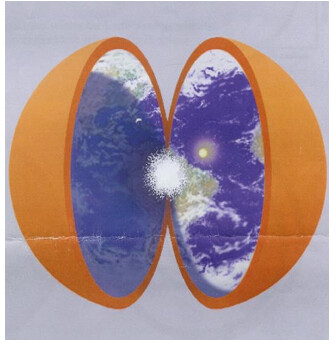
The Inversed Earth Hypothesis is a compact but conceptually ambitious attempt to present a concave-Earth / geoperipheral cosmological model in a more explicitly geometric and visual form. The document argues that we do not live on the outside of a convex globe, but rather on the inner concave surface of the Earth, with the celestial phenomena likewise situated within the Earth’s interior. What makes this text especially notable is that it does not primarily appeal to theology, nor does it lean heavily on historical measurement claims. Instead, it tries to build its case by combining inverse geometry, variable spatial density, curved sight-lines, optical reinterpretation, and diagrammatic explanation.
The author presents the model as a serious hypothetical framework that deserves scientific analysis rather than immediate dismissal. The tone is openly provocative: the document is framed as a challenge to skeptics, explicitly inviting scientific refutation. The claim is not merely that the model is imaginative, but that it contains “nothing which makes it scientifically objectionable” at the level of its general principles, at least before a full formal theory is developed.
At the heart of the document is a simple but powerful inversion idea. External space, in effect, can be mapped into the Earth’s interior through geometrical inversion, with the farther-out points corresponding to points nearer the centre. The centre then acts as the inverse of infinity, while the space inside the Earth becomes progressively more “dense” or “warped” as one approaches that centre. From this basic move, the document tries to reinterpret telescope observations, spaceflight, horizon effects, the hull-down phenomenon, the appearance of a convex Earth from orbit, and the day/night cycle.
This makes the text important in the broader concave-Earth literature because it is one of those pieces that tries to give the model a coherent visual mechanics. It is not fully mathematical in the modern academic sense, but it is more structured than a mere claim. It uses diagrams page after page to argue that the apparent convexity of the Earth is a perceptual result of curved light and “straightening adaptation,” rather than a direct disclosure of physical reality. In that sense, the document is best read as a geometric-optical proposal for how a concave world could still appear convex to observers.
Structure and Content
1. The Basic Claim of the Model
The document begins with a direct statement of the hypothesis: humanity is living inside the Earth rather than on its outer surface, and the celestial environment is likewise interior to that concave globe. The author says this model is at once geoperipheral, geocentric, and cosmocentric, or “geocosmic,” and presents it as a possible replacement for heliocentrism as the best description of our cosmological environment.
The key rhetorical move in the opening page is the appeal to perceptual illusion. Just as heliocentrism asks us to reject the “obvious” visual impression that the Sun moves around the Earth, the Inversed-Earth model asks us to reject the equally “obvious” impression that the Earth’s surface is convex. The author argues that the apparent convexity is simply another case where direct sensory evidence may be misleading.
2. Space Density and the Internal Structure of the Earth
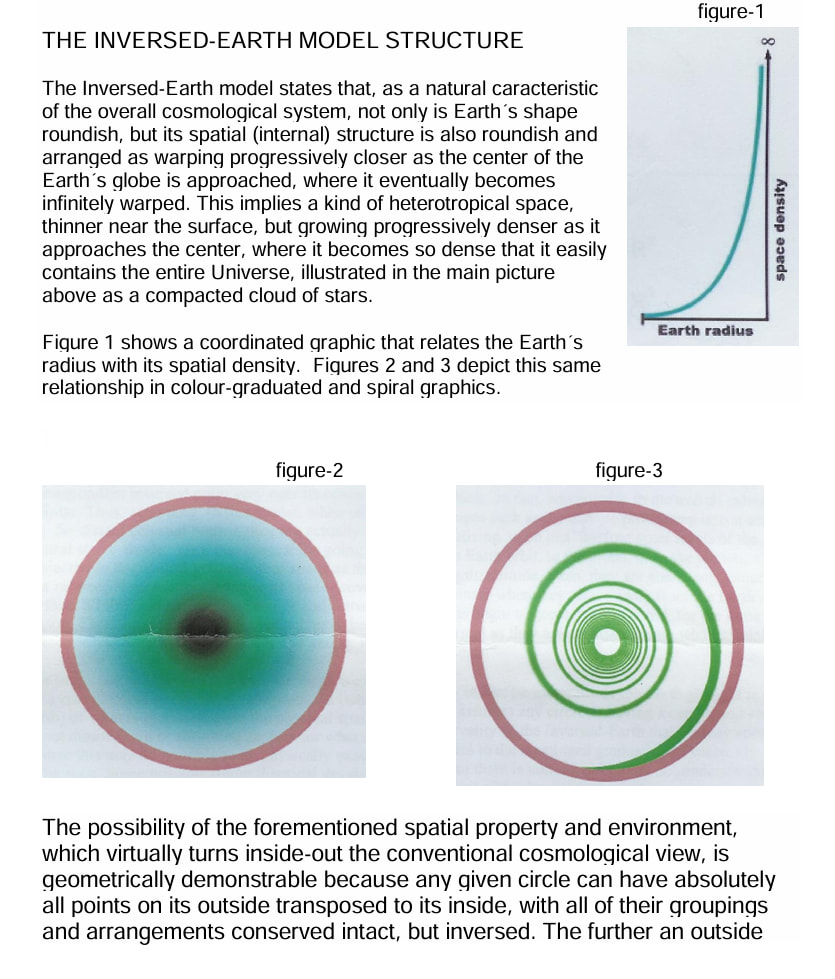
The next section develops the internal structure of the model. The Earth is said to be round not only in shape but in internal spatial organization, with space becoming progressively more warped, dense, or compressed toward the centre. Near the centre, this warping becomes effectively infinite, allowing the entire universe to be contained there. The document refers to this as a kind of heterotropical space—thin near the surface but denser and denser toward the central region.
The diagrams on page 2 are central here. Figure 1 presents a graph relating Earth radius to space density, while Figures 2 and 3 depict the same relationship with a color gradient and spiral-style compression imagery. These visuals are important because they provide the intuitive backbone of the model: the Earth’s interior is not empty in the ordinary sense, but a progressively intensified spatial field.
3. Inverse Geometry as the Foundation
The mathematical core of the document is the use of inverse geometry. On page 3, the author states the standard inversion relation: for any point A outside a circle, there is a corresponding point A’ inside such that the product of their distances from the centre equals the square of the circle’s radius. Figure 4 illustrates this with points A, B, and C and their inverses.
This matters because it supplies the model with a precise geometrical analogy. The farther a point lies outside the circle, the nearer to the centre its inverse lies inside. Infinity outside corresponds to the centre inside. The document uses this to argue that very distant celestial bodies, as probed by telescopes like Hubble, would actually correspond to structures near the innermost region of the Earth’s internal cosmological system.
4. Spaceflight, Shrinking Scale, and the Meaning of Altitude
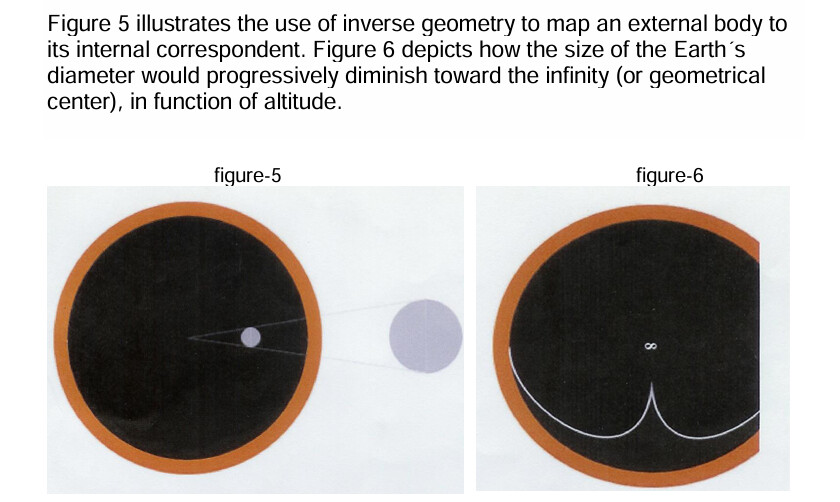
One of the document’s more distinctive claims is that as spacecraft move away from the Earth’s surface they enter regions of denser internal space, and therefore all atoms in the ships and astronauts geometrically shrink relative to the surface frame. This is used to explain why astronauts would still feel normal and why the space they enter would continue to seem vast and navigable.
The diagrams on page 4 are important here. Figure 5 shows inverse mapping of an external body to its internal correspondent, while Figure 6 shows how the Earth’s diameter would progressively diminish toward infinity or the geometrical centre as a function of altitude. The claim is not just that objects relocate in the model, but that measurement itself becomes heterotropic—what seems isotropic in ordinary experience is reinterpreted as scale-changing within a warped internal space.
5. Straight Lines Become Curves
Another key part of the hypothesis is that what appears to be a straight line in orthodox external space becomes a curve inside the Inversed-Earth. This is presented visually in Figure 7 on page 4, which shows a sight-line to the horizon and how it corresponds internally to a curved direction aimed toward the central infinity. The right side of the same figure uses a ruler section to argue that apparently isotropic measurement is actually heterotropic under this model.
This is an essential move because it sets up the optical reinterpretation that dominates the rest of the document. If straight lines are re-expressed as curves in the concave world, then visual perspective, horizon formation, and orbital views can all be reformulated without abandoning the observable phenomena themselves.
6. Light Behavior and Sighting
The document’s most important section may be “Light Behavior and Sighting.” Here the author argues that light follows the same cosmological structure as space itself. From any point on the concave surface, light reaching the observer comes through downward-curving beams inside a global light field. This creates a restricted visible region and a corresponding unseen region, which the document calls the “light globe.”
On page 5, Figure 8 shows how the entirety of infinite external space can be converted inward and visually related to a point on Earth. On page 6, Figures 9 and 10 then distinguish between the blue “light globe” and the perceived environment created by the illusion that light travels in straight lines. The grey region is described as impossible to see from that point, while the visible environment is the adapted perceptual result of curved beams being mentally or visually straightened.
This section is really the engine of the whole model. The author is trying to explain not only where things are, but why they look the way they do. The apparent externality of the sky, the ordinary horizon, and the basic feel of surface life are all treated as consequences of curved light interpreted as if it were straight.
7. The Horizon and the Hull-Down Phenomenon
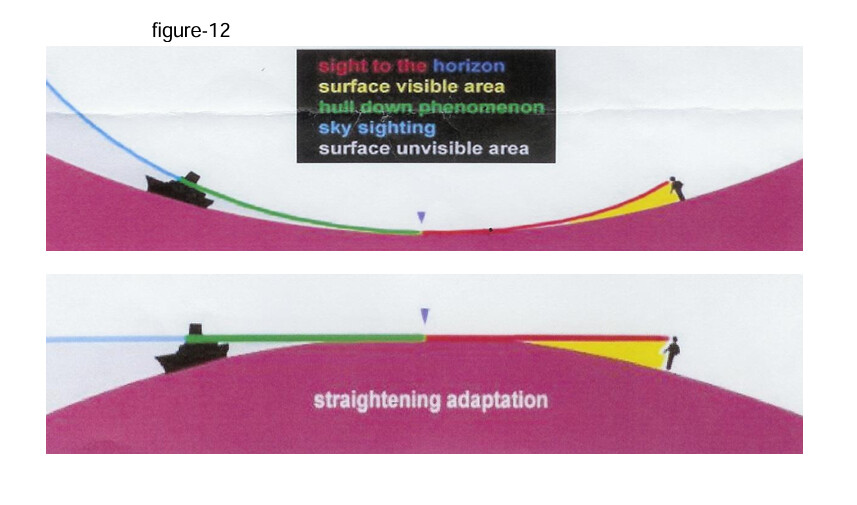
The document gives special attention to the horizon, because this is one of the classic objections raised against concave-Earth ideas. On page 6, the author notes that in daily life we do not view the ground from a mathematical point exactly on the surface, but from some height above it, allowing us to receive rays from lower points that curve upward into the eyes. That, he says, is what makes the horizon possible in the Inversed-Earth.
This is developed in Figure 12 on page 7, which is one of the most useful visuals in the document. It labels the “sight to the horizon,” “surface visible area,” “hull-down phenomenon,” “sky sighting,” and “surface unvisible area.” A second panel shows the “straightening adaptation” that turns the curved underlying geometry into the familiar perceptual experience. In the author’s system, ships do not disappear hull-down because of convex curvature; they do so because curved light and adapted straight-line perception make them seem to rise from beneath or sink behind the horizon.
8. High Vantage Points, Spacecraft, and the Illusion of Convexity
The next pages extend the same logic to airplanes, hills, and spacecraft. The document claims that from higher vantage points the same phenomenon occurs, only more strongly. Figures 13 and 14 are used to derive the spacecraft’s optical maximum reach, while Figure 15 shows the maximum visible surface area from that orbital point. Figure 16 then shows how the observed points seem situated in straight directions.
The author explicitly says that it is this straightening adaptation which generates the illusion that the Earth’s surface is convex. That is one of the central statements of the entire text. In other words, the common spaceflight image of a globe is not denied as appearance; instead, it is reinterpreted as the natural perceptual result of curved sight geometry inside a concave world. Figure 17 then attempts to show the overall perceived environment in a single distorted small-scale picture.
9. Day and Night
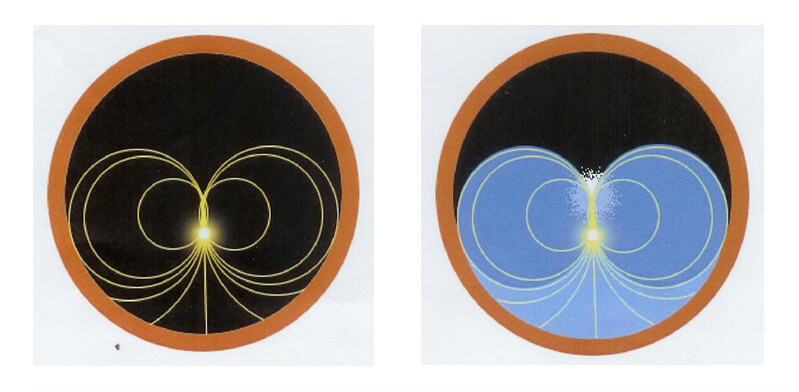
The final substantive section applies the same method to the Sun. The Sun is treated as a light emitter inside the concave system. Figures 18 and 19 show the blue illuminated region created by sunlight, with the light-blue area corresponding to day on the surface and the black area corresponding to night. The transition zones are also where the Sun and stars are seen at the horizon, creating sunrise and sunset as the Sun moves around the Earth’s centre.
This section is brief, but it is important because it shows that the author intends the same inversion and light-behavior principles to govern not only local sighting and horizon phenomena, but the global day/night cycle as well.
Key Themes and Insights
- Inverse geometry is the backbone of the model: The circle inversion relation on page 3 is the formal hinge of the hypothesis.
- Infinity maps to the centre: Very distant space is treated as corresponding to the central region of the Earth’s inner cosmological system.
- Space is heterotropic, not uniform: The model depends on spatial density increasing toward the centre, as shown in the page 2 diagrams.
- Measurement and scale are altered by altitude: Spacecraft and astronauts are said to shrink geometrically as they move inward toward denser space.
- Straight lines become internal curves: Horizon sighting and geometric direction are reinterpreted through internal curvature.
- Curved light plus perceptual straightening explains appearances: This is the document’s main explanatory strategy for the sky, horizon, and globe illusion.
- The hull-down phenomenon is treated as optical, not geometric proof of convexity: Figure 12 is central for this.
- The appearance of a convex Earth from orbit is reinterpreted rather than denied: Figures 15–17 are meant to show how the illusion emerges from the model.
Section-by-Section Summary
Opening Statement
The document opens by defining the Inversed-Earth model and positioning it as a serious challenge to heliocentrism. The author emphasizes that the page is meant to provoke scientific refutation, not simply preach belief.
The Model Structure
Pages 2–4 establish the structural basis of the hypothesis: increasing spatial density toward the centre, inverse geometry, internal mapping of external points, and the reinterpretation of altitude and scale. Figures 1 through 7 do most of the heavy lifting here.
Light and Vision
Pages 5–8 form the real core of the work. They explain the light globe, the visible and invisible regions, the perceptual environment generated by curved rays, and the horizon/hull-down phenomena. This is where the model becomes less an abstract inversion and more a functional optical cosmology.
Orbital Perception
The same logic is then extended to high-altitude and orbital viewpoints. The author argues that the appearance of Earth as convex from space is itself produced by curved geometry interpreted through straightening adaptation.
Day and Night
The last developed section applies the model to solar illumination, giving a compact explanation of day, night, sunrise, and sunset in the concave framework.
Why This Document Matters in Concave Earth Literature
This document matters because it is one of the more focused attempts to build a visual-geometric mechanism for concave Earth appearances. It does not simply claim that the Earth is concave and then leave the reader with unanswered objections. Instead, it tries to answer the key objections by means of a repeated explanatory method: inverse geometry + heterotropic space + curved light + perceptual straightening.
It is also useful because it shows a particular style of concave-Earth reasoning that differs from more overtly religious or historical approaches. Here the emphasis is not on scripture or old experiments, but on constructing a model that can explain why ordinary and orbital observations still look the way they do. Even if one finds the theory unconvincing, it is a good example of how inversion-based concave-Earth advocates try to preserve the observable world while radically reinterpreting the underlying geometry.
The many diagrams are part of what makes it worth reading. This is a text that thinks visually. Page after page, it tries to guide the reader from abstract inversion into concrete seeing: how the horizon forms, how ships disappear, how surface sighting works, how orbit looks, and how the day/night boundary emerges. That gives it a special place among concave-Earth documents.
Conclusion
The Inversed Earth Hypothesis is a concise but ambitious attempt to present a concave-Earth cosmology as an inverse-geometric and optical model of appearances. Its central strength, at least on its own terms, is that it does not merely assert an inside-world arrangement. It tries to show how such a world could still produce the familiar visual phenomena normally taken as proof of convexity: the horizon, hull-down disappearance, the apparent globe from orbit, and the cycle of day and night.
For readers interested in concave-Earth literature, this document is valuable because it captures an important line of thought: that the decisive issue is not only where things really are, but how curved geometry and light would make them appear. In that sense, it stands as one of the more diagram-driven attempts to give the Inversed-Earth idea a coherent explanatory framework.