The Hollow-World Theory in Physics: Roman U. Sexl on Alternative Cosmologies, Theory Equivalence, and Scientific Method
Images from the Document
Download the Document
Translated Professor-Roman-U.-Sexl.pdf (680.2 KB)
Overview
This short but unusually rich text is not a standard concave-Earth manifesto. It is something more interesting in a different way. Roman U. Sexl uses the hollow-world theory as a teaching case in physics, not because he endorses it as literal truth, but because it exposes deep questions about how physical theories work, what experiments can and cannot prove, and why some worldviews are preferred over others even when they can be mathematically reformulated into equivalent forms.
That is what makes this document valuable. It is far more academic, reflective, and science-philosophical than most concave-Earth texts. Instead of simply asserting that the Earth is hollow and we live on the inside, Sexl reconstructs the hollow-world theory in a rationalized, physics-based way and then uses it to challenge students. He asks them to object, and then shows how—if the theory is modified consistently enough—many of the usual objections lose their force. That in turn creates a serious epistemological problem: if a rival worldview can be reformulated so that it matches the same experiments, then what exactly gives the standard worldview its privileged status?
So this document is really about two things at once. On the surface, it is about the hollow-world theory, including Teed, Lang, curved light, gravity reformulations, shrinking objects toward the center, and transformation-based reinterpretations of astronomy. But at a deeper level, it is about the philosophy of physics: falsifiability, symmetry, simplicity, clarity, scientific preference, and the difference between a merely adaptable theory and one that is genuinely exposed to failure.
What This Document Is
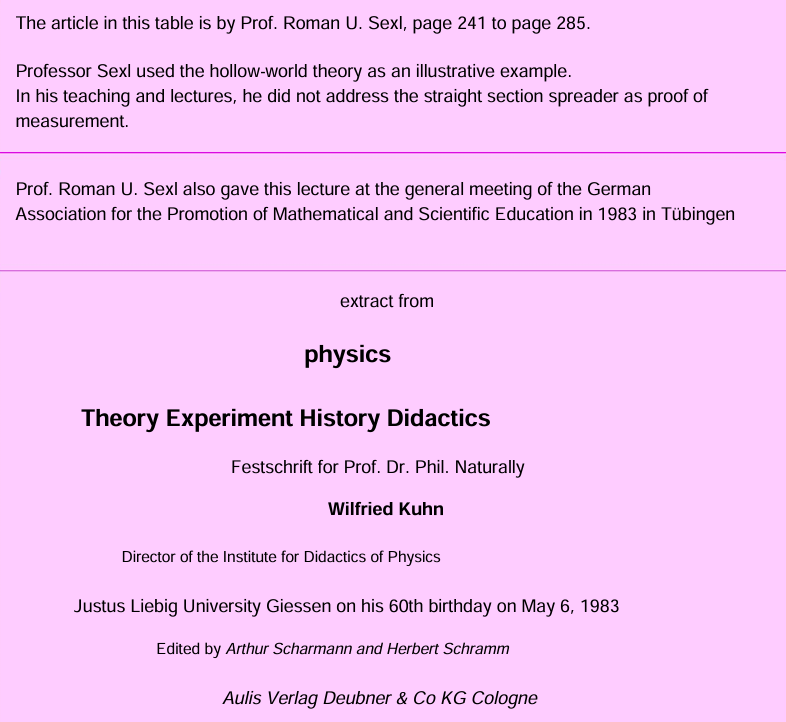
This piece is an excerpt from a broader academic publication tied to physics education and the history/didactics of science. The opening page explains that Prof. Roman U. Sexl used the hollow-world theory as an illustrative example in teaching, especially to explore the relationship between experiment, theory, and worldview. It also explicitly notes that he did not treat the straight-section spreader measurement as proof, which already distinguishes this work from other concave-Earth texts that lean heavily on Morrow-style measurement claims.
The first page also states something crucial: at first glance the hollow-world theory seems absurd and easily dismissed, but the article argues that, if suitable physical laws are assumed, an experimental refutation is in principle impossible. That sentence is the key to the whole essay. This is not a text trying to “prove” the hollow world in the ordinary sense. It is showing why certain forms of theory construction can become empirically slippery, and why that matters for science.
Structure and Content
1. Historical Origins: Teed, Lang, and the Hollow-World Tradition
The essay begins with a concise history of hollow-world theory. It traces one of the main origins to Cyrus Reed Teed in the United States, who in 1870 presented a revelation-based worldview in which the Earth is a hollow sphere and we live on its interior. Inside this world are also found the sun, moon, stars, planets, and comets. The text notes that in Teed’s view the sun itself had two hemispheres, one luminous and one dark, whose rotation explained day and night, while celestial appearances were mediated by reflections rather than direct sight.
Sexl then notes that Teed’s work extended into physics, including optical phenomena and attempts to explain the apparent spherical appearance of the Earth as an illusion. The text also links Teed with religious organization, showing how the hollow-world theory historically crossed boundaries between cosmology, metaphysics, and sectarian belief. Later, the essay moves to Johannes Lang, one of the important German proponents, whose 1938 book is treated as a major source for the more developed German form of the theory.
This historical setup is not just background. It shows that hollow-world theory was not merely a bizarre isolated claim, but a structured alternative worldview with physical, optical, cosmological, and philosophical ambitions.
2. Hollow-World Theory as a Pedagogical Device
One of the most interesting parts of the document is how Sexl uses the theory in teaching. He says he presents the hollow-world model in lectures on space, time, and matter, then asks students to attack it using their physics knowledge. Predictably, they raise common objections: how day and night occur, how gravity works, how the horizon forms, what the space photographs show, what happened in moon flights, how the little sun can produce enough energy, and what lies outside the world.
But Sexl’s point is that these objections do not automatically destroy the theory. If one is willing to appropriately alter the physical laws within the hollow-world framework, many of those objections can be answered. That is the “magic” of the hollow world in this essay: not that it is true, but that it is harder to dismiss rigorously than students first assume. This makes it a powerful teaching tool for exposing naïve assumptions about what counts as proof in physics.
3. Curved Light and the Optical Reconstruction of the World
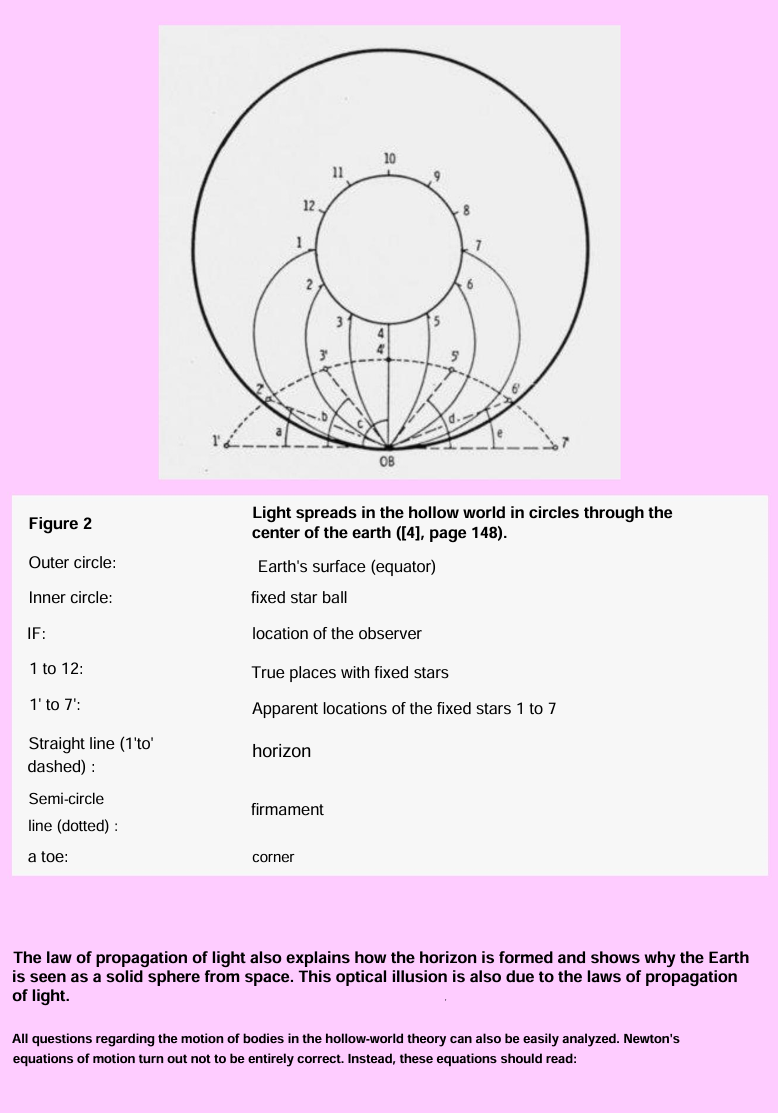
A central technical feature of the reconstructed hollow-world theory is the claim that light propagates in circles through the center of the Earth. The diagram on page 5 is especially important here. It lays out the observer’s position, the apparent and true positions of stars, the horizon, the firmament, and the Earth’s inner surface, all organized by curved light paths rather than straight Euclidean sight lines. The accompanying text says this law of light propagation explains both the formation of the horizon and why the Earth is seen as a solid sphere from space.
This is one of the most recognizable features of mathematically rationalized hollow-world models. Instead of denying ordinary appearances, the theory tries to reproduce them through altered propagation laws. In this case, the celestial sphere, the apparent firmament, and even globe-like visual impressions are treated as optical consequences of curved light. The document therefore takes seriously the need for a full transformation, not just a change in geometry while leaving optics untouched.
4. Reformulating Gravity and Motion
The text then moves to motion and gravitation. It states that Newton’s ordinary equations of motion are no longer sufficient within the hollow-world model and must be replaced by modified equations. On page 6, the document gives transformed expressions for force and related quantities, presenting them as “Lang’s equations of motion” or as laws obtained from the relevant transformation. The point is not to derive them in full for the casual reader, but to show that the hollow-world theory can be given a formal mathematical backbone rather than being left as loose speculation.
Sexl also notes that orbital shapes can, at least in principle, be computed on a computer within this modified scheme and made to correspond to observation. That is critical to the essay’s argument. The theory is not being treated as a vague story; it is being reconstructed as a dynamical alternative capable of fitting celestial motions if one consistently transforms the laws.
5. Shrinking Toward the Center
Perhaps the most memorable mathematical idea in the essay is the claim that objects shrink as they approach the center of the Earth. The document gives a formula relating the size of an object to radial distance from the Earth’s center, so that bodies become progressively smaller toward the interior center. This is then used to answer objections about the moon, astronauts, and spaceflight imagery. A moon that would otherwise seem far too small can still appear plausible if both the moon and the observers or instruments are subject to the same scale transformation.
Sexl uses this to show how powerful such a theory can be when it is allowed to alter not only geometry but also scales, atomic dimensions, light speed, and force laws. What first looked like an absurdity now becomes internally manageable. This does not mean the theory is true, but it does mean the easy dismissals fail unless one identifies deeper scientific criteria.
6. The Bible and Fritz Braun’s Transformation of Reciprocal Rays
The essay also connects to Fritz Braun’s Biblical hollow-world work, especially the idea that the contradictions between a literal Biblical cosmos and modern astronomy can be removed through a transformation of mutual or reciprocal rays. Sexl summarizes Braun’s claim that the Copernican worldview can be transformed into a world corresponding to the Bible’s three-tiered universe, while preserving the model-like laws of Kepler and Newton.
This is highly relevant for concave-Earth readers because it shows the bridge between older hollow-world physics and explicitly Biblical inner-world cosmologies. In Braun’s formulation, the transformation turns straight Copernican rays into curved ones, shrinks the immense distances of astronomy, and re-centers heaven as the throne of God. Sexl presents this as part of the broader rational reconstruction of alternative worldviews.
7. Theory Equivalence and the Problem of Experimental Refutation
This is the real heart of the essay. Once the transformation is carried out consistently, Sexl says the hollow world appears as a mathematically equivalent form of the conventional worldview. If one worldview can be converted into the other, and if the old worldview was experimentally irrefutable in a certain sense, then the transformed one is too. The document explicitly states that the same experiments that support the conventional worldview now also support the hollow-world theory, once everything has been transformed appropriately.
That is what destabilizes the students. Their empirical training tells them that experiments settle things. But Sexl is showing that this is not always straightforward. If a rival theory can absorb the evidence by redefining scale, light, and force laws, then experiment alone may not decide between frameworks. This pushes the discussion from laboratory empiricism into the territory of scientific theory choice.
8. Why the Standard Worldview Is Still Preferred
Sexl does not leave the matter there. He asks what reasons remain for preferring the standard Copernican framework once simplistic experimental refutations have been ruled out. According to the text, the usual arguments students raise are:
a) Simplicity
b) Clarity
c) Freedom of choice / arbitrariness concerns
He then examines these in turn. Simplicity matters, because the transformed hollow-world laws are more complicated than Newtonian ones. But he notes that simplicity arguments are not always decisive, since physics has often preferred more complex theories, such as relativity, when they better organize the facts. Clarity also matters: the standard theory aligns more directly with ordinary theoretical interpretation, whereas the hollow world relies on a more contrived reformulation. Yet even clarity is not absolute, because what seems “clear” often depends on prior theory. The apparent size and nature of the sun, for example, are themselves theory-laden.
Finally, there is the issue of arbitrariness. If one can invent a hollow-world transform, could one not also invent a hollow-moon theory or a flat-earth transformation? This exposes the danger of unlimited reformulation. Once too much freedom is allowed, one can generate many worlds fitting the same evidence. So the issue becomes not mere compatibility with experiment, but the quality and discipline of the theoretical structure.
9. Popper, Falsifiability, and Symmetry Groups
The last major section is the most academically substantial. Sexl brings in Popper’s philosophy of science and argues that the superiority of the standard worldview lies in falsifiability. The hollow-world theory, because it lacks the same spatial symmetry assumptions, can accommodate almost any height dependence or variation in experimental results. The Copernican worldview, by contrast, builds in homogeneity and isotropy of space. That means its predictions are more constrained, and thus easier to falsify.
This leads to one of the strongest ideas in the paper: symmetry groups are fundamental. Theories with richer invariance groups make stricter predictions and therefore expose themselves more sharply to failure. Sexl then draws an analogy with the historical replacement of ether theory by relativity. Ether theory could often be patched to survive negative results, while relativity, with its stronger symmetry structure, made bolder, more unified, and more falsifiable claims. In the same way, hollow-world theory resembles a more weakly constrained framework, whereas standard physics derives strength from the tightness of its invariances.
This is the deepest scientific point in the document. The preference for mainstream physics is not reduced to mockery of alternative worldviews, nor to blind appeal to authority. It is grounded in the epistemological idea that better theories are not merely those that fit facts, but those that do so with greater structure, less arbitrariness, and greater vulnerability to disproof.
Key Themes and Insights
- The hollow world as a teaching instrument: Sexl uses it to reveal what students often misunderstand about theory, evidence, and proof in physics.
- Experimental irrefutability is not enough: A theory can be very hard to refute and still be scientifically weaker than a rival.
- Curved light is essential: The theory must consistently transform optics, not just geometry, to preserve appearances. The page 5 diagram is central here.
- Modified dynamics matter: Gravity, motion, scale, and even atomic size are reformulated within the hollow-world framework.
- Braun’s reciprocal-ray transformation appears as a bridge: This connects hollow-world geometry with Biblical three-tiered cosmology.
- The real issue is scientific method: Why choose one empirically adaptable theory over another? Sexl answers through simplicity, structure, and falsifiability.
- Symmetry groups are decisive: The richer invariance structure of standard physics gives it greater predictive discipline and greater falsifiability.
- Historical analogy with ether vs relativity: Hollow-world theory is treated as analogous to patchable alternative systems that are harder to falsify but theoretically weaker.
Section-by-Section Summary
Opening Framing
The first page situates the text in an academic setting and states the main thesis: hollow-world theory seems absurd, but if one starts from suitable basic laws, experimental refutation becomes impossible in principle. Already the essay is less about cosmology itself than about the status of physical theories.
Historical Background
Pages 2–3 summarize the development of hollow-world thought from Teed to Lang, noting both the physical claims and the worldview ambitions. The diagrams and quotations show that this was presented as a unified explanation of nature, not just a geometric novelty.
Student Objections and Rational Reconstruction
Page 4 introduces the recurring questions students ask. From there, Sexl shows how the reconstructed hollow-world theory can answer them by changing the propagation of light, the laws of motion, and the scale of objects.
Optical and Dynamical Reformulation
Pages 5–7 are the most technically important. They present the curved-light diagram, transformed force and scale laws, and the Braun-style reciprocal-ray transformation that maps standard cosmology into a Biblical hollow-world form.
Scientific-Theoretical Critique
Pages 8–11 move into philosophy of science. The discussion shifts from “Can the hollow world mimic the evidence?” to “Why is the standard theory still superior?” Here the key answers are simplicity, clarity, arbitrariness constraints, symmetry, and falsifiability.
Final Notes
The closing page reinforces that this kind of case study has real didactic value. It forces physics, didactics, history, and philosophy of science into one frame. That is why the hollow-world example continues to be useful: it is not merely a curiosity, but a way of clarifying the foundations of theory choice itself.
Why This Document Matters in Concave Earth Literature
This text matters because it is one of the more intellectually serious pieces adjacent to concave-Earth and hollow-world literature. It does not simply repeat the worldview from within. It examines it from the outside, but respectfully enough to show where the real philosophical pressure points are. That makes it especially useful for readers who want something beyond slogans, diagrams, and claims of visual proof.
It is also important because it helps separate two different questions that are often blurred together:
- Can a hollow-world or concave-world model be made to imitate the appearances?
- Would that make it scientifically preferable?
Sexl’s answer is essentially that the first question can be answered more positively than many people assume, but the second is where the real contest begins. And that contest is decided not by crude ridicule, but by deeper criteria of theory structure and scientific method.
Conclusion
Roman U. Sexl’s essay is one of the most useful short academic texts for anyone studying hollow-world or concave-Earth thought from a serious angle. It does not function as straightforward advocacy, yet it takes the theory seriously enough to reconstruct it mathematically and philosophically. That is exactly what makes it valuable. It shows how an alternative cosmology can be made resilient, how experiments alone may fail to settle everything, and why science still needs higher criteria such as symmetry, simplicity, and falsifiability to choose between competing descriptions of the world.
For a concave-Earth forum, this document is worth posting because it expands the conversation beyond “proof” and “disproof.” It opens the door to a more mature discussion about the nature of models, the limits of experiment, and the philosophical reasons some cosmologies survive while others remain endlessly adaptable alternatives.