This thread is a work in progress, an exploration of an idea and to merge to ideas. I’ll put resources here, more and more as I explore this topic.
IHCcosmology
https://www.reddit.com/r/IHCcosmology/ –
https://zenodo.org/records/19654546
Other
https://www.researchgate.net/publication/351755104_Unconventional_reconciliation_path_for_quantum_mechanics_and_general_relativity –
https://www.youtube.com/playlist?list=PLdneLCf9vDMADQtpk8OXwZkqcAuOsXGlC –
Translating Concave Earth Geometry into an IHC / RP⁴ Hypersphere Framework

I want to explore a bridge between two different visual languages:
The concave Earth model(below), where Earth is represented as the outer inhabited inner-shell, with the atmosphere, Van Allen belts, orbitals, solar paths, and celestial regions arranged inside the sphere.
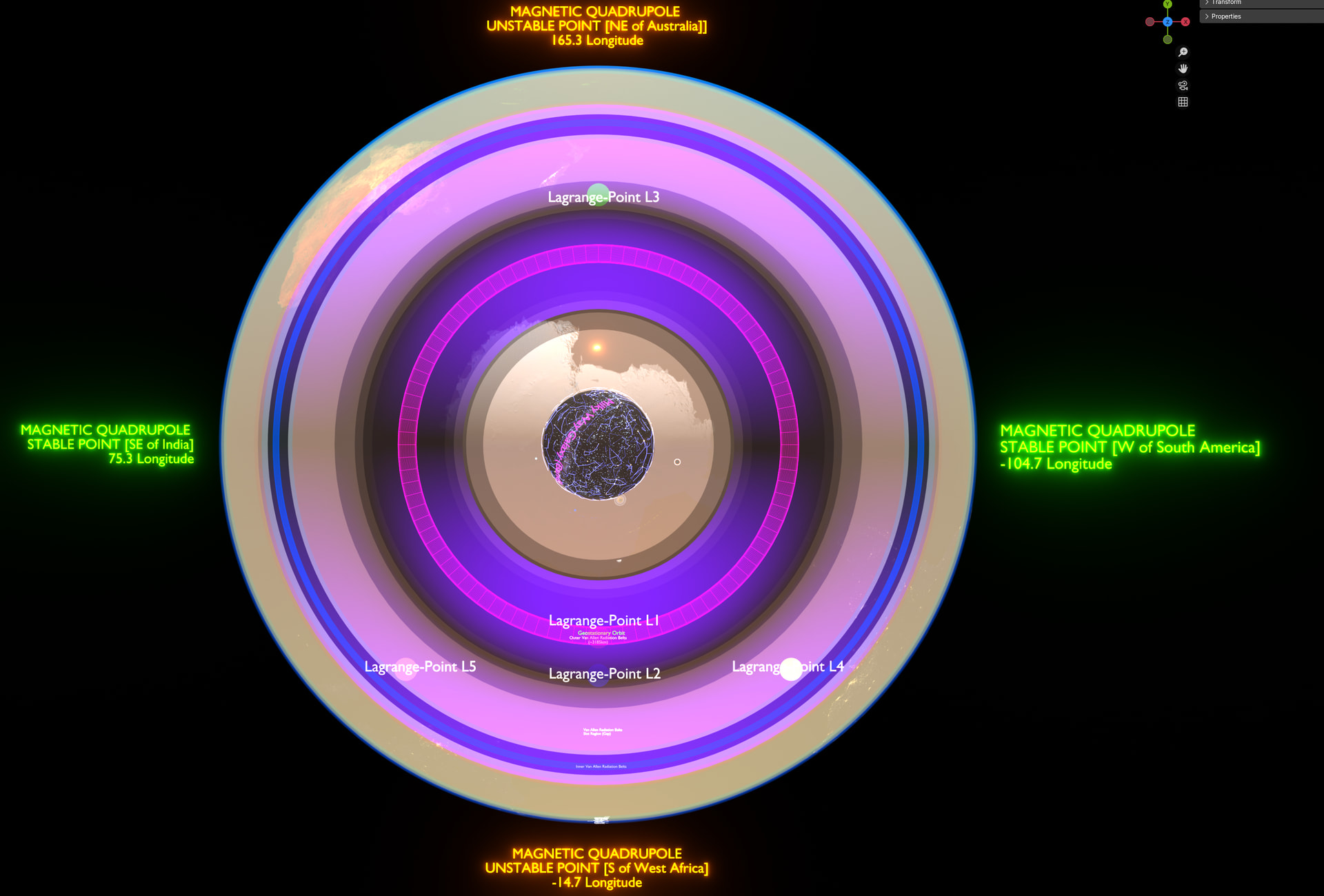
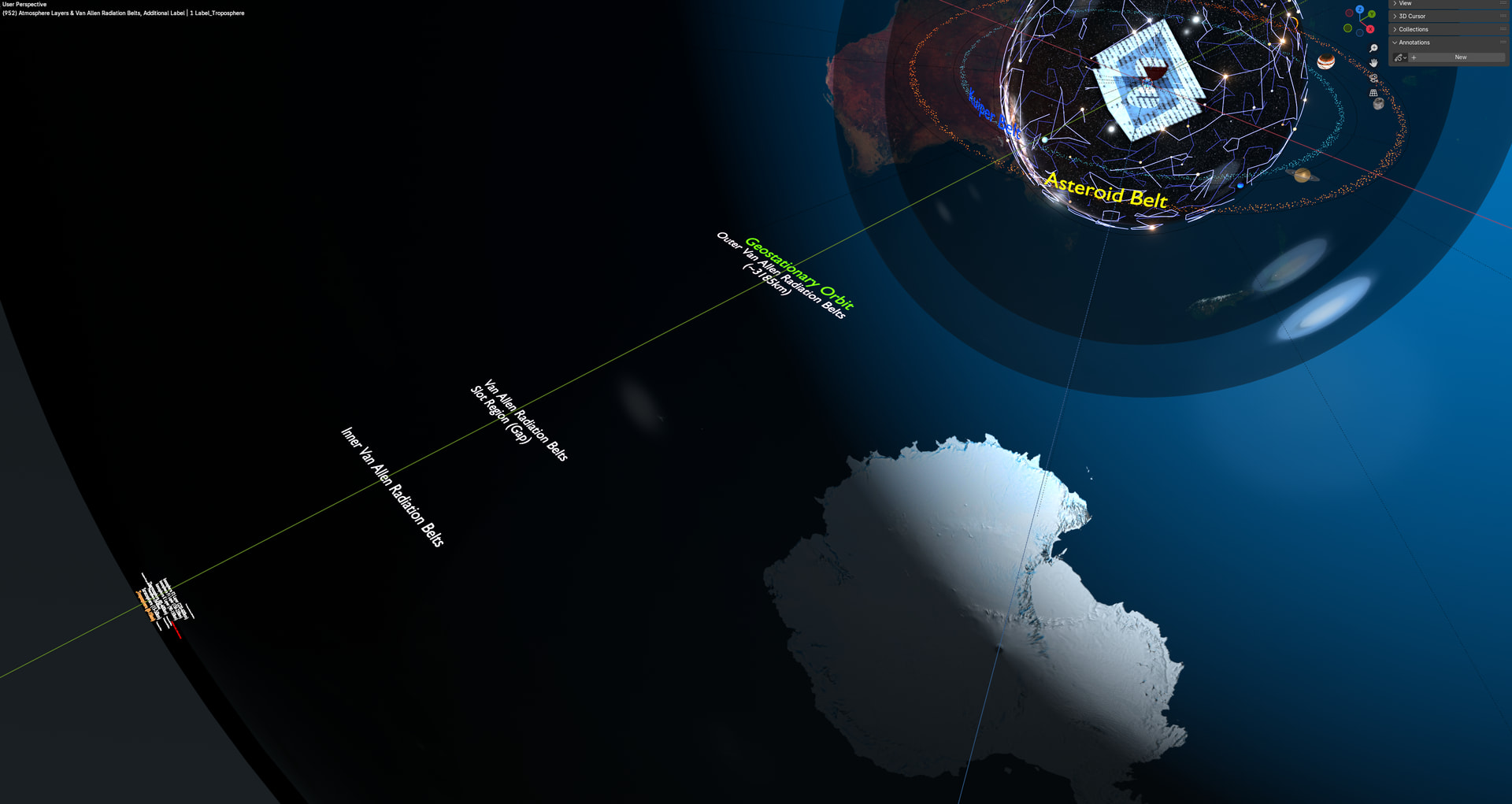
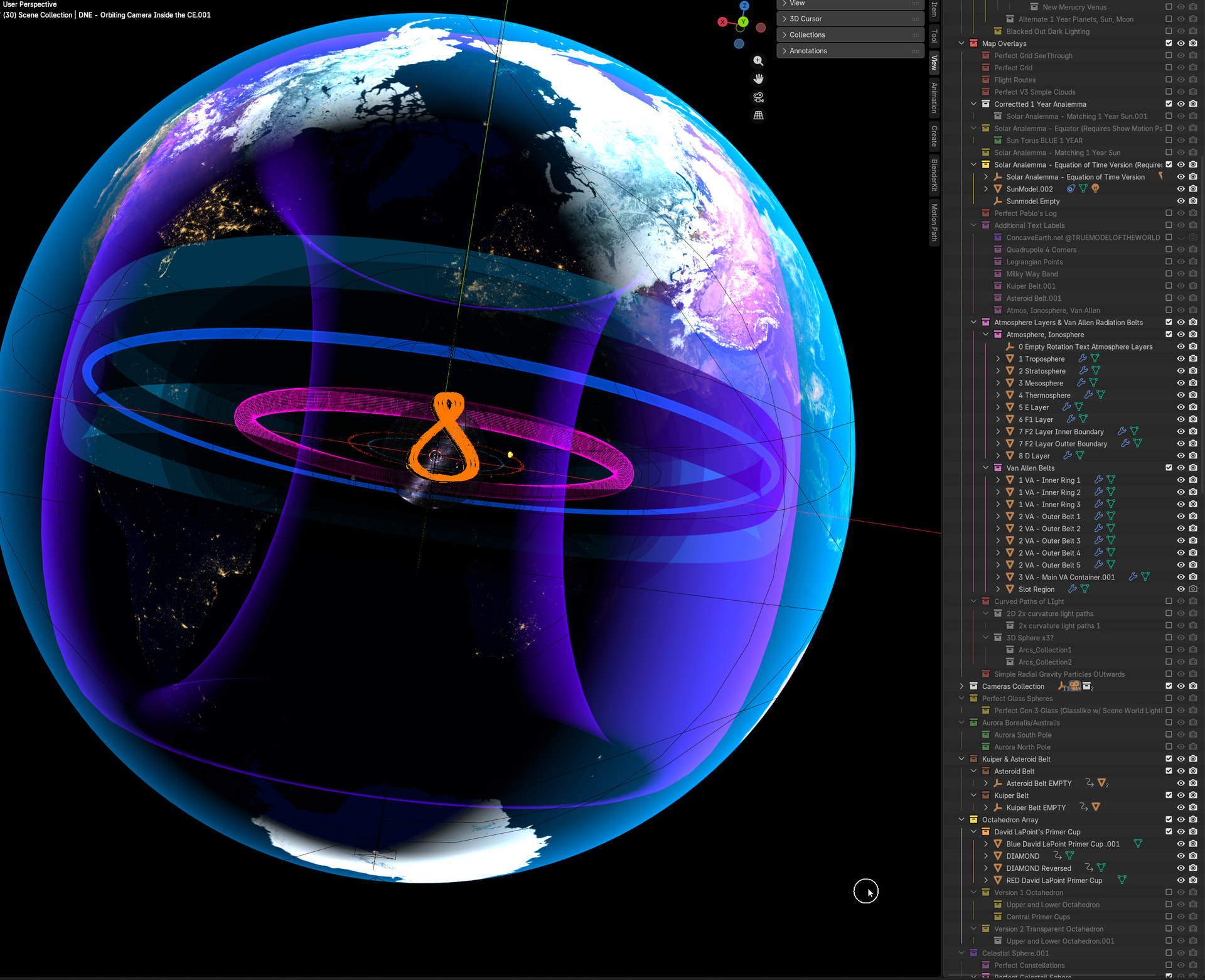
The IHC / RP⁴ hypersphere model(Below), where the universe is described as a higher-dimensional projective geometry:
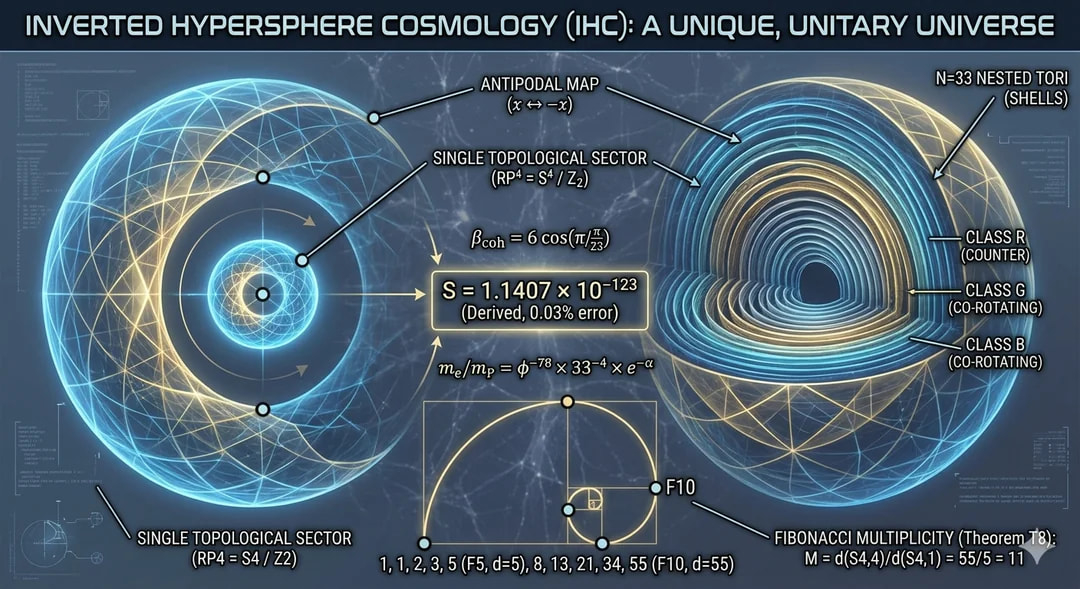
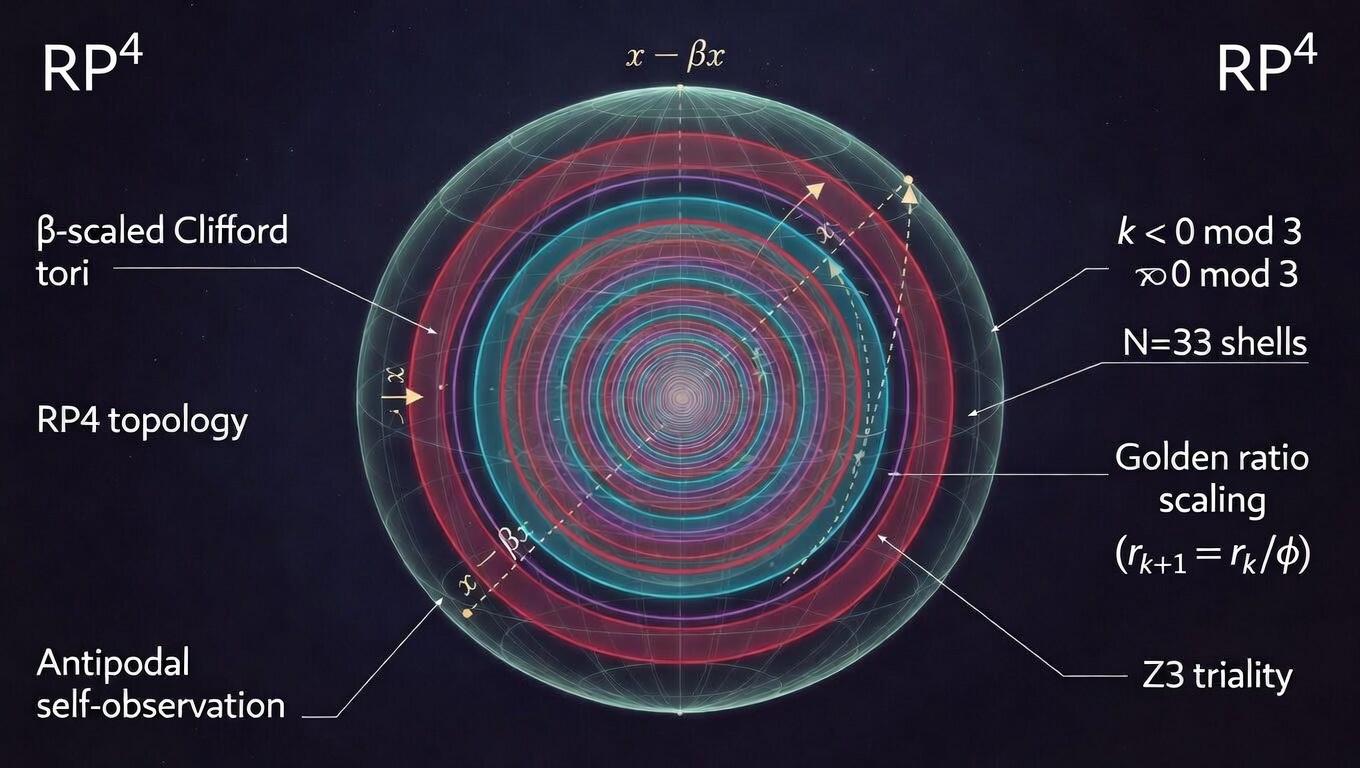
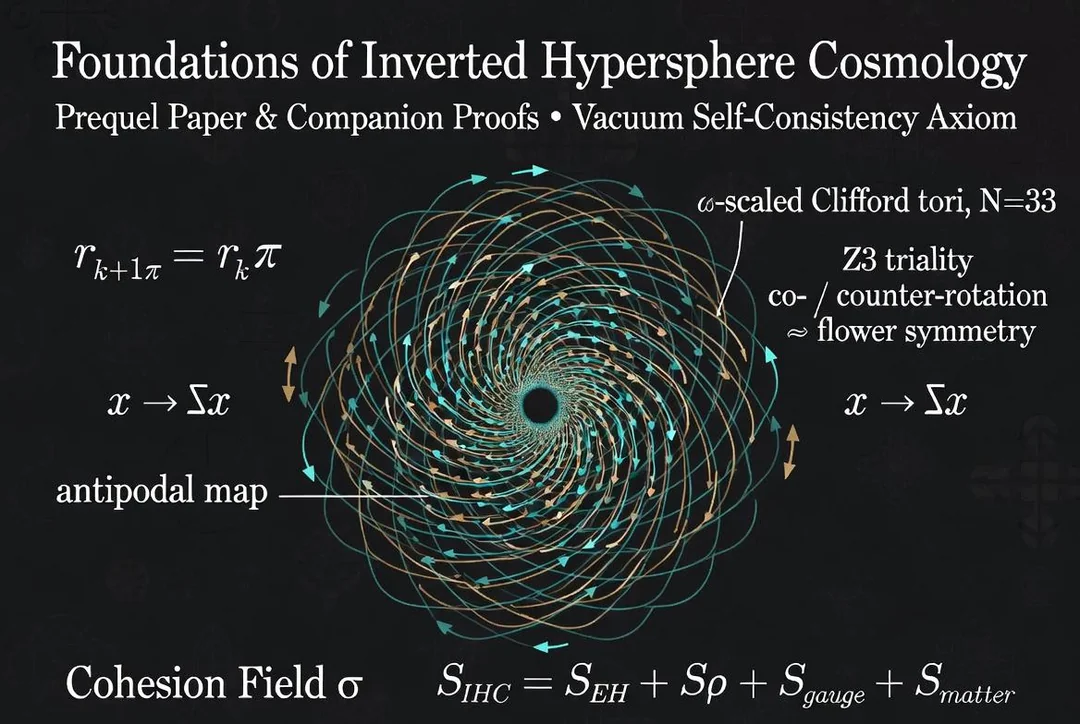
with antipodal point identification:
The purpose here is not to say “IHC proves concave Earth” or “concave Earth proves IHC.” Rather, the goal is to ask whether the geometry-language of concave Earth — inner shell, central celestial region, nested belts, orbital bands, radiation shells, analemma structures, and interior observer space — can be reinterpreted as a local projected chart of a larger IHC / RP^4 hypersphere framework.
In other words:
In a normal concave-Earth model, the Earth shell is treated as the boundary of the whole cosmos.
In an IHC-style translation, that same concave-Earth shell could instead be treated as one observer-centered projection surface inside a larger higher-dimensional projective geometry.
This opens up a much richer interpretation.
The concave Earth visual language may still be useful, but the outer shell does not necessarily have to be the final absolute boundary of all existence. It could instead be the boundary of a local observational projection.
The Core Mapping
In a typical concave-Earth diagram, we have something like:
In the IHC / RP^4 model, the universe is described as a four-sphere with antipodal identification:
or more explicitly:
This means each point on the four-sphere is identified with its opposite point. The antipodal pairing is not merely an added force or mechanism. It is the topology itself.
The IHC-style structure also involves 33 nested Clifford/Hopf-like torus shells, golden-ratio scaling, and three groups of 11 shells, with one group counter-rotating.
So the translation becomes:
| Concave Earth diagram element | IHC-style reinterpretation |
|---|---|
| Outer Earth shell / inner surface | Local observer horizon or projection boundary |
| Central celestial sphere | Projection caustic / inner focal region / self-observation core |
| Van Allen belts, atmosphere, orbit bands | Local lower-dimensional shadows of higher-dimensional shell harmonics |
| Sun analemma and solar path | Local slice through rotating shell families |
| Asteroid / Kuiper belts | Not necessarily literal central belts, but phase-orbital bands inside the observer chart |
| “Inside the Earth” cosmos | A 3D projective chart of a higher-dimensional RP^4 manifold |
| Earth as cosmic boundary | Replaced by Earth as one inhabited shell/chart among possible shell charts |
| Upward refraction / curved light | Projection rule, metric curvature, or mapping from higher-dimensional geometry into local observation |
This means the concave Earth model can be reimagined as a local coordinate patch.
Not the whole master object.
A patch.
A projected “room” inside the larger RP^4 architecture.
The Biggest Conceptual Upgrade
The normal concave-Earth picture says:
We live on the inside wall of the cosmic sphere.
The IHC-translated version could say:
We experience reality as an inside-wall projection because our local observational chart maps the higher-dimensional manifold onto an inward-facing shell.
That is a major difference.
In the first version, Earth is physically the ultimate boundary.
In the second version, Earth is the boundary of our observational projection, but not necessarily the boundary of all existence.
This opens up an alternative possibility:
Maybe our Earth-shell is not the special place or final boundary of the cosmos, but one of many projection shells or inhabited observational charts inside a hyperdimensional setup.
That may be the cleanest bridge between concave Earth visual language and the IHC theory.
Three Nested Realities
The merged model can be imagined as three nested levels.
1. The Local Concave Earth Chart
This is the ordinary concave-Earth visual model.
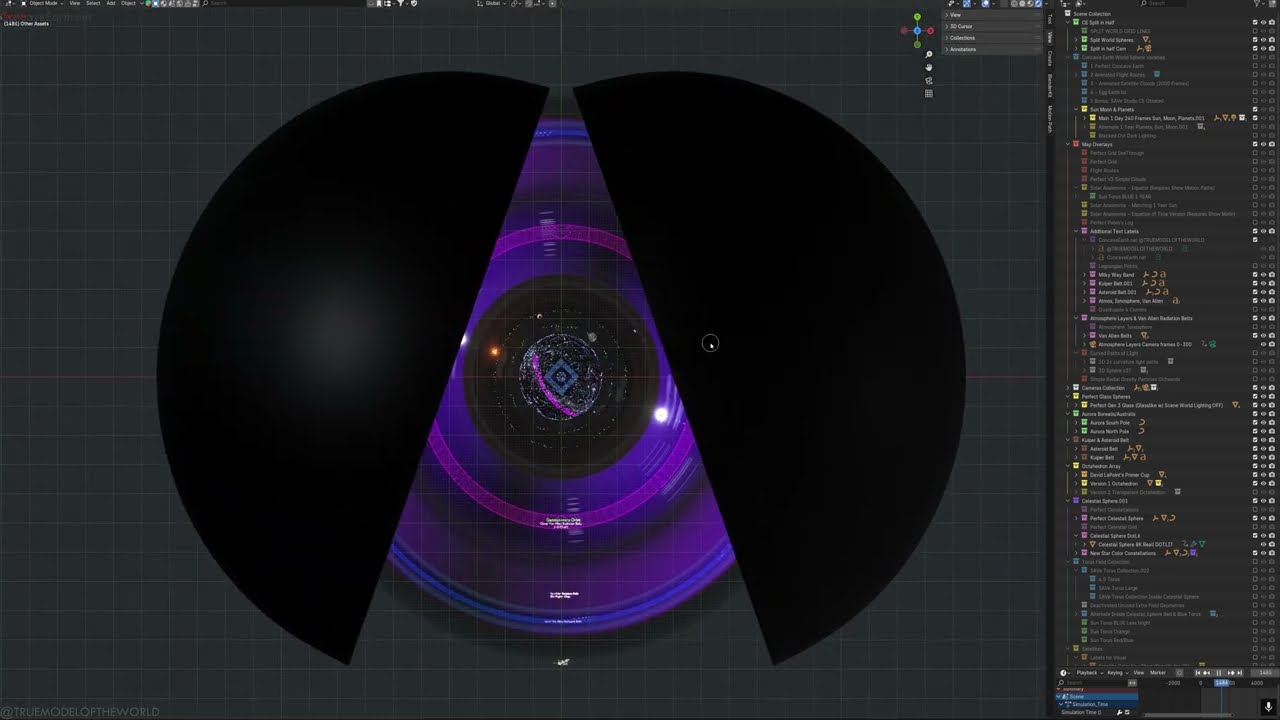
It includes:
- the outer Earth shell,
- continents and oceans on the inner surface,
- atmosphere layers,
- Van Allen belts,
- geostationary regions,
- solar analemma,
- lunar path,
- planetary bands,
- asteroid belt,
- Kuiper belt,
- central celestial region.
This is the observer’s apparent cosmos.
It is what an internal observer sees when higher-dimensional relations are projected into their local world.
2. The Shell-Harmonic Layer
Behind or through the concave-Earth chart, we can imagine the IHC 33-shell structure.
But these should not be understood as simple rings. They are more like transparent phase-shells passing through the concave-Earth interior. Some would intersect the local CE region as belts, arcs, or luminous caustics.
In this interpretation:
The IHC model describes 33 shells divided into three groups of 11:
These three shell families can be interpreted visually as triality families.
Two families co-rotate, while one counter-rotates.
So in the merged model, we could translate the three families like this:
| IHC family | Concave Earth visual translation |
|---|---|
| Family A, co-rotating | Solar / ecliptic order, daylight cycle, ordinary orbital progression |
| Family B, co-rotating | Lunar / planetary resonance layer, secondary orbital harmonics |
| Family C, counter-rotating | Retrograde, precessional, analemma, seasonal counter-structure |
The third counter-rotating family is especially important.
In a CE visualization, this could become the geometric reason the system is not merely static nested spheres. It creates twist, precession, analemma asymmetry, retrograde loops, and time evolution.
3. The Master RP⁴ Manifold
Outside the local CE chart — not outside in ordinary space, but outside in conceptual hierarchy — we have the higher-dimensional master geometry.
This is the RP^4 projection atlas.
The concave-Earth sphere would be only one glowing cell, one local patch, or one observer bubble.
Its antipodal partner would also exist:
The local Earth-chart does not stand alone. It has a hidden mirror-chart, antipodal to it — not as another ordinary planet in space, but as its projective counterpart.
Translating the Main Concave Earth Regions
Here is how the major concave Earth regions might translate into the IHC-style language.
Earth Inner Surface
In the classical concave-Earth model, this is the actual physical ground at the inner shell.
In the IHC translation, this becomes:
It is the surface where local sensory physics stabilizes.
It is not necessarily the ultimate edge of the universe. It is the “screen” where the higher-dimensional projection becomes inhabitable, stable, and metric-like.
Atmosphere Layers
Atmosphere layers become the first local metric layers above the observer-boundary.
They remain physical atmosphere in the local chart, but geometrically they also act like gradually changing refractive or projective layers.
This fits well with concave-Earth thinking, where atmospheric refraction, curved light, and inner-shell observational effects are central.
Van Allen Belts
The Van Allen belts become electromagnetic resonance belts, not merely radiation zones.
In the merged model, they could be where the local CE chart begins visibly expressing the global shell harmonics.
They form a bridge between ordinary geophysics and the higher-dimensional shell system.
Geostationary Orbit Region
The geostationary orbit region becomes an equilibrium shell.
In the CE model, geostationary orbit is placed at a meaningful internal radius.
In an IHC translation, it could be treated as a stable phase layer: a place where ordinary orbital motion and shell-harmonic motion balance.
Solar Analemma
This may be one of the strongest bridges.
In a normal CE model, the analemma is the path of the Sun inside the sphere.
In the IHC translation, the analemma becomes a local trace of a higher-dimensional rotating torus family.
The Sun’s figure-eight motion would not merely be a path through 3D space. It could be the projection of two coupled angular coordinates:
This fits Clifford/Hopf torus thinking very naturally, because a Hopf or Clifford torus is described by two simultaneous circular motions.
So the analemma could be interpreted as:
rather than simply a 3D curve inside a hollow sphere.
Planetary Orbitals
In a simple CE model, planetary paths are nested bands around the central region.
In the IHC translation, planets become local phase-locked paths on torus-shell cross-sections.
They do not need to be interpreted crudely as “small balls orbiting inside a hollow Earth cavity.”
Instead:
not merely:
The visual may still look like orbital rings, but the interpretation changes. The orbit becomes a lower-dimensional projection of a higher-dimensional periodic structure.
Central Celestial Sphere
This may be the most important translation point.
In the CE model, the central celestial sphere is where stars, planets, lights, or celestial mechanisms appear concentrated.
In the IHC translation, the central sphere is not necessarily a physical ball of stars.
It becomes the projection caustic.
A caustic is where many lines, rays, or projected relations concentrate into a bright, dense, or structured region.
So the central celestial region could be interpreted as:
Stars could then be interpreted as:
not necessarily little suns pasted onto a literal inner ball.
This would explain why the center region feels “special” in CE diagrams without requiring it to be the absolute center of the universe.
Concave Earth as a Projection Domain
A powerful way to think about this is to compare the CE sphere to something like a Poincaré ball model.
In hyperbolic geometry, the boundary of the ball is not an ordinary wall in Euclidean space. It is a projection boundary. Distances distort as one approaches it. Lines curve. The visual model is finite, but the geometry being represented is not simply finite in the naive way.
Likewise, the CE shell could be interpreted as a finite visual container for a non-Euclidean or higher-dimensional manifold.
This could solve one of the weaknesses of standard CE visuals:
they often look like a literal Euclidean snow globe.
The upgraded interpretation would say:
The sphere is not necessarily a literal Euclidean container. It is a projection domain. The apparent “inside” geometry is how a higher-dimensional projective manifold appears from an observer chart.
That is the bridge.
The “Earth Is One of Many” Version
This framework allows two possible versions.
Version 1 — Classical Concave Earth Translation
In this version:
Earth is the outer inhabited boundary.
Everything else is interior.
This keeps the standard CE emotional and visual framework.
Version 2 — IHC-Compatible Concave Earth Chart
In this version:
Earth is one observer shell or chart inside a larger RP^4 manifold.
There may be many such charts:
Each chart may have:
- its own apparent inner sky,
- its own central celestial projection,
- its own shell, belt, and orbital mapping,
- its own antipodal partner,
- and its own relation to the 33-shell master harmonic lattice.
In this version, our Earth is not the universe’s final boundary.
It is the stabilized boundary of our local observational manifold.
That allows us to imagine worlds not merely as planets floating in space, but as projection interiors:
This connects with the idea that planets, stars, or worlds may appear convex from one viewpoint, while from another higher-dimensional or projective viewpoint they may function more like interior domains, portals, or spatial charts.
A Mental Model of the Fusion
Picture a master RP^4 object.
It cannot be directly seen in 3D.
Inside it are 33 golden-ratio shell harmonics:
or equivalently:
Those shell harmonics rotate in three triality families:
A local observer does not see the full RP^4.
The observer sees a projected interior sphere.
That projected interior sphere is what we call the concave-Earth chart.
The outer wall of that local sphere is the inhabited world-surface.
The center is the celestial caustic.
The Sun, Moon, planets, and stars are not necessarily ordinary objects placed inside a hollow cavity. They are projected stable loci where the master shell-harmonics intersect the observer’s chart.
The antipodal partner of every local thing exists, but not as a simple opposite point in the room. It is paired through the master RP^4 quotient:
So every “here” has a hidden “there,” and every local scale may have a cosmic-scale partner.
Why This Matters Visually
The next visualization should not merely put IHC rings inside a concave-Earth sphere.
That would still be primitive.
A better merged visualization should show three coordinate systems at once:
| Layer | What the viewer sees |
|---|---|
| Local CE coordinates | Earth shell, atmosphere, belts, analemma, planet bands |
| Projection geometry | Curved light paths, caustic center, distorted metric grids |
| Master IHC coordinates | 33 shell lattice, Z_3 triality, antipodal partner beams, Hopf/Clifford phase paths |
Then there should be a conceptual toggle:
Classical CE Mode
IHC Chart Mode
This toggle is the conceptual breakthrough.
It lets us visually ask:
Is concave Earth a literal final container, or is it the local observer-chart shape of a deeper projective cosmology?
That is the question these geometries seem to point toward.
