source: https://wizard.gen.nz/ideas/turning-the-universe-inside-out/ –
Turning the Universe Inside-Out: The Geoperipheral Model, Inversion Geometry, and the Return of a Cosmic Centre
Images from the Document
Download the Document
the-inside-out-universe.pdf (343.0 KB)
Overview
This document is one of the more unusual and ambitious texts in the broader concave-Earth / geoperipheral literature. It is not written like a conventional scientific paper, nor like a simple religious tract. Instead, it is a hybrid work: part cosmological proposal, part philosophical critique of modern science, part metaphysical manifesto, and part cultural argument for adopting a new frame of reference for humanity. Its central idea is that the universe can be “turned inside-out” through conformal inversion geometry, producing a model in which we live not on the outside of a globe in outer space, but on the inside surface of a spherical biosphere, with the sun, moon, planets, and distant galaxies arranged in the inner space above us.
What makes the text distinctive is that it does not present this merely as a geometrical curiosity. The author argues that modern physics, especially through increasingly general symmetry principles and conformal transformations, has already moved toward a mathematical setting in which such inversions can be entertained. In that sense, the inside-out universe is presented not simply as a fantasy, but as a valid transformed model arising from the same kind of mathematical reasoning already present in modern theoretical physics.
But the document does not stop there. Its deeper concern is with what happens when cosmology loses its centre. The author argues that Newtonian and Einsteinian science attempted to erase the old metaphysical centre of the world, replacing it first with absolute frames and later with abstract equations and singularities. The geoperipheral model is therefore offered not only as an inversion of space, but as a way of restoring a central singularity, a cosmic “highest point,” and even a renewed location for something like heaven. The document is thus as much about the reunification of physics and metaphysics as it is about inversion geometry itself.
This gives the work a very unusual tone. In one moment it is discussing singularities, conformal invariance, and coordinate transformation; in the next, it is criticizing the military-industrial capture of science, attacking reductionism and materialism, and arguing that modern humanity needs a new post-modern cosmology capable of reintegrating biology, culture, symbolism, teleology, and transcendence. So although the inside-out universe is the formal subject of the piece, the real project is much larger: it is an attempt to build a new worldview on top of a transformed physical model.
Structure and Content
1. Science, Generality, and the Problem of Singularities
The document opens with a broad philosophical critique of the scientific enterprise. It argues that since the Renaissance, science has been driven by a quest for complete generality in the laws of nature. Physical reality was increasingly reduced to differential equations meant to apply universally, while singularities and exceptions were treated as embarrassing residues to be excluded or dismissed as “unphysical.” The author sees this as more than a technical move: it reflects a desire to explain and therefore control everything.
This critique sets up the rest of the essay. Rather than seeing modern physics as a triumphant elimination of metaphysical singularities, the author argues that singularities never disappeared. They simply changed form. Newton had his absolute frame, vaguely linked to the “Mind of God.” Einstein replaced that with other absolutes, especially the invariant speed of light, and general relativity reintroduced cosmological singularities in the form of the big bang. So the text’s first move is to claim that modern science never truly escaped singularity or metaphysics—it only concealed them under more sophisticated language.
2. From Newton and Einstein to the Almighty Equation
A recurring theme of the document is that the attempt to make physical laws more and more universal ends up making the laws themselves more singular and absolute. The text memorably says that “Almighty God” is replaced by the “almighty equation.” In other words, the medieval divine singularity is not abolished but displaced into mathematical formalism.
This is important because it frames the inside-out universe as a response to a philosophical problem in science. If modern cosmology still depends on hidden singularities and privileged structures, then perhaps a different geometry—one that makes the centre explicit again—could produce a more satisfying worldview. The argument here is not that inversion geometry proves an inner-world cosmos in a narrow empirical sense, but that it reveals how contingent and metaphysically loaded the modern cosmological picture already is.
3. The Inside-Out Model of the Universe
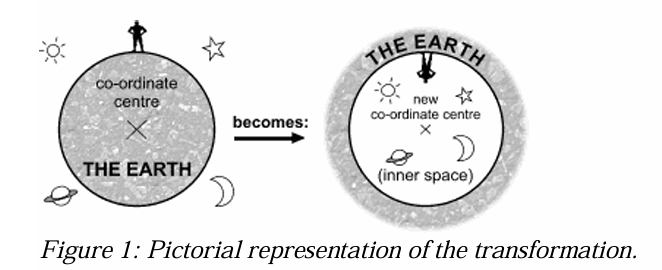
The central proposal appears early and clearly: begin with a standard frame of reference—here chosen as a geocentric one centered on Earth—and then apply inversion geometry, a conformal transformation in which distance scales vary but angles remain unchanged. The result is a universe turned “inside out.” In this new geoperipheral model, we live on the inside of a spherical shell, the Earth’s biosphere, while the sun, moon, planets, galaxies, and the rest of the cosmos are located in the inner space above us.
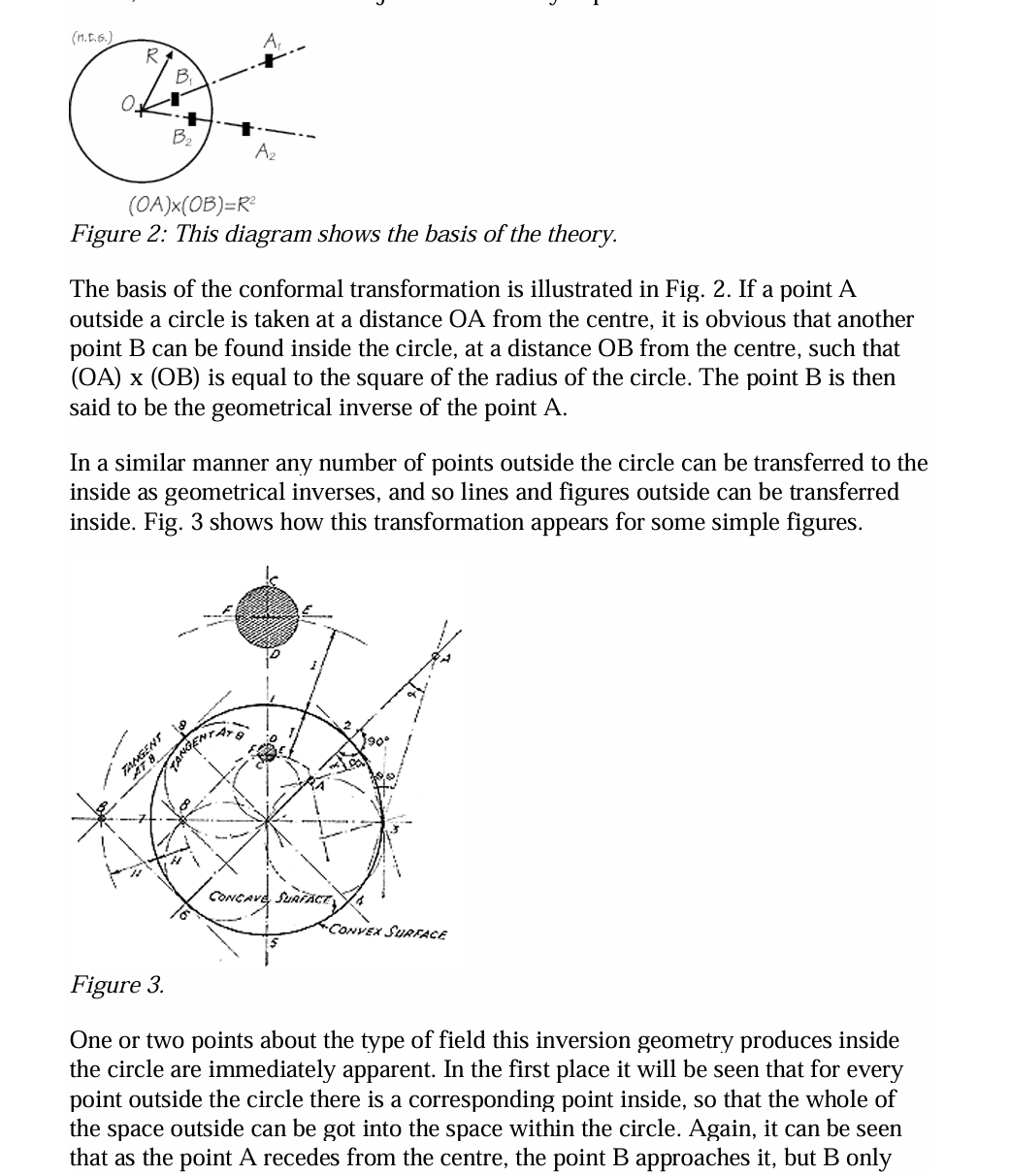
The text is careful to emphasize that inversion geometry maps points outside a circle to points inside it through the relation shown in Figure 2 on page 4: if point A lies outside at distance OA, then point B inside is chosen so that the product of the two distances equals the square of the radius. This geometric inverse relation is the formal basis of the whole model. The page 4 diagram is central because it shows that the transformation is not arbitrary imagery but a definite mapping rule.
4. Vision, Horizon, and the Preservation of Angles
A major part of the argument is optical. The text explains that when lines of sight outside the circle are transferred inward, their apparent directions relative to an observer’s horizon are preserved. That means an observer on the inside can see the inverse of an object at the same angular elevation that an external observer would see in the standard picture. This is a key claim, because it is used to answer the immediate objections that always arise when someone first hears of an inside-out cosmos.
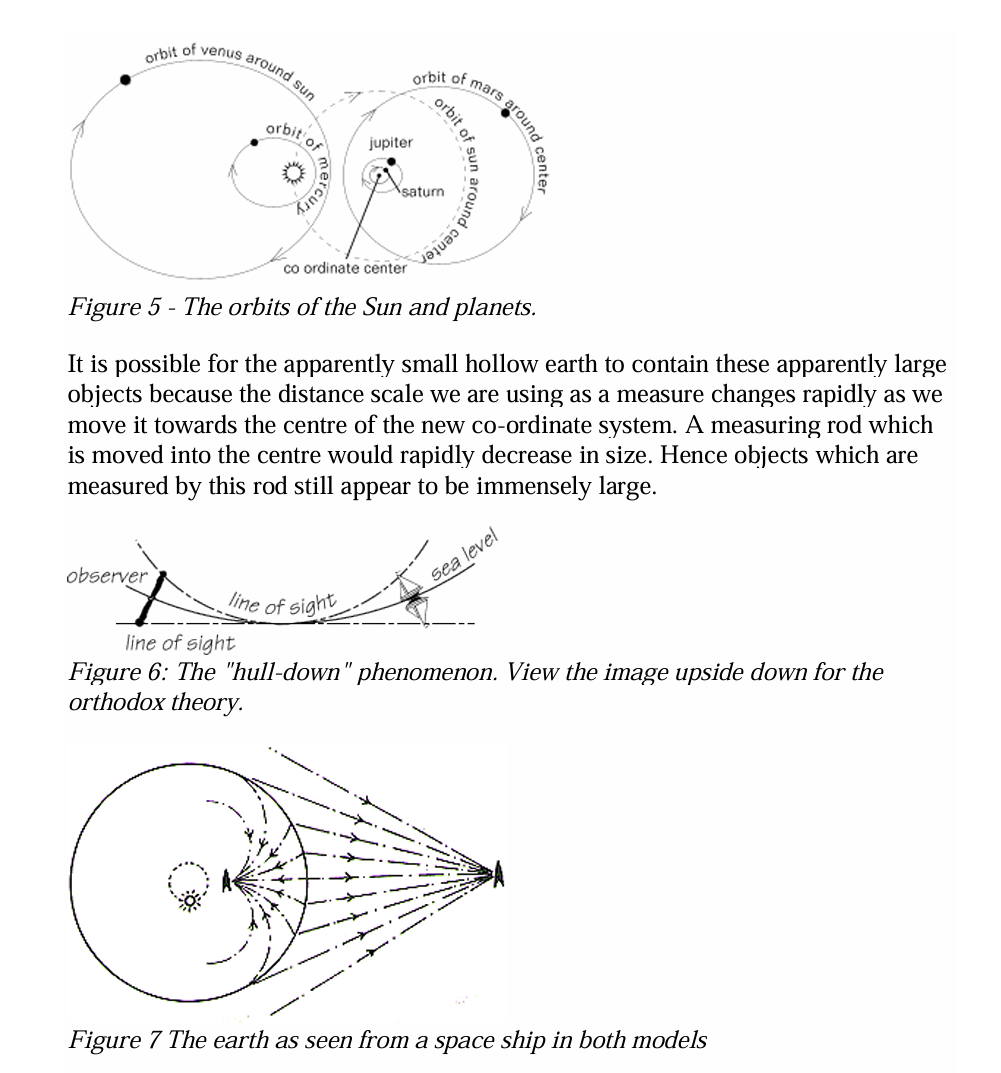
The document explicitly mentions several of these objections: the ship disappearing hull-down over the horizon, the inability to see from New Zealand to Spain, the shape of Earth’s shadow on the moon, and the problem of the sun and stars being located “inside” without burning us up. The author insists that these and many other objections are “easily explained” in the new model once the inversion and its optical consequences are properly understood. Figures 6 and 7 later in the document are especially important here: figure 6 addresses the hull-down phenomenon, and figure 7 compares the appearance of Earth from a spaceship in both models.
5. Day, Night, and Planetary Arrangement in the Geoperipheral Universe
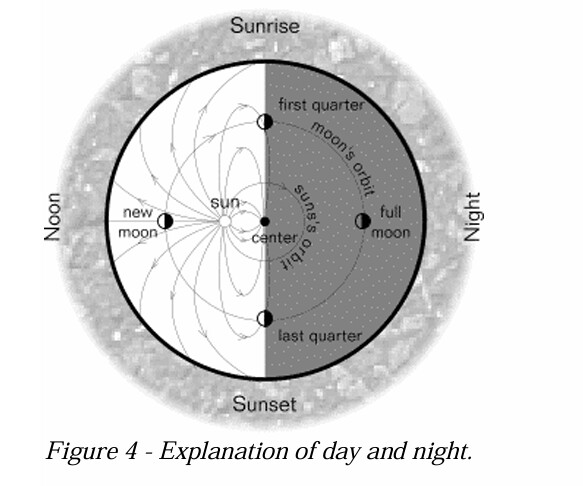
Pages 5 and 6 develop the internal cosmography of the model. The sun and moon are described as revolving around the coordinate centre once every twenty-four hours, with the moon slowly shifting relative to the sun so as to complete its own additional cycle. The planets also have ordered motions, with Mercury and Venus treated as inner planets circling the sun, and Mars and the outer planets circling the coordinate centre more directly. Figure 5 on page 6 lays this out diagrammatically and is one of the most visually important images in the document.
The author then addresses the apparent size problem: how can such a small hollow Earth contain objects that seem so vast? The answer is that the distance scale itself changes rapidly toward the centre. A measuring rod moved inward would shrink dramatically, so the internal cosmic system can still appear immense when measured by local standards. This is one of the main mathematical ideas supporting the model: the transformation does not merely relocate objects; it changes the meaning of scale in a regular way.
6. Infinity Becomes the Centre
One of the most conceptually important statements in the essay is that, under inversion geometry, the centre becomes the geometrical inverse of infinity. As an external point recedes without bound, its corresponding internal point approaches the centre. This means that what appears infinitely distant in orthodox cosmology is relocated toward a single central singularity in the geoperipheral one.
The author takes this much further than a mathematical observation. He sees it as cosmologically and metaphysically transformative. The most distant parts of the universe, distant galaxies receding in conventional cosmology, become nearest to the centre in the inside-out model. Matter is therefore understood as converging toward a central point in inner space. This produces what the author calls a “single great singularity,” which becomes the structural key to the entire model.
7. Heaven Reappears in Cosmology
This is one of the most revealing parts of the document. After laying out the geometry, the author explicitly says that the most interesting aspect of the model is its creation of a definite centre which is physically “highest” for all observers and can function as the geometrical location long sought in older metaphysical systems under names like heaven or paradise. The text therefore treats the centre not merely as a coordinate convenience, but as the recovery of a lost supra-mundane singularity.
This is where the essay crosses decisively from alternative cosmography into metaphysics. The geoperipheral model is being proposed because it restores a meaningful, central, elevated point in the universe. The modern reductionist cosmology, in the author’s view, fragmented human understanding by severing physical speculation from metaphysical speculation. The inside-out universe is therefore presented as a bridge back toward a non-reductionist cosmology in which the centre once again matters.
8. Reuniting Physics and Metaphysics
The second half of the document becomes broader and more openly programmatic. The author argues that humanity needs not just a new physical model but a new frame of reference for life itself. Science, he says, is now captive to technocratic and industrial goals, while modern secular life reduces existence to work, warfare, economic growth, and mechanistic values. The geoperipheral universe is offered as a symbolic and conceptual means of breaking this spell of matter.
The text then lists a series of claimed advantages of adopting the inside-out model. These include restoring human beings to a central role within the cosmos, relocating heaven to a meaningful singularity overhead, weakening the hold of materialist assumptions, and opening the door to a more interactive, purposive, symbolically rich cosmology. In this view, the act of turning the universe inside-out is not just a geometrical choice but a civilizational and psychological intervention.
9. The Geoperipheral Universe as Ground for a Post-Modern Cosmology
One of the more original sections of the piece is its attempt to place the geoperipheral physical universe at the base of a much larger layered cosmology. The author describes a hierarchy of levels: sub-material particles, the physical world, the biosphere, behavioural ecosystems, vertebrate social systems, and the human symbolic communication system or “nousphere.” Above all this, he leaves room for some kind of metaphysical transcendence, possibly involving ascension or dematerialisation toward the central singularity.
This section makes clear that the document is not simply defending concave Earth in isolation. It is trying to create a total worldview in which physical space, biology, behaviour, culture, symbol, spirituality, and transcendence are all reintegrated. In that sense it is closer to a philosophical cosmology than to a narrowly scientific theory.
10. Critique of Materialism, Reductionism, and Scientific “Objectivity”
Large portions of the later pages turn into a sustained critique of modern secular science. The author argues that materialism, atomism, reductionism, and utilitarianism are themselves irrational dogmas masquerading as pure reason. He claims that the modern university division between natural sciences and human sciences is catastrophic, and that the scientific establishment hides its metaphysical commitments behind claims of objectivity.
This critique extends into a discussion of Whitehead, the Greek origins of scientific rationalism, the collapse of older religious cosmologies, the rise of utilitarian industrial civilization, and the alliance between science and the economic priorities of modern states. This section is important because it shows that the geoperipheral model is being used as a weapon in a much wider argument against modernity as a whole.
11. Turning the World Upside-Down and the Culture War Against Materialism
Before returning to the inside-out model, the author offers another symbolic inversion: turning the world map upside-down. He argues that if there is no absolute frame, then North-up cartography is just one historically contingent and power-laden convention. He even imagines a global vote to make maps South-up. This is not a random aside. It serves as a warm-up for the larger inversion of the universe itself. If orientation is conventional and politically charged, then cosmological framing may be too.
The proposal to turn the universe inside-out is then described as “the ultimate Zen koan,” a conceptual shock meant to break people out of rigid utilitarian materialism. The document openly frames this as part of a culture war—not in the ordinary partisan sense, but as an attempt to force a paradigm shift through a symbolic and philosophical intervention.
12. Abdelkader, Gardner, and the Reaction of Scientific Orthodoxy
The later pages also discuss Mostafa Abdelkader’s “A Geocosmos: Mapping Outer Space into a Hollow Earth” and Martin Gardner’s hostile response to it. This section is important because it shows the author aligning his geoperipheral model with a more formal inversion-based alternative that he insists should not simply be lumped together with crude hollow-Earth myths. He argues that Gardner misused Occam’s razor and conflated a rational alternate frame of reference with irrational pseudo-science.
This gives the text a polemical edge. The author’s point is not only that the geoperipheral model is conceptually serious, but also that the scientific establishment reacts to unsettling ideas in ways very similar to dogmatic religious authorities. In his telling, the resistance to inversion cosmology is sociological and ideological as much as intellectual.
Key Themes and Insights
- Inversion geometry as the foundation: The whole model rests on conformal inversion, where outside space is mapped inside while preserving angles.
- The centre is the inverse of infinity: This is one of the most important mathematical and symbolic ideas in the document.
- Optical preservation of appearance: Horizon effects, sight lines, and even space-based views are treated as reproducible within the transformed model. Figures 6 and 7 are central here.
- Restoration of a cosmic centre: The inside-out universe restores a physically highest point, explicitly linked with older ideas of heaven or paradise.
- A critique of modern physics and metaphysics: Newtonian and Einsteinian cosmologies are presented as hiding rather than eliminating singularities.
- Science is treated as culturally embedded: The document repeatedly argues that scientific “objectivity” is shaped by utilitarian, industrial, and political interests.
- The model is meant to ground a larger worldview: It is not just about where the sun and planets are, but about building a post-modern cosmology including biology, culture, symbol, and transcendence.
- This is a worldview text, not just a geometry text: The geometry matters, but the author’s deeper aim is civilizational, spiritual, and philosophical.
Section-by-Section Summary
Part I: Scientists and Singularities
The opening pages critique the scientific drive toward universal laws and argue that singularities were never truly abolished. Newton’s absolute frame and Einstein’s invariant light speed are both treated as hidden absolutes. This prepares the ground for a model that openly embraces a cosmic centre again.
Part II: The Inside-Out Model
The document then introduces inversion geometry and shows how a geocentric frame can be transformed into an inside-out universe. Pages 4–6 are the most mathematically and visually important here, especially figures 2 through 7. They explain the point inversion relation, transformed figures, day and night, planetary orbits, hull-down appearance, and Earth as seen from space.
Part III: Heaven Reappears in Cosmology
Once the transformed model is established, the author pivots to its metaphysical significance. The centre becomes a unified singular point, geometrically high and symbolically resonant, corresponding to what pre-scientific cosmologies meant by heaven or paradise. This is a major conceptual turning point in the document.
Part IV: Reuniting Physics and Metaphysics
The next section argues that modern humanity needs a new frame of reference, one that can overcome mechanistic materialism and restore purpose, symbol, and transcendence. The geoperipheral universe is proposed as the physical base for a broader post-modern cosmology extending upward through biological, behavioural, social, and cultural levels.
Part V: Science, Materialism, and Cultural Power
The later pages broaden into a critique of the modern secular worldview. Materialism, atomism, utilitarianism, and the alliance between science and industrial power are all attacked. Science is portrayed not as pure reason, but as a historically situated and morally loaded system.
Part VI: The Inside-Out Universe as Cultural Shock
The final pages frame the model as a deliberate conceptual shock meant to provoke a paradigm shift. The discussion of Abdelkader, Gardner, and the Internet-era dissemination of the idea shows that the author sees this not as a closed theory, but as a live intervention in culture and worldview formation.
Why This Document Matters in Concave Earth Literature
This document matters because it is not merely another “hollow earth” pamphlet. It is one of the clearer attempts to present an inversion-based geoperipheral cosmology as something mathematically grounded, culturally significant, and metaphysically rich. Unlike more traditional concave-Earth texts that rely heavily on isolated measurements or purely Biblical claims, this one tries to build from conformal transformation, then expand outward into a total worldview.
It is also important because it makes explicit something that often remains implicit in this literature: the attraction of these models is not only that they rearrange astronomy, but that they restore centre, height, hierarchy, meaning, and transcendence to the cosmos. The mathematical inversion is inseparable here from its symbolic and spiritual appeal.
At the same time, the document is valuable as a historical artifact of a certain strand of post-modern alternative cosmology. It shows how inversion geometry, Whiteheadian criticism of scientific reductionism, dissatisfaction with modernity, and spiritual/cultural reconstruction can all merge into a single argument.
Conclusion
Turning the Universe Inside-Out is a deeply unconventional but highly revealing text. It offers a geoperipheral model based on inversion geometry, but its true ambition is much larger than altered astronomy. It seeks to overturn the metaphysical consequences of modern cosmology, restore a meaningful cosmic centre, and provide the physical ground for a new post-modern synthesis of physics, life, culture, symbolism, and transcendence.
Whether one reads it as speculative cosmology, philosophical provocation, symbolic manifesto, or culture-war document against reductionist science, it is undeniably one of the more distinctive entries in the broader concave-Earth and inside-out-universe tradition. For forum readers interested not only in how the world might be geometrically inverted, but why such an inversion carries spiritual and civilizational significance, this document is an especially worthwhile one to study.