Universal Laws Never Before Revealed: Keely’s Secrets — Sympathetic Vibration, Etheric Force, and the Dream of a New Science
Images from the Document
Download the Document
Overview
Universal Laws Never Before Revealed: Keely’s Secrets is not a single-author treatise in the ordinary sense. It is a large compiled volume, edited by Dale Pond, that gathers together writings by and about John Worrell Keely, alongside material linked to Nikola Tesla, Edgar Cayce, Clara Jessup Bloomfield-Moore, Laurence Oliphant, Henry Wood, R. Harte, Dr. Hall, Henry Hudson, and others. The book presents itself as an effort to recover, organize, and interpret a neglected body of ideas centered on sympathetic vibration, etheric or dynaspheric force, musical ratios, neutral centers, and the possibility of an entirely different science of matter, force, mind, healing, levitation, and energy.
What makes the volume unusual is its mixed character. It is at once a sourcebook, a commentary, a technical scrapbook, a historical recovery project, and an esoteric-scientific manifesto. It is not limited to Keely’s nineteenth-century inventions, nor does it remain within ordinary history of technology. Instead, it tries to reinterpret Keely as the discoverer of a much deeper vibratory science whose principles touch chemistry, gravity, resonance, mind, acoustics, electricity, healing, and the underlying structure of nature itself.
The table of contents alone shows the scope of the project. The book ranges from early historical pieces like “Disintegration of Stone,” “Etheric Force Identified as Dynaspheric Force,” “On Dynaspheric Force,” and “What is Matter and What is Force?” to systematic sections such as “Keely’s Definitions of His Own Terms,” “The Basis of a New Science,” and long runs of titled “laws” covering matter, vibrations, attraction, repulsion, cycles, conductivity, oscillation, chemistry, polarity, gravity, refractive indices, and more. It also includes interpretive essays by Dale Pond on subjects like sympathetic vibratory physics, music as analysis, induction, sympathy, resonance, molecular morphology, waveform structure, and anti-gravity experiments.
So this is best understood not as a normal modern scientific text, but as a canon-building volume for a Keely-centered worldview. Its real aim is to persuade the reader that Keely’s work was not a historical curiosity or fraud narrative, but a fragment of a much larger, still unrealized physics in which vibration is primary, matter is derivative, and force is mediated through harmonic, sympathetic, and etheric relationships.
Structure and Content
1. A Recovery Project Around John Keely
The book opens by framing itself as an attempt to preserve and reintroduce a body of work that the editor believes has been misunderstood, neglected, or deliberately sidelined. Dale Pond’s acknowledgements make clear that the book draws on archival material from organizations and collections preserving Keely-related sources, and that it is intended not just as history, but as something readers may still apply to current scientific work and research.
That is important, because it tells you how to read the whole volume. This is not merely antiquarian curiosity. The editor believes Keely’s ideas still matter and that modern science may yet rediscover or reinterpret them.
2. The Core Idea: Sympathetic Vibration
At the center of the entire volume is the concept of sympathetic vibration. The repeated claim, stated in different ways across the contents and commentary, is that bodies, particles, molecules, and forces do not merely collide mechanically, but associate through harmonic relation. A particle or body must be “sympathetic” to another in order to be affected by it. Harmonic relation is treated as the basis of aggregation, transmission, dissociation, and force development.
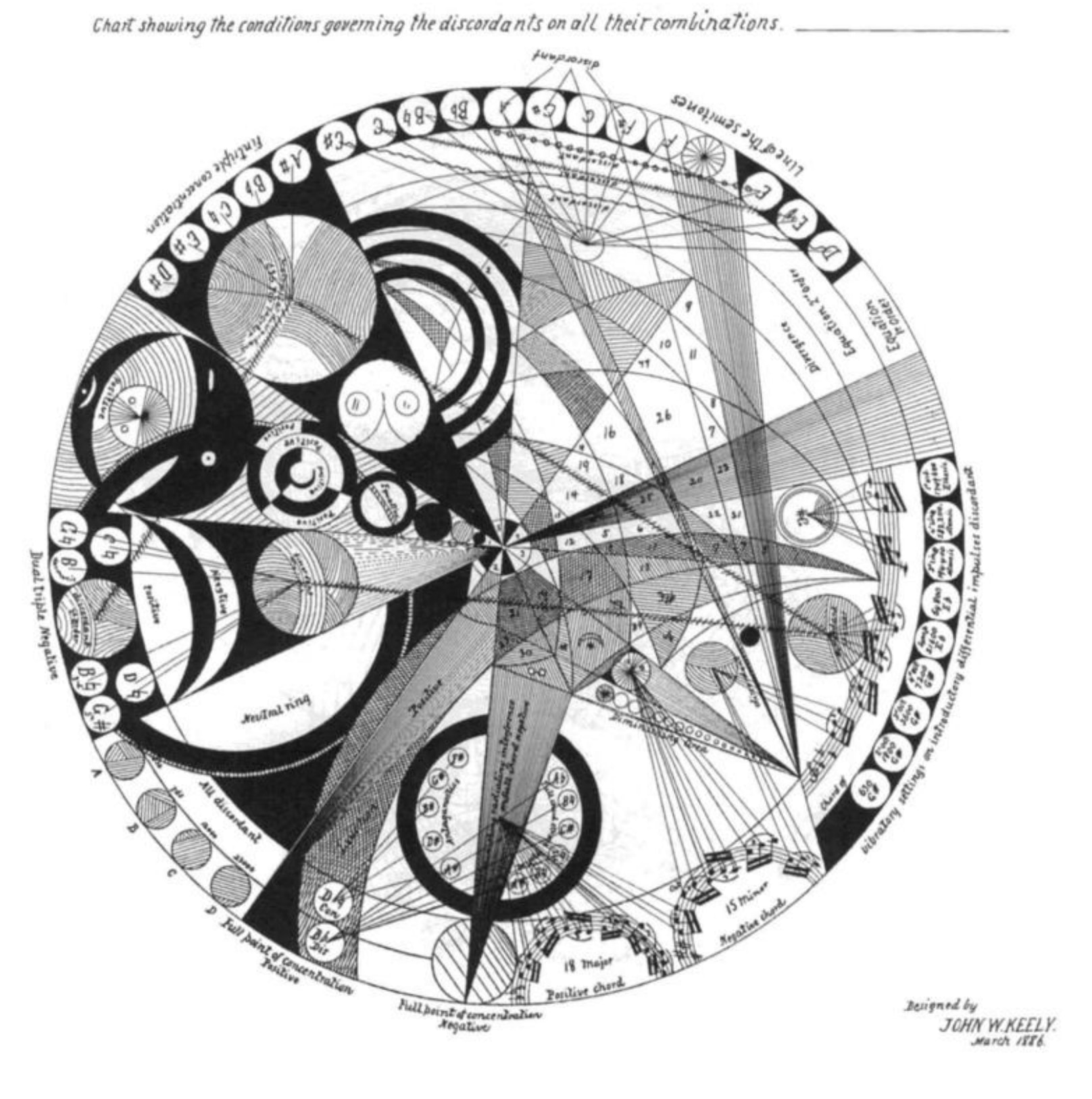
One particularly revealing commentary states that vibrating bodies must stand in a harmonic relationship in order to associate, and that the “signature” of a molecule together with its fundamental is what Keely calls a mass chord. Discordance, conversely, is linked with dissociation and repulsion. This gives the whole system a distinctly musical-metaphysical cast: matter behaves not like a dead assembly of objects, but like a structured vibratory composition, with stable forms emerging from consonance and disruptive ones from dissonance.
3. Etheric Force and Dynaspheric Force
One of the earliest and most important historical sections is “Etheric Force Identified as Dynaspheric Force,” attributed to Clara Jessup Bloomfield-Moore. This section presents Keely as a discoverer of previously unknown forces in nature, working with something like ether, astral light, or dynaspheric force rather than conventional steam, electricity, or mechanical power. It describes demonstrations in which vibratory force stored in a receiver lifts enormous weights and fires projectiles, all while being interpreted as expressions of a deeper etheric principle unknown to orthodox science.
The same section links Keely’s work to occult and theosophical language: Akasa, astral fluid, divine will, attraction and repulsion, and the idea that there exists an inner medium subtler than visible matter. In that framing, Keely is not merely an inventor but a discoverer of one of nature’s profound hidden principles.
4. Disintegration, Levitation, and Extraordinary Demonstrations
The contents and early chapters show that one of the major fascinations of the book is Keely’s alleged demonstrations: disintegration of stone, etheric vapor lifting, levitation, vibratory motors, acoustic transmission of power, and other dramatic effects. The section titled “Disintegration of Stone” presents the famous image of Keely as a persecuted genius who supposedly found ways to break down matter through vibratory methods rather than brute mechanical force.
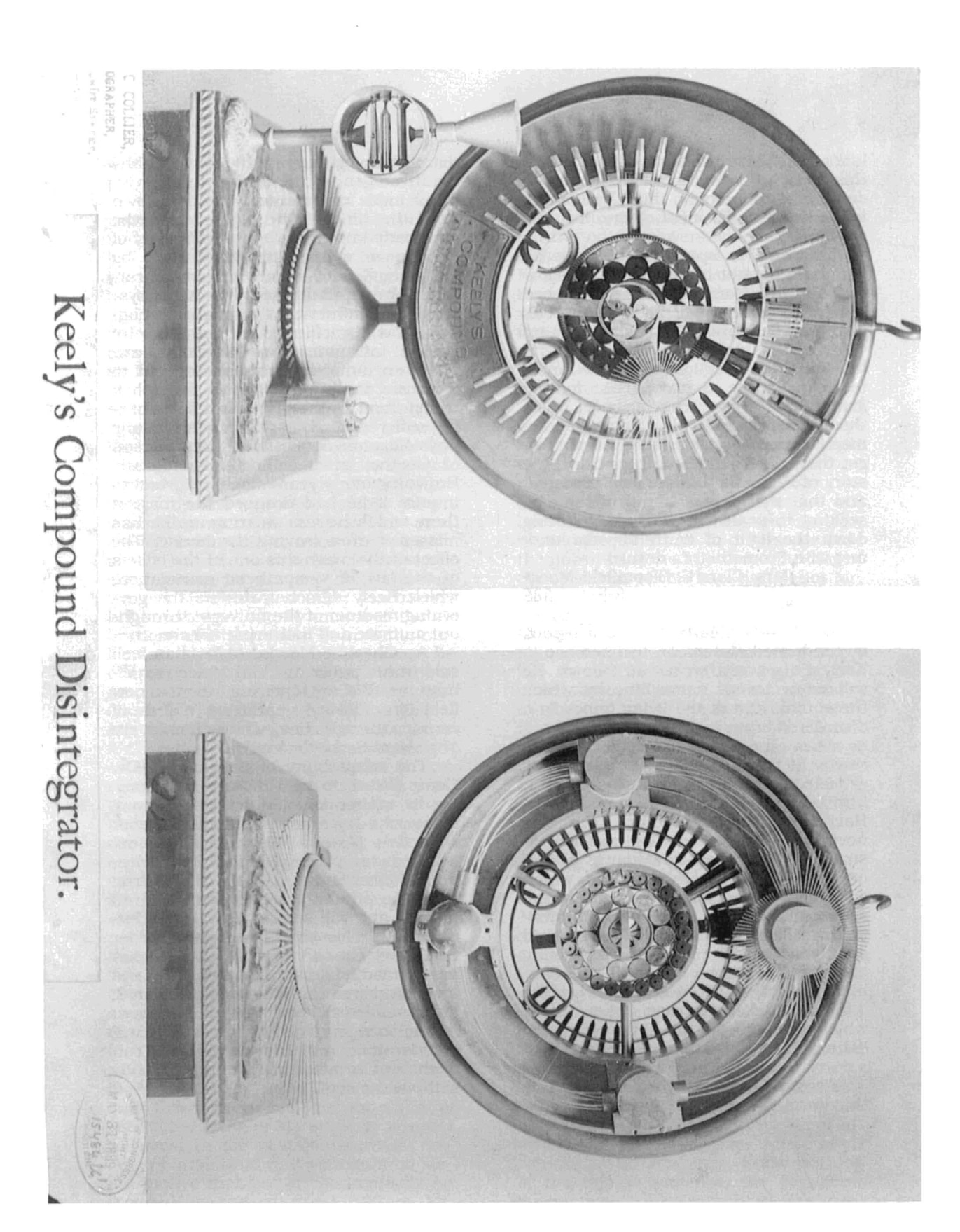
The illustrations list reinforces this emphasis. The book includes images of compound disintegrators, vibratory globes, resonators, planetary globes, musical sphere motors, hydro-pneumo-vacuo motors, liberators, vibratory indicators, attractive disks, etheric vapour generators, and even a “Zither and Anti-gravity Experiment.” The sheer density of apparatus imagery tells you that the book wants the reader to feel that this was a serious experimental tradition with physical machinery, not just mystical speculation.
5. A New Science Built from “Laws”
A major structural feature of the volume is the long series of formalized laws. These include the Law of Matter and Force, Law of Corporeal Vibrations, Law of Harmonic Vibrations, Law of Transmissive Vibratory Energy, Law of Sympathetic Oscillation, Law of Attraction, Law of Repulsion, Law of Cycles, and many more extending into chemistry, polarity, conductivity, pitch variation, refractive indices, and molecular behavior.
This is one of the clearest signs that the book is trying to elevate Keely’s scattered concepts into the status of a genuine alternative framework. Instead of presenting isolated marvels, the editor organizes them as a body of principles that together amount to the outline of a new physics. Even where some laws remain fragmentary or briefly stated, the editorial effort is toward systematization.
6. The Neutral Center
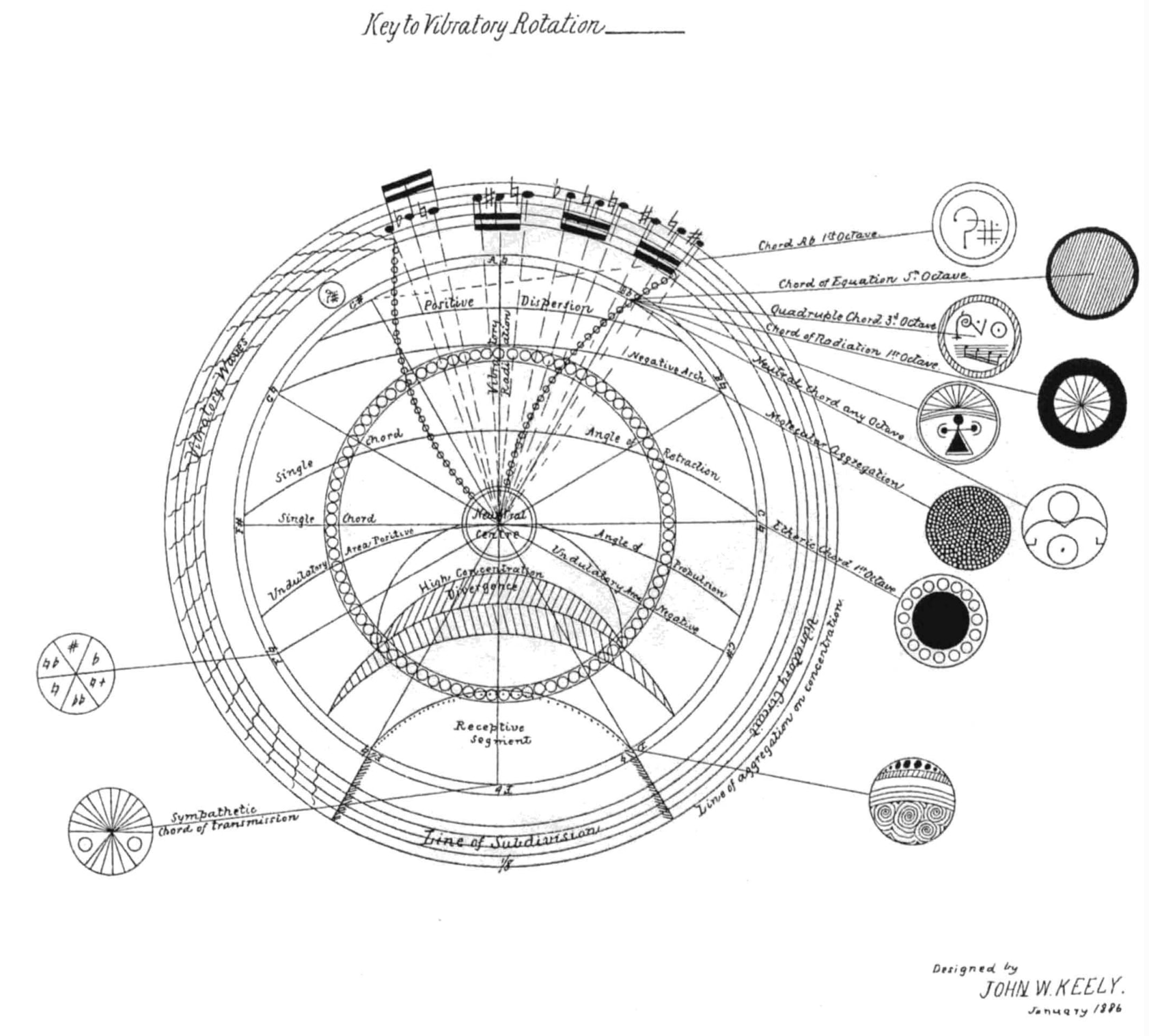
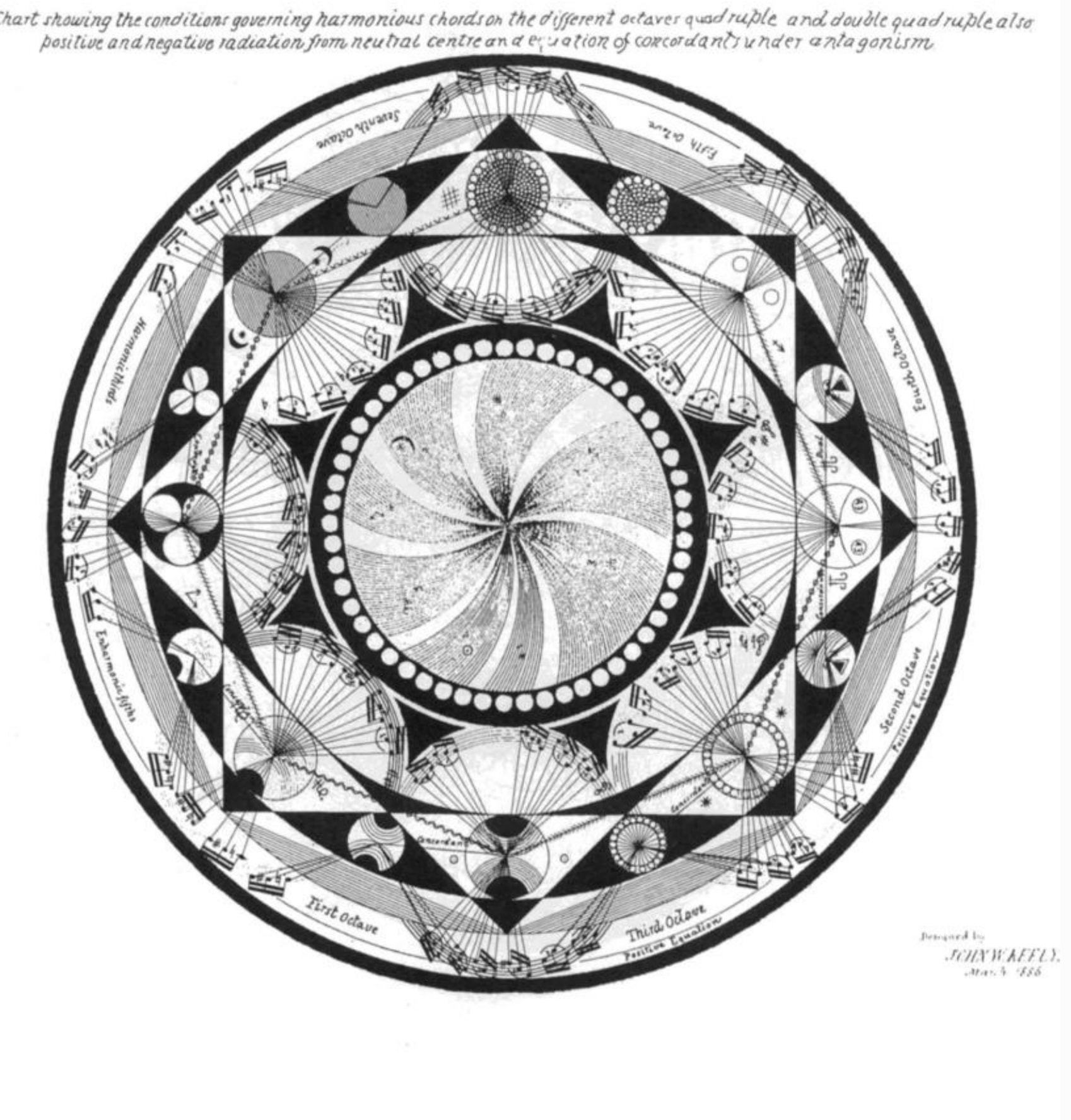
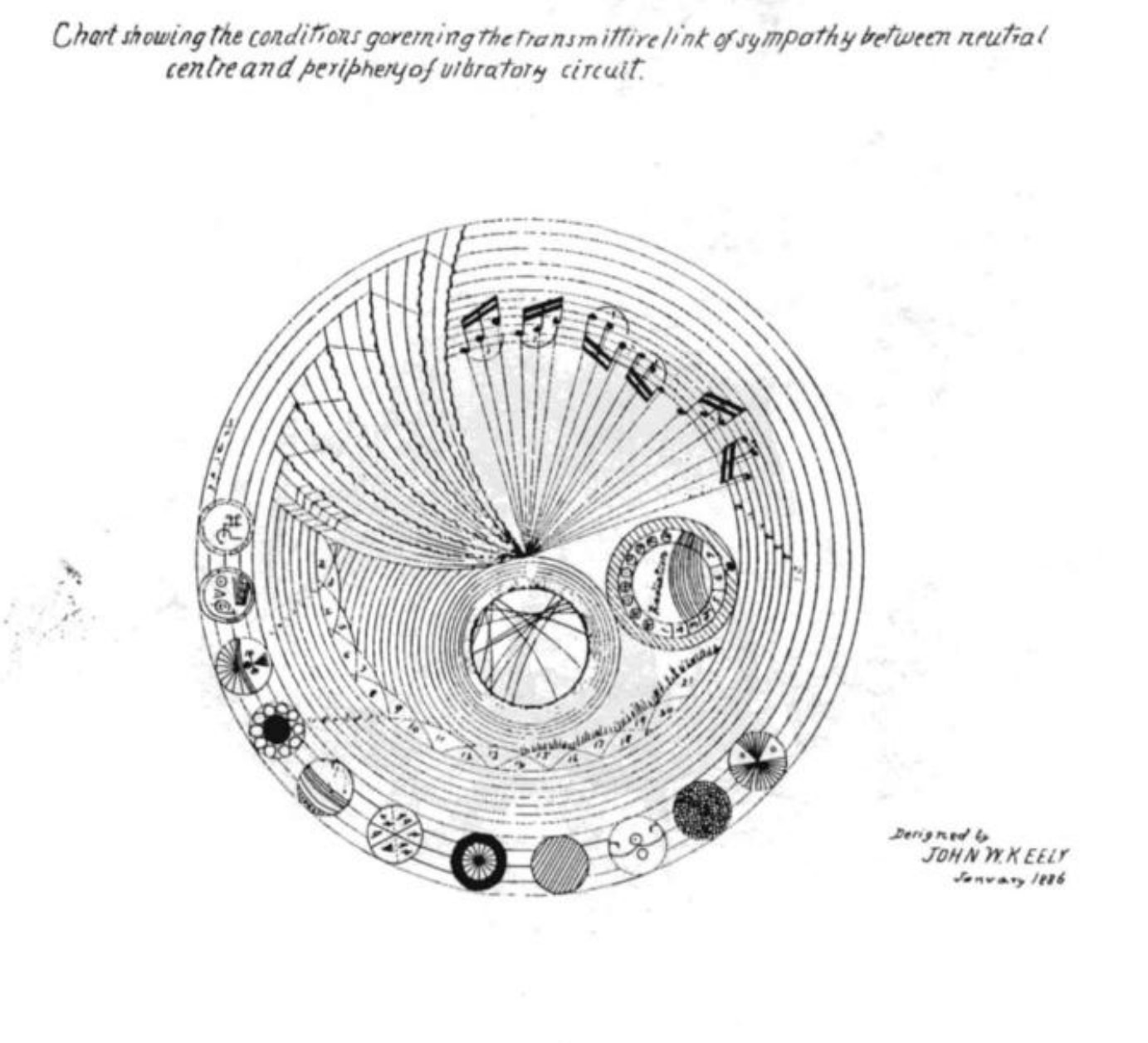
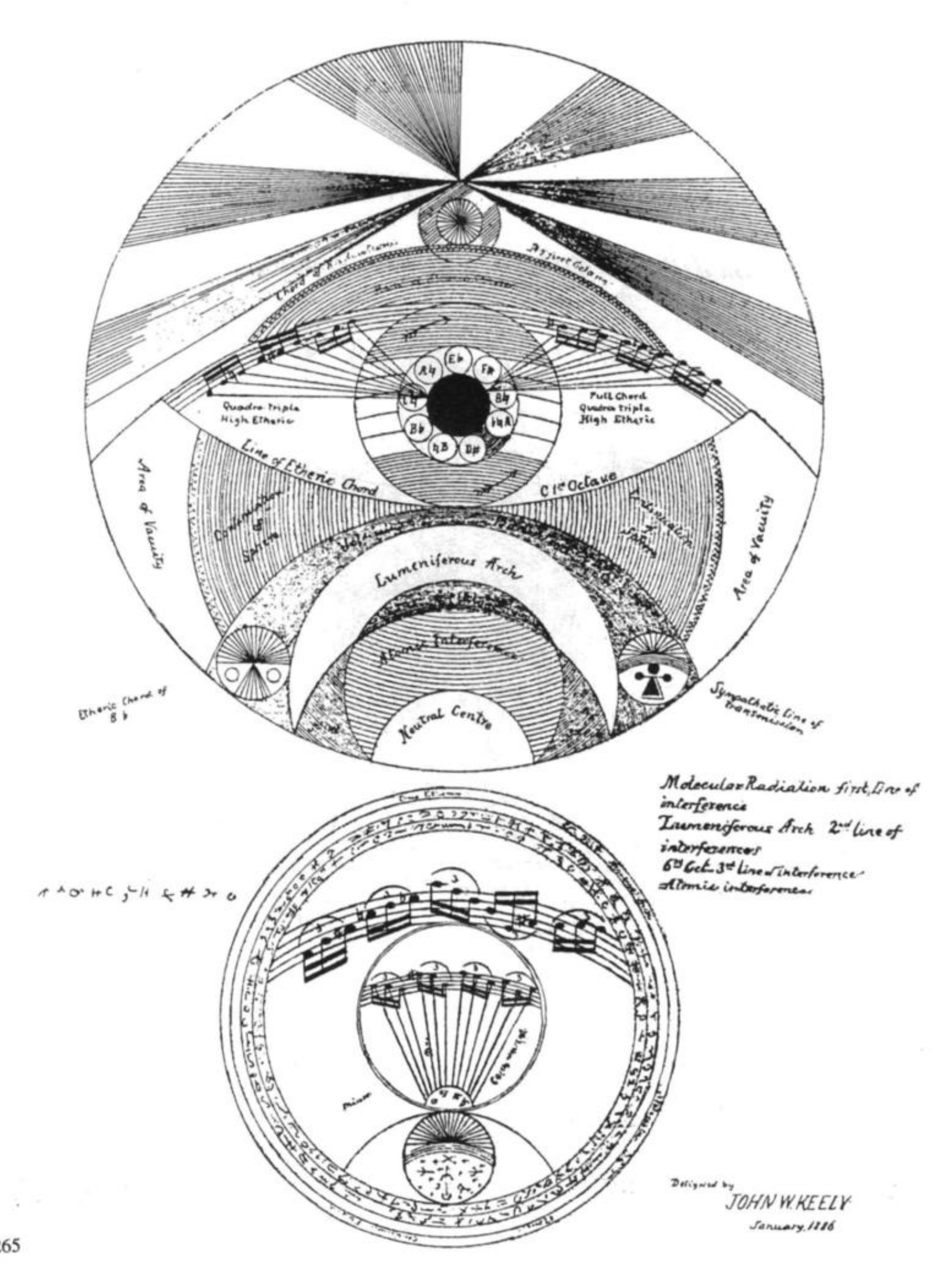
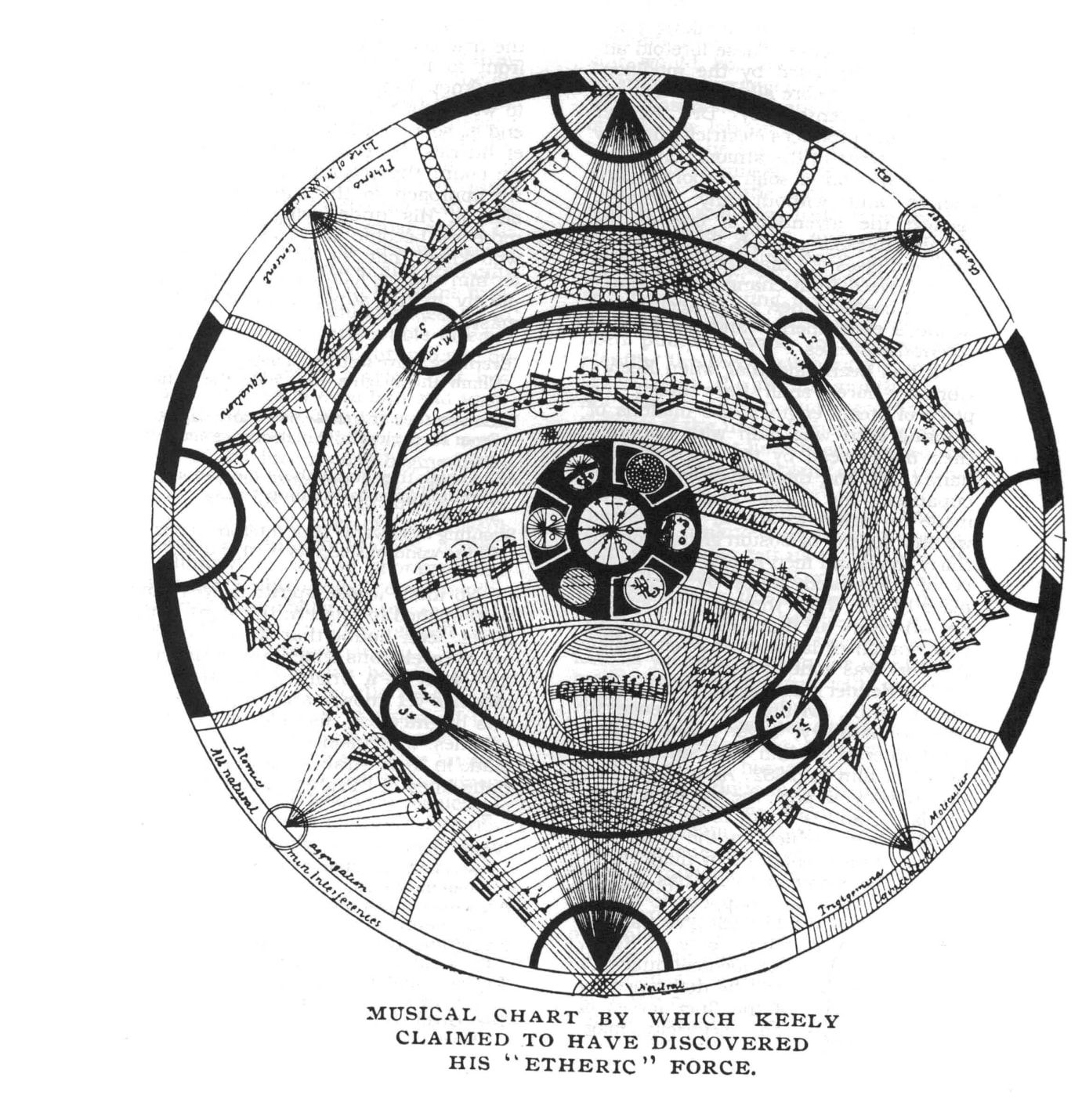
Another recurring theme is the neutral center, which appears in chapter titles, illustration titles, and chart labels. It is treated as structurally central to Keely’s worldview, not just as a mechanical detail. The front-cover chart and later acoustic diagrams emphasize chords of neutral center, quadruplicate settings, lines of radiation, and vibratory circulation.
Within the logic of the book, the neutral center seems to function as a balancing point around which vibratory, aggregative, and dispersive effects organize themselves. It is one of those Keely ideas that appears both geometrically and metaphysically: part physical schema, part universal principle. The repeated attention it receives suggests that the editor sees it as one of the master concepts for decoding the rest of Keely’s work.
7. Music, Chords, and the Structure of Matter
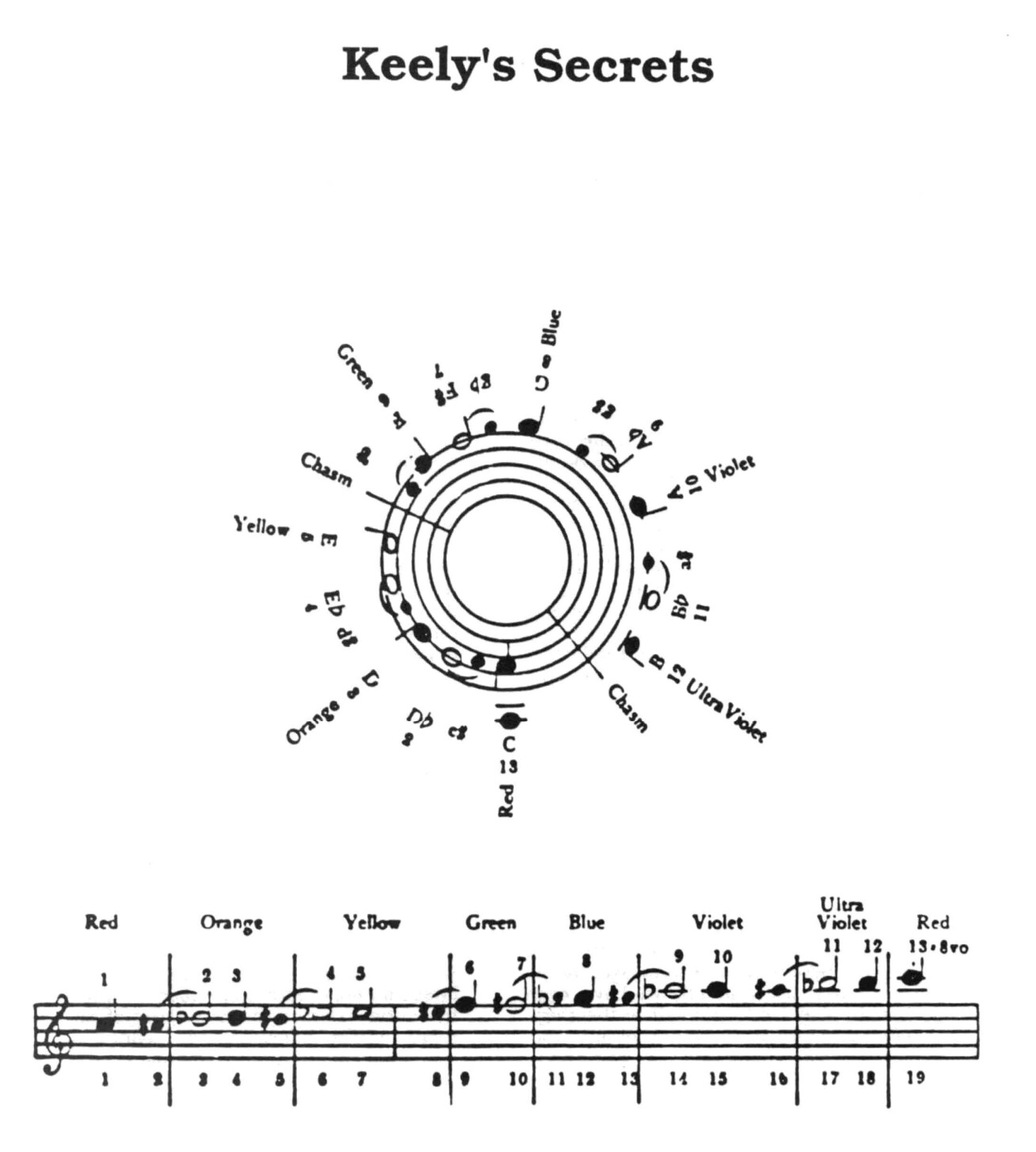
One of the most distinctive features of the volume is how relentlessly it treats music as more than analogy. Chapters like “Music: A Vibration Analysis Shortcut,” “Scale of Forces in Octaves,” “Music of the Molecule,” “Musical Intervals,” “Music - The Realm of Activity,” and “Keely’s Triple Chords” show that ratios, octaves, harmonics, and chords are being used as keys to physical understanding.
This is where the book becomes especially intriguing for readers interested in sacred geometry, harmonic cosmology, or esoteric physics. Matter is described in terms of pitch, interval, and vibratory concord rather than solely mass and motion. One commentary explicitly suggests that lower bands such as heat and sound affect solid matter, while far higher frequency ranges are needed to affect subatomic structures. Another uses the rainbow as an illustration of how harmony manifests as apparent multiplicity.
8. Matter, Force, and Ether
The index snippets and chapter titles make clear that the book repeatedly returns to questions like What is matter? What is force? What is ether? It treats ether as cosmic, tangible in some sense, and deeply bound up with space, density, undulation, and transmission. Force is divided into many types: dynaspheric, etheric, atomic, mental, spiritual, health-related, chemical, female, male, transmissive, and universal.
That tells you something essential about the worldview here. Modern distinctions between physical, mental, and spiritual force are deliberately softened. The book moves toward a unified field of activity in which matter, life, mind, electricity, and vibration are all nested expressions of a deeper continuum.
9. Keely as Persecuted Genius
A strong historical-emotional theme running through the early essays is the portrayal of John Keely as an inventor ignored, mocked, exploited, or misunderstood by orthodox science and commercial interests. The long selections from Bloomfield-Moore and related writers present him as a man who discovered genuine forces but was surrounded by ridicule, lawsuits, speculation, disbelief, and the inability of official science to grasp what he was doing.
This matters because the book is not neutral history. It is constructing a mythos around Keely: the lone discoverer of a new order of natural law, opposed by institutions too narrow, too mercenary, or too spiritually dull to receive it. That heroic framing is part of the book’s persuasive strategy.
10. Dale Pond’s Editorial Role
Although Keely is the central figure, the book is also very much a Dale Pond project. Pond provides modern commentary, connects old terminology to newer scientific language, and repeatedly tries to translate Keely’s ideas into something more systematic and comprehensible for contemporary readers. The contents list shows Pond’s name attached to many of the interpretive chapters, especially those concerning modern explanation, musical ratios, resonance, waveform analysis, and molecular morphology.
So the book should also be read as a late-twentieth-century effort to revive Keely through synthesis rather than mere republication. It is Keely through a Pond lens: part restoration, part interpretation, part expansion.
Key Themes and Insights
- Sympathetic vibration is the master principle: association, resonance, aggregation, transmission, and disruption are all treated as consequences of vibratory relation.
- Matter is harmonic, not merely mechanical: molecules and bodies are framed through pitch, chords, concord, discord, and musical ratio.
- Ether / dynaspheric force is central: Keely’s work is repeatedly interpreted as interaction with a subtle medium deeper than conventional mechanics.
- The neutral center is foundational: diagrams and laws place it near the center of Keely’s system.
- The volume tries to systematize Keely into a full alternative science: the many titled “laws” are evidence of this editorial aim.
- Extraordinary experiments function as narrative anchors: disintegration of stone, levitation, vibratory engines, etheric vapour, and anti-gravity claims all give the book its dramatic force.
- The book fuses science, esotericism, and metaphysics: Akasa, occultism, will, astral light, and atomic vibration appear in one broad conceptual field.
- Keely is portrayed as a neglected genius rather than a failed inventor: the historical framing is sympathetic and revisionist throughout.
Section-by-Section Summary
Front Matter and Framing
The title pages and opening material present the book as an effort to understand and use the science of sympathetic vibration. The list of contributing voices signals immediately that this is a broad assembled tradition rather than one isolated document.
Historical and Biographical Essays
The first substantial pieces focus on Keely’s discoveries, demonstrations, and historical treatment by his contemporaries. These sections construct the narrative of Keely as a profound but misunderstood discoverer of etheric force.
Technical Concepts and Definitions
The middle of the book appears to move toward clarification: Keely’s terms, neutral center, molecule structure, dynaspheres, force relationships, pitch, oscillation, and sympathetic association. This is where the work becomes less anecdotal and more systematic.
Formal Laws of a New Science
A large central section gathers laws of vibration, attraction, repulsion, cycles, chemistry, variation of pitch, oscillation, conductivity, and related phenomena. This is the book’s strongest claim to being a coherent alternative framework rather than a museum of odd ideas.
Music, Ratios, and Harmonic Analysis
Later sections intensify the link between physics and music, using octaves, intervals, and waveform analysis as interpretive tools for matter and force. This harmonic emphasis is one of the book’s most distinctive features.
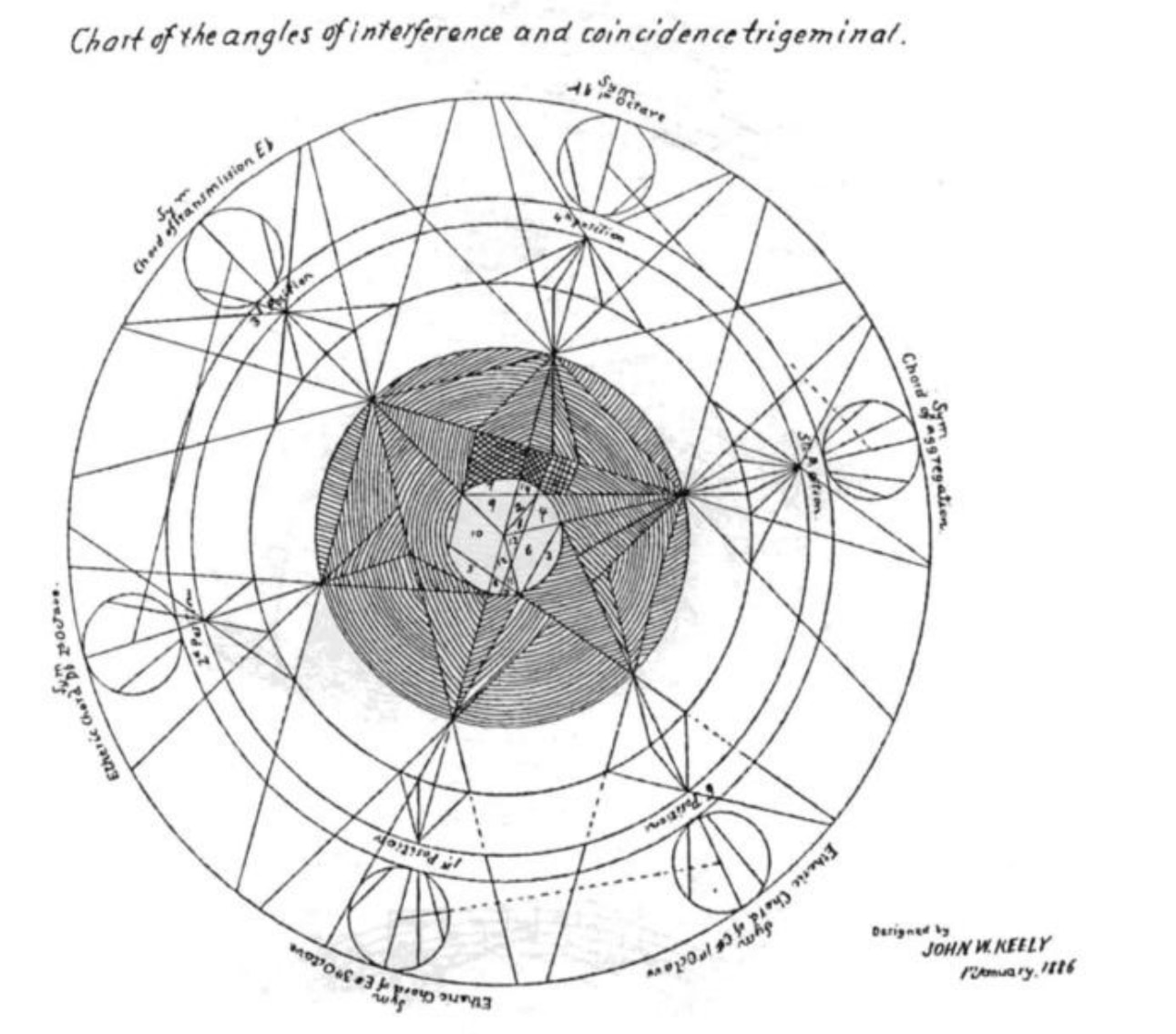
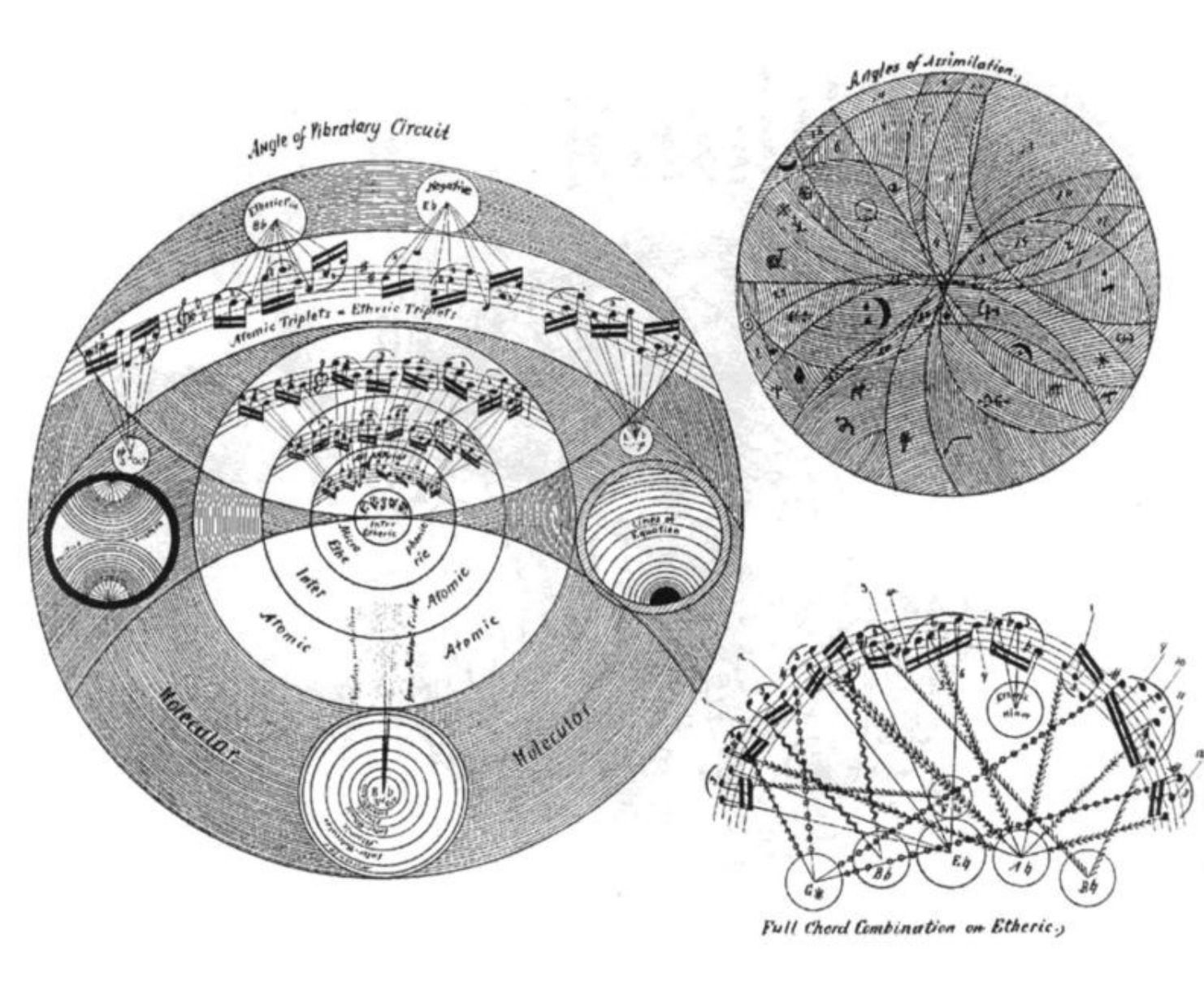
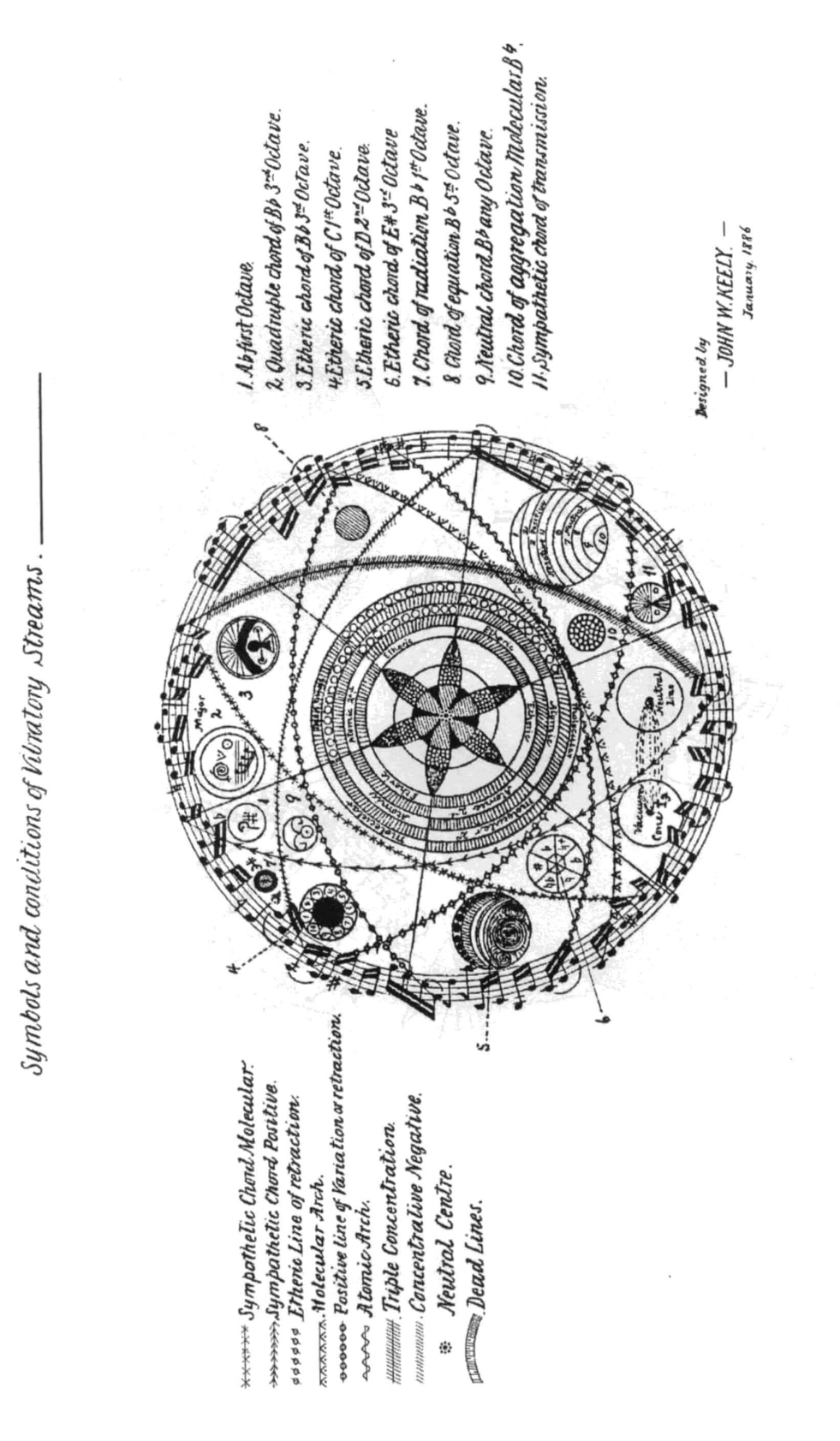
Charts, Apparatus, and Visual System-Building
The many illustrations and acoustic charts serve almost as a parallel text. They are meant to show that Keely’s science had geometry, machinery, notation, and pattern — not just verbal speculation. The “Key to Vibratory Rotation” and later acoustic theoretical charts are especially important in this respect.
Why This Document Matters
This volume matters because it is one of the more comprehensive modern attempts to reassemble the Keely tradition into a usable worldview. Many people know Keely only as a fringe inventor associated with mysterious motors and etheric force. This book tries to show him instead as the nucleus of a far larger synthesis linking vibration, music, force, matter, chemistry, healing, spirituality, and consciousness.
It also matters because it shows how certain alternative scientific traditions preserve themselves: not by publishing one tidy theorem, but by building a canon of stories, laws, diagrams, commentaries, cross-references, and recovered terminology. This is very much that kind of book. It is a repository of a tradition that wants to be taken as both historical archive and future science.
And finally, it matters because of the bridge it tries to build between hard and soft categories. In this book, sound is not just sound, music is not just music, mind is not wholly separate from matter, and ether is not just a discarded Victorian speculation. Everything is drawn toward a single vibratory continuum. That ambition, whether one accepts it or not, is what gives the volume its strange power.
Conclusion
Universal Laws Never Before Revealed: Keely’s Secrets is a sprawling, ambitious, and deeply characteristic revival text. It presents Keely not simply as an inventor of curious machines, but as the central figure in an unfinished science of sympathetic vibration, in which matter, force, ether, resonance, music, mind, and even healing all become aspects of one underlying order.
For readers interested in esoteric science, vibratory cosmology, forgotten energy theories, or the intersection of harmonic thought and physical speculation, this is an especially rich document. It is part sourcebook, part doctrine, part technical lexicon, and part manifesto for a science that — in the eyes of its editor and contributors — was never properly understood the first time around.